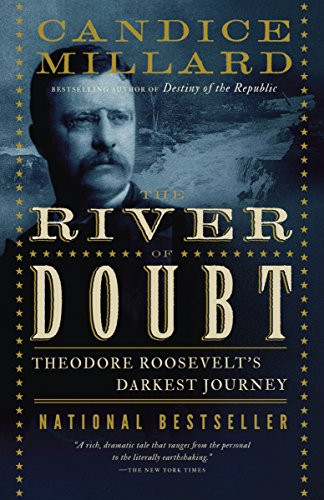
The River of Doubt: Theodore Roosevelt’s Darkest Journey, by Candice Millard

Candice Millard impressed our group before as an historian and as a storyteller – see our earlier review of Destiny of the Republic. This book repeats those skills and adds naturalist to our accolades.

Millard first introduces us to Theodore Roosevelt after his defeat for the presidency in 1912. After two terms as president, Roosevelt had selected William Howard Taft as his successor, but during Taft’s term they had a falling out and TR tried to unseat Taft in the 1912 election. In the end, they both lost to Woodrow Wilson. As he had done after the death of his first wife and after other disappointments, Roosevelt began looking for an adventure to make up for the loss. He seized on the idea of an Amazonian exploration. Both the North and South Poles had recently been explored, and the major rivers of Africa had been mapped; the Amazon was still largely unexplored. He outlined a speaking tour of South America with a river expedition to follow, descending a previously explored river that joined the Amazon. While Roosevelt was planning the speaking tour, various hangers-on planned and equipped the expedition for that route, though with little information on which to base their provisioning.

Filling in the map of interior Brazil was an ongoing challenge to its government, and the task was primarily entrusted to the Telegraph Commission, headed by Colonel Cândido Rondon, an army officer whose career mission was explore the Amazon Basin and to peacefully meet the indigenous inhabitants of the region. As luck would have it, Rondon was assigned to accompany and guide Roosevelt’s expedition. To further his own interests, Rondon preferred a route that would explore new country, and Roosevelt welcomed the adventure of new discovery. The River of Doubt met both men’s purposes. It was a river that was presumed to run hundreds of miles across the Amazon rain forest, but as of 1913, it remained unexplored and unmapped. Its source and outlet were known, but its course was a matter of doubt. 

The expedition shifted to the River of Doubt, and it entered the unknown in February 1914. 

What they passed through was Amazonian rain forest, a terrain for which they were remarkably unprepared. Here the naturalist part of Millard’s skill comes alive. She explains how the rain forest looks and feels, how it evolved, and importantly why the expedition was not able to forage food there. The rain forest had evolved highly specialized plants and animals that disperse themselves over wide regions and in unfamiliar ways. Animals and fruit are often at tree-top level and camouflaged so that the American and even the Brazilians could not spot anything, hunt anything, or harvest anything. Their crates of provisions, with rations of white wine and mustard, provided little nutrition but were a weighty hindrance at every one of the portages around the frequent rapids and waterfalls of the river. The expedition began on short rations, and since foraging was unsuccessful, time became the measure of their danger.

The expedition met a succession of native tribes, especially the Cinta Larga, who tracked them while remaining almost invisible. Remarkably, the tribes let the expedition pass without attack, not perceiving them as an actual threat. Given Rondon’s steadfast insistence on peaceful dealings, that judgment proved right, at least as to this expedition. The only deaths of the expedition were due to river accidents and a murder. (But in the long run, the fate of South American tribes was not much better than their North American counterparts).

Roosevelt’s ambition for adventure was more than satisfied. The expedition was out of touch with the rest of the world for about eight weeks. It was poorly equipped for what it confronted. The boats they took to Brazil were completely unsuitable, and the expedition ended up using hollow-log canoes with very shallow draft that were difficult to bring through rapids and were extremely heavy to portage. It lost half of those canoes and had to hollow out new ones at the cost of time and labor.  The labor, of course, was initially performed by Brazilian camaradas, but soon the American and Brazilian officers were laboring alongside them. Rations were short to begin with, quickly diminished through accidents, and to the extreme disappointment of the Americans could not be supplemented by hunting. The rain forest proved as inhospitable as any adventurer could want. It was hot, buggy, and – surprise – rainy. Portaging the frequent rapids and falls ate up time and energy and invited accidents. The river contained piranhas and other deadly fish, along with parasites and disease. On land, the expedition was open to attack by unseen Indians and snakes. Insects brought constant misery and disease. Most of the expedition suffered from malaria, especially Roosevelt’s son Kermit, who had joined the expedition to protect his father. TR had a seriously infected leg injury that brought him near death. At one point he talked with Kermit about leaving him behind.  Millard uses diaries and letters to give first-hand accounts of the desperation the expedition felt. It finally approached the Amazon and met rubber harvesters and the army unit that awaited them at the edge of civilization. 

The book gave us a wealth of subjects for discussion. Most of us have crossed an Amazonian expedition off our bucket lists. The expedition was rife with the sense of cultural superiority common to explorers of that period, such as the reluctance to seek out local advice on such basics as food and boats. Millard gives great insights into the always fascinating characters of the Roosevelt family.  While we are not planning Amazonian travel, we would be happy to read more of Millard’s work. 

— Bill Smith

Before We Were Yours, by Lisa Wingate

This novel is based on true events that actually boggle the mind of the modern reader. Georgia Tann was a prominent maven of Tennessee society who sought to better society through the adoption of poor, underprivileged children into wealthy socially-advantaged families. Operating during the distressed times of the 1930s Depression, she established the Tennessee Children’s Home Society which operated orphanages across Tennessee and Georgia. That good intention went badly awry, however, and many of the children who ended up in these orphanages were never actually given up for adoption by their birth families. Some were snatched up on their way home from school. Others were taken from parents who were conned into signing away their parental rights by promises that their children would be returned when the family could get back on their feet. When the parents tried to reclaim their children, adoptions had been finalized, names changed, and records sealed. All of that is true and it is a grisly story that continued for more than a decade.

Against this history, Wingate structures her novel in two voices. The voice of 12-year-old Rill in Memphis, Tennessee, in 1939 alternates with that of Avery, a 30-something daughter of wealth and privilege in modern-day Aiken, South Carolina. Rill’s story moves us forward in time. Avery’s story ultimately unravels backward through the unsuspected secrets of her family,

Rill is the oldest of five children who were taken from their family’s vagabond houseboat on the Mississippi River when their father takes their mother to the hospital. Her story and the story of her siblings unfolds over a three-month period in alternating chapters of the book as Rill, rechristened May in the orphanage, fights to keep her sisters and brother with her.

In the interwoven story, Avery encounters a woman, May, in a nursing home who grabs her wrist and takes a bracelet that was given to Avery by her grandmother.  Avery’s grandmother is in the dementia unit of a different nursing home. As Avery retrieves her bracelet, she begins to talk with May and sees a photograph that looks suspiciously like one that her grandmother has. 

We see where this is going. And it does go there, at a fast tempo, and with some riveting scenes and phrases (such as fans trying to move humid summer air that has no desire to be moved). 

Our book club mostly enjoyed reading this book and it is indeed a good tale.  However, many thought the “Avery” story was too pat, too romance-novel-ish and used unnecessarily stereotyped characters, particularly Avery’s fiancé and the man who helps her unravel her family’s past. Our discussions of the book mostly centered around the character of Rill and her mighty efforts to save her siblings and their memories of their “real” parents; and around Georgia Tann, who died before she could be charged with the crimes she committed; and around our society’s changing views about adoption. The book did push us to consider what we might have done in the circumstances that confronted families in abject poverty during the Depression.  What might we have done to save our children? The scene where a father comes to the orphanage to reclaim his children and is told that they are already gone “to a better life,” is riveting. 

Review by Jeanie and Bill Smith

Sea of Glory, by Nathaniel Philbrick

Exploration! Adventure! See the world! The U.S. Exploring Expedition of 1838-1842 offered all that. With a task force of six sailing ships and 346 men, the Expedition discovered Antarctica, mapped much of the South Pacific and the Pacific Northwest, and circled the globe. It returned with materials that formed the basis of the collections of the Smithsonian Institution and the U.S. Botanic Garden, and sparked the formation of the U.S. Hydrographic Office and the Naval Observatory. 

Why is this Expedition not ranked alongside Lewis and Clark in our history?  Nathaniel Philbrick, noted for histories of Washington, Custer, and the whaling ship Essex, takes on that question through a review of the journals and correspondence of the principal officers of the Expedition and other historical records. 

Those records revealed a corking tale of the inner turmoil of the commander of the Expedition, Charles Wilkes, and the resulting tension among the officers and crew.  Throughout the voyage, Philbrick traces the deteriorating relations between Wilkes and his officers, particularly William Reynolds, who started as an admirer of Wilkes and by 1842 was his adamant opponent. Wilkes was at once supremely self-confident and supremely insecure. This internal tension (Philbrick quotes Thoreau’s description of “the private sea”) was reflected in inconsistent and ineffective leadership of the Expedition’s officers and crew, unwarranted transfers, unnecessary and brutal floggings. 

Our group’s discussions kept coming back to Wilkes’s tragic character flaws. Was it arrogance and self-conceit? Yes, but the accomplishments of the Expedition deserved high regard. Would Wilkes have been better balanced and more tolerant if he had been given the recognition he thought was deserved? Melville is quoted: “All mortal greatness is but disease.” Could another commander have managed the personnel better? Maybe, but no senior officer of the Navy wanted to take this command. And maybe a more collaborative commander would not have achieved as much as Wilkes did. The title “Sea of Glory” comes from Shakespeare’s Henry VIII as Cardinal Wolsey laments his loss of office: “I have ventured . . . this many summers in a sea of glory, but far beyond my depth.” These are universal questions, but they are magnified by small ships, large oceans, and four years at sea. 

Ah, but the adventure. The Expedition brought together threads of scientific investigation, the commercial needs of traders and whalers, and the U.S. diplomatic expansion of the Jackson and Van Buren era. It visited Antarctica twice, once from the tip of South America, and a year later from Australia. The seamanship needed to take sailing vessels through the fog and ice of the high southern latitudes was a real adventure, which Philbrick tells skillfully. Between and after the Antarctic visits, the Expedition surveyed hundreds of Pacific Islands, had a hostile encounter with Fijians, climbed through the climate changes of Mauna Loa in Hawaii to make pendulum observations which would increase scientific understanding of the earth’s gravity, shape, and density. After completing that task, the Expedition moved to the Pacific Northwest, surveyed the coast from California to Vancouver Island and the Puget Sound, and entered the mouth of the Columbia River, traversing some of the most dangerous waters in the United States. 

The Expedition returned to the United States in 1842 to a Tyler administration whose interests had shifted to westward expansion, the annexation of Texas, and conflict with Mexico. In the naval culture of that time, after-action disputes were taken to courts martial. Wilkes, Reynolds, and three others were given suspensions and reprimands that gave no sense of vindication for anyone, and undercut the public image of the Expedition. Over the next few years, its scientific output gained greater appreciation as books, memoirs, and findings were written. But the public had moved on to other interests and the Expedition missed the moment of accolade that Wilkes and his crew had expected. But what an adventure they had.

— Bill Smith