Rise: How a House Built a Family, by Cara Brookins

Rise advertises itself as a memoir – and that’s largely what it is. It is Cara Brookins’ story of her ridiculously huge decision that affected her whole family. It is an absorbing story of a year in the life of a family as they undertook what would seem to be the impossible, and maybe thoroughly crazy, job of building their own house. Not a simple one-story house on a level piece of ground. No. A two-story, five bedroom house on sloping property.

The story of the publication of this book tells its own tale. Brookins tried initially to tell just the story of the building of the house – largely by herself with her children. The children were 16-year-old Hope, 15-year-old Drew, 12-year-old Jada, and 2-year-old Roman. Did they know anything about how to build a house? No. But YouTube can show you how! And that’s how they learned. It sounds like an okay story.

But here was the problem. Brookins tried to tell that story without telling the back story. Why? Why would anyone want to do this? Publishers told her she had to add that part to the story. And there’s no question, this was a difficult task because it involved baring her soul and her continued guilt for the choices that she made that put her children at risk.

We discover that back story in flashbacks all throughout the book. She was married to Adam, who over the course of her marriage sank ever deeper into schizophrenia, at one and the same time promising to protect her and the children and threatening to kill them all. She escaped from that marriage, only to marry another man, Matt, who turned abusive as he began to drink heavily and abuse drugs. She and her children were frightened and broken, keeping secrets from one another in a vain effort to protect each other.

Cara’s decision to build a house was based on two equally important and urgent facets of her own mind and personality. The first was her optimism and boundless conviction that she could do anything. We discover that this trait was bred into her by parents who, among other things, dug and built a full-size swimming pool themselves – with shovels! The second was a vision that she had of a house that would provide sanctuary. Listen as she describes how the idea came about:

The house stands sturdy and straight.  To us—my four children and me—it is a marvel, as surreal and unlikely as an ancient colossus.  It is our home, in the truest sense.  We built it.  Every nail, every two-by-four, every three-inch slice of hardwood flooring has passed through our hands.  Most pieces slid across our fingers multiple times as we moved material from one spot to another, installed it, ripped it out, and then tried again.  Often the concrete and wood scraped flesh or hair, snagging physical evidence and vaulting it into the walls.  Sometimes bits of wood or slivers of metal poked under our skin.  I have shavings of house DNA permanently embedded inside my palm and dimpled forever in my left shin.  The house wove us all together in this painful and intimate union, until we were a vital part of one another.

The idea of building our own home was not born out of boredom, but rose as the only possible way to rebuild my shattered family while we worked through the shock waves of domestic violence and mental illness. The dangers of our past were more difficult to leave behind than we ever imagined.

How she did it, how she kept going against a looming bank deadline and some “professionals” who failed to show up when promised and turned out to be high most of their waking hours when they did show up, is a fascinating story.

The book includes a number of photographs of Cara and her kids in construction mode and a picture of the family in front of their completed house. Pretty amazing!

Our book group enjoyed reading this book and think you might enjoy it as well. If you do, check out the YouTube video of Cara and her kids as they were interviewed by the Clinton Foundation. Seeing them in person and hearing their voices just adds to the enjoyment!

–Jeanie Smith

Poverty by America, by Matthew Desmond

Matthew Desmond puts the central question of his book this way: 

“This is who we are: the richest country on earth, with more poverty than any other advanced democracy. If America’s poor founded a country, that country would have a bigger population than Australia or Venezuela. Almost one in nine Americans – including one in eight children – live in poverty…. Books about poverty tend to be books about the poor. It’s been this way for more than a hundred years…. Bearing witness, these kinds of books help us understand the nature of poverty. They are vital.  But they do not – and in fact cannot – answer the most fundamental question, which is: Why? Why all this American poverty?”

That IS the question. And this book is important because Desmond takes great pains to examine all of the supposed root causes of poverty in this land of plenty. One by one he refutes the arguments (and mostly pejorative arguments) about why people in this country are poor. And he comes to the conclusion that the reason why we have poverty in this country is that we like it that way. Too many of us profit from the penury of our neighbors.

Desmond outlines how we, the not-poor in this country, undercut workers, how we force the poor to pay more, how we rely on welfare, how we buy opportunity. He ends with three powerful chapters exhorting us to invest in ending poverty by empowering the poor and tearing down the walls that separate us.

The book is exhaustively researched and documented. Fully one-third of the pages in the book are devoted to citations of studies, quotes and powerful examples that shore up his statistics. And Desmond is angry. He wants us to be ashamed of ourselves. He wants us to become poverty abolitionists. 

“There are a good many challenges facing this big, wide country, but near the top of the list must be concerns about basic needs. We must ask ourselves – and then ask our community organizations, our employers, our places of worship, our schools, our political parties, our courts, our towns, our families: What are we doing to divest from poverty? Every person, every company, every institution that has a role in perpetuating poverty also has a role in ameliorating it. The end of poverty is something to stand for, to march for, to sacrifice for. Because poverty is the dream killer, the capability destroyer, the great waster of human potential. It is a misery and a national disgrace, one that belies any claim to our greatness. The citizens of the richest nation in the world can and should finally put an end to it. We don’t need to outsmart this problem. We need to outhate it.”

Yes, this is an important book. A really important book. I wish everyone would read it and begin to think, “What can I do today to be a poverty abolitionist?”

— Jeanie Smith

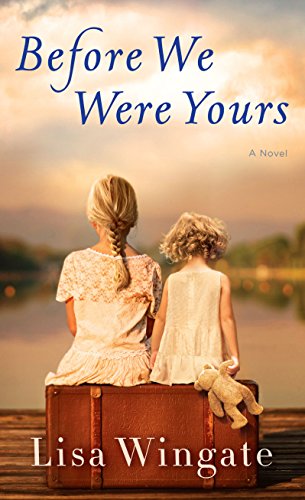
Before We Were Yours, by Lisa Wingate

This novel is based on true events that actually boggle the mind of the modern reader. Georgia Tann was a prominent maven of Tennessee society who sought to better society through the adoption of poor, underprivileged children into wealthy socially-advantaged families. Operating during the distressed times of the 1930s Depression, she established the Tennessee Children’s Home Society which operated orphanages across Tennessee and Georgia. That good intention went badly awry, however, and many of the children who ended up in these orphanages were never actually given up for adoption by their birth families. Some were snatched up on their way home from school. Others were taken from parents who were conned into signing away their parental rights by promises that their children would be returned when the family could get back on their feet. When the parents tried to reclaim their children, adoptions had been finalized, names changed, and records sealed. All of that is true and it is a grisly story that continued for more than a decade.

Against this history, Wingate structures her novel in two voices. The voice of 12-year-old Rill in Memphis, Tennessee, in 1939 alternates with that of Avery, a 30-something daughter of wealth and privilege in modern-day Aiken, South Carolina. Rill’s story moves us forward in time. Avery’s story ultimately unravels backward through the unsuspected secrets of her family,

Rill is the oldest of five children who were taken from their family’s vagabond houseboat on the Mississippi River when their father takes their mother to the hospital. Her story and the story of her siblings unfolds over a three-month period in alternating chapters of the book as Rill, rechristened May in the orphanage, fights to keep her sisters and brother with her.

In the interwoven story, Avery encounters a woman, May, in a nursing home who grabs her wrist and takes a bracelet that was given to Avery by her grandmother.  Avery’s grandmother is in the dementia unit of a different nursing home. As Avery retrieves her bracelet, she begins to talk with May and sees a photograph that looks suspiciously like one that her grandmother has. 

We see where this is going. And it does go there, at a fast tempo, and with some riveting scenes and phrases (such as fans trying to move humid summer air that has no desire to be moved). 

Our book club mostly enjoyed reading this book and it is indeed a good tale.  However, many thought the “Avery” story was too pat, too romance-novel-ish and used unnecessarily stereotyped characters, particularly Avery’s fiancé and the man who helps her unravel her family’s past. Our discussions of the book mostly centered around the character of Rill and her mighty efforts to save her siblings and their memories of their “real” parents; and around Georgia Tann, who died before she could be charged with the crimes she committed; and around our society’s changing views about adoption. The book did push us to consider what we might have done in the circumstances that confronted families in abject poverty during the Depression.  What might we have done to save our children? The scene where a father comes to the orphanage to reclaim his children and is told that they are already gone “to a better life,” is riveting. 

Review by Jeanie and Bill Smith