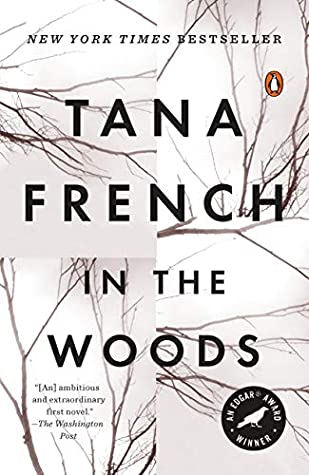
In The Woods, by Tana French


Tana French’s debut novel, In the Woods, is fascinating, complex and ultimately leaves its different readers with many different impressions of how we are to view the main characters and what actually happens in the story.

In literary genre circles, this book is classified as a “police procedural.”  The story takes place in and around Dublin, Ireland, where the weather, the atmosphere, the ethos of the place are almost characters in the plot.  The book is narrated by Murder Squad detective Rob Ryan who, we discover early in the book, has an unsolved mystery at the heart of his life. His memory of the incident is gone.  And he tells us, “Contrary to what you might assume, I did not become a detective on some quixotic quest to solve my childhood mystery.  I read the file once, that first day, late on my own in the squad room with my desk lamp the only pool of light….It was these arcana I craved, these near-invisible textures like a Braille legible only to the initiated.  They were like thoroughbreds, those two Murder detectives passing through Ballygobackwards; like trapeze artists honed to a sizzling shine.  They played for the highest stakes, and they were experts at their game.”

Rob and partner Cassie Maddox, the only person other than Rob’s parents who knows about his relationship to this old unsolved mystery, are assigned a murder case involving a 12-year-old girl from the same suburb where Rob grew up and where the old unsolved mystery took place.  Should he be investigating this new case?  His doing so is absolutely against department regulations, but he and Cassie proceed anyway.  Thus we begin a journey into the intertwining of these two stories.

We remember that Rob-the-narrator has also told us in the first line of the first chapter of the book:  “What I warn you to remember is that I am a detective.  Our relationship with truth is fundamental but cracked, refracting confusingly like fragmented glass.  It is the core of our careers, the endgame of every move we make, and we pursue it with strategies painstakingly constructed of lies and concealment and every variation on deception.”  So, is everything that follows somehow “fundamental but cracked truth”?  Are we part of a web of deception?  Is Ryan himself part of that web?

This first book in French’s “Dublin Murder Series” is a highly satisfying read, open to interpretation and re-interpretation.  Are there clues we have missed?  What is the significance of the object found in the remnant of the woods, now an archeological dig, at the end of the story?  Can we add up the brief flashbacks that Rob experiences during the course of the current investigation?

Read it yourself and see what you think.

Jeanie Smith

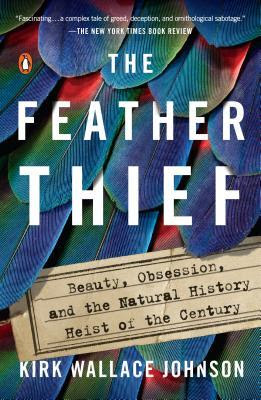
The Feather Thief: Beauty, Obsession and the Natural History Heist of the Century, by Kirk Wallace Johnson

Is this book autobiography?  Memoir?  Is it the story of a quest for the answers to an absorbing crime story with an uncertain ending?  Is it scientific history?  Answer: All of the above!  In weaving together these several strands, this non-fiction tale led to provocative discussion. 

Kirk Wallace Johnson opens his tale autobiographically:  He’s suffering from PTSD in the aftermath of the war in Iraq.  His current work, seeking to resettle Iraqi interpreters in the US, meets with limited success and constant frustration.  To relieve his depression, he takes up fly-fishing.  From his guide, he learns about fly-tying, the creation of beautiful works of art that are ostensibly for use as hooks to attract salmon.  In reality, these salmon flies are almost never actually used to fish.  They are bought and sold and hoarded as the works of art they are.  Trouble is, however, that the “best” require the use of rare and expensive bird feathers, many from extinct or near-extinct birds. 

As the author enters the world of the fly-tiers, he starts to hear of a theft from the British Museum’s ornithological collection held at the Tring Museum outside London.  This theft was accomplished by a young man, barely out of his teens, named Edwin Rist.  To explain not only the lure of the beautiful bird feathers that drew Rist to the heist, but also the scientific value of the birds taken, the author discovers the work of naturalist Alfred Russell Wallace, who in the middle years of the 19th century, traversed the Malay Archipelago where he gathered and catalogued over 125,000 specimens of rare birds.  His meticulous efforts to tag the date and location of each skin, as the bird carcasses are called, led him independently from Charles Darwin to arrive at the theory of evolution via natural selection.  

But what of Edwin Rist?  Rist is an American young man studying flute at the Royal Conservatory in London, hoping to be selected to play with a major European orchestra when his studies are completed.  He is also an up-and-coming expert fly-tier, featured in the fly-tying world’s website as “the future of fly-tying.”  He needs money to purchase the exotic bird feathers to use in tying his flies.  His visit to the Tring museum awakens him to the possibilities of securing a supply of rare feathers for his own fly-tying and of a steady source of income from feather sales to other fly-tiers.  

The subtitle speaks of obsession and there are many to examine in this book.  There is, first, the scientific obsession of Alfred Russell Wallace, the collector of the specimens, who from his lower-class origins sought academic recognition that was at the time only granted to upper class Britons.  There is Edwin Rist’s obsession with tying classic fishing flies that motivates the theft.  And there is the author’s own obsession with the crime and with recovering feathers for the museum, an obsession that has therapeutic value in alleviating his PTSD symptoms.   

Fly-tying with exotic feathers has exerted an obsessive pull on anglers and on pure hobbyists, with an upsurge of interest in the late 20th century.  With that enthusiasm comes the obsessions that fuel an underground market in rare and often illegal feathers.  Edwin Rist fell into this obsession as a young teenager.  He was later arrested and tried for the theft, was found guilty but lightly punished with a short period of probation after pleading incapacity due to Asperger’s syndrome.  

Many of our discussions were prompted by the judicial treatment of the case.  Could the system do justice to all the interests of society?  The police were essentially done when Rist was identified and tried.  The prosecutor and judge felt limited by prior decisions on the Asperger defense.  The museum’s interest waned when the specimens that were recovered were missing their sourcing tags or had been cut into marketable parts.  The general silence of the “feather underground” made it more difficult to track the fate of the specimens.  What do we think should have been a just punishment or a restorative action imposed on Edwin Rist?  And could he have pulled this off alone?  

Where does the value of the specimens to the scientific community collide with the value of the birds as objects of true beauty that the public might want to see?  Fly-tiers ask:  “Why does the Museum need so many examples of the same bird anyway?”

The Feather Thief is a good read, provocatively posing questions to which different readers might well derive different answers.

Jeanie and Bill Smith


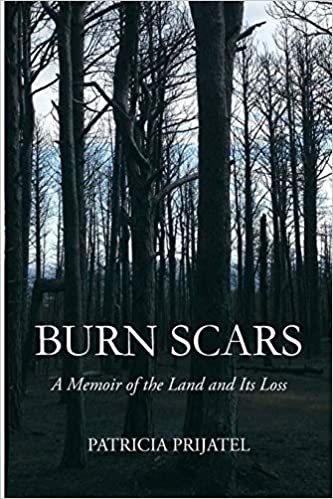
Burn Scars, by Patricia Prijatel

COMMENTS FROM BBB MEMBERS:

As I read this beautifully written memoir, it was like having my own sense of loss affirmed by someone who truly understands. When a landscape we love and are intimate with (whether it’s splendid mountains and valleys or our own backyard), is destroyed by the freakishness of our changing climate, it hurts. It changes us. We stop trusting nature. We feel stress. Maybe we get sick. We need to recover. Patricia Prijatel’s beautifully written account of the burn scars on “her” mountain and on herself is a must read if you care about climate change. It’s well researched and informative, fast paced and vivid. And perhaps surprisingly, in places it’s laugh-out-loud funny.
Sharelle Moranville

This is a beautiful book. The author has infused the opening chapters with descriptions of this land and its people she so loves. But there is a clear sense of suspenseful foreboding for a catastrophe that you know is coming. Her descriptions of the fire and the response of the human beings who are affected by it gain weight the farther we get from the event itself. Far from going back to normal, she chronicles the work of the people to prevent land erosion, how difficult and sometimes impossible it is, and the emotional toll it takes. What grows in the wake of the fire is not a regeneration of what was there before but in some cases harmful plant life that will change the landscape forever. We watch human emotions as they deny, accept, grieve and try to move on. What we learn in the process of reading this book is how precious our earth is and, in taking it for granted, how much we have endangered it.
Jeanie Smith

“Burn Scars” tells the true personal story of a Colorado family’s love for the land and the mountains. They enjoyed a wonderful life near the East Spanish Peak. Then fire erupted. They fled for their lives. Courageous firefighters saved most of the homes but the trauma lasts to this day. Prijatel talks about the personal grief. She tells the impact of fire, wind and flood on the plants and animals. She describes the increasing danger. Each year spawns higher temperatures and dryer forests. Each year sees more and bigger fires. Her well researched story flows easily. Read this book.
Ray Gaebler

The author did an extraordinary job of giving us a personal account of climate grief and educating us. Very readable, relatable and touching.
Karen Peters