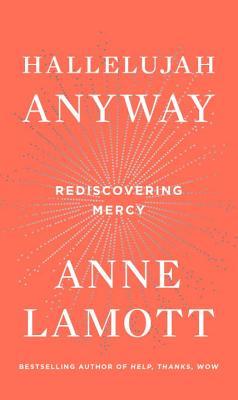
Hallelujah Anyway: Rediscovering Mercy, by Anne Lamott

For people who have read Anne Lamott’s previous writings on faith and life, this book will come as no surprise.  It continues her own confessions, struggles, insights, longings, and gropings toward understanding herself and a fuller relationship with God and with her fellow human beings.
 
For those who have not read any of Lamott’s earlier books, pick this one up.  Lamott writes with humor and unfailing honesty as she confronts her own (and our) human greed and selfishness and love and honor and, yes, mercy.
 
Woven throughout are her own takes on various Bible passages and people that may well resonate with the reader.  They certainly do with me.  Listen to her about St. Paul with whom I have long had a difficult relationship:
 
“Putting aside the little problem with all the people he had killed, he was annoying, sexist, stuffy, and theoretical.  He was not a great storyteller like the Gospel writers. He often got preachy, and his message was frequently about trying to be more stoic, with dogmatic ‘Shape up’ and ‘Shame on you’ talks.  He was cranky, judgmental and self-righteous, worse even than I.  Yes, he had moments of genius and light, but then he’d start wagging his fingers again.  Yet, he knew my heart, he knew the struggle with our dark side:  ‘I do not understand what I do.  For what I want to do I do not do, but what I hate I do.’  And he preached the willingness to be loved and included, as is.  He knew that people like me would want to have the willingness to have the willingness, but that this is scary and hard.  He knew that it comes from the pain of staying the way we are, cut off from ourselves, squandering our lives, envying others, bingeing on whatever, terrified of making mistakes.”
 
Lamott explains that it is mercy – the promise to offer and receive relief and forgiveness – that lies at the heart of all great faith traditions and our own spiritual identity.  Mercy gives us the chance to “soften ever so slightly” so that we can understand one another more deeply.  Mercy is, in her words, “the medicine, the light that shines in dark places.”
 

This book is beautiful, with so many wonderful passages that beg to be read and savored, pulled close into your heart and pondered there.  Read it.  You won’t be disappointed.—Jeanie Smith
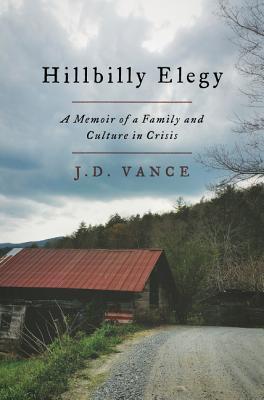
Hillbilly Elegy, by J.D. Vance

This book, subtitled A Memoir of a Family and Culture in Crisis, is exactly that, a memoir.  Hard to think of a memoir written by someone who was only 31 years old when he wrote it! Vance himself confesses the absurdity of this in his introduction where he writes, “I didn’t write this book because I’ve accomplished something extraordinary.  I wrote this book because I’ve achieved something quite ordinary, which doesn’t happen to most kids who grow up like me.  You see, I grew up poor, in the Rust Belt, in an Ohio steel town that has been hemorrhaging jobs and hope for as long as I can remember.”

And so Vance begins to tell his story. What makes this story compelling is that, while it tells of all the ways in which the decline of manufacturing jobs in the United States has left people behind, he is unflinchingly honest about the ways in which many of his people, whom he calls “hillbillies,” have brought about their own demise and their own lack of hope – their lack of care for their children, their sinking into the drug culture, their laziness and lack of any self-awareness.

Vance’s own family has had its difficulties.  As he writes, “I have, to put it mildly, a complex relationship with my parents, one of whom has struggled with addiction for nearly my entire life.”  He himself came close to flunking out of high school: “Whatever talents I have, I almost squandered until a handful of loving people rescued me.  That is the real story of my life, and that is why I wrote this book.  I want people to know what it feels like to nearly give up on yourself and why you might do it.  I want people to understand what happens in the lives of the poor and the psychological impact that spiritual and material poverty has on their children.  I want people to understand the American Dream as my family and I encountered it.  I want people to understand how upward mobility really feels.  And I want people to understand something I learned only recently: that for those of us lucky enough to live the American Dream, the demons of the life we left behind continue to chase us.”

Vance clearly has a great love for the people about whom he writes, particularly his crazy grandmother and grandfather – and “crazy” is his word, not mine.  This love comes shining through the book even when he sees clearly how the ways in which they act have negative effects on everyone around them.

— Jeanie Smith

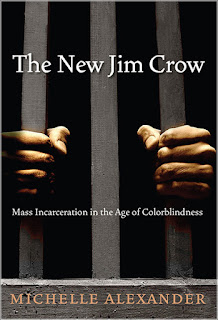
The New Jim Crow: Mass Incarceration in the Age of Colorblindness, by Michelle Alexander

 The New Jim Crow
This book is an important, but tough, read.  Important because we need to know the extent of our massive prison population and how it got that way.  Important because we need to understand that mass incarceration, in the name of the war on drugs and “law and order,” has been applied discriminatorily against our black and brown youth, particularly boys and young men.  Important because mass incarceration is the new face of a very, very old attempt to keep black and brown people from being full members of society.  Important because those of us who are part of the white majority need to see the face of our society from the perspective of those who are not white.
The book is tough because the conclusions are inescapable.  It’s tough because well-meaning Christian white Americans have let this happen under our eyes.  It’s tough because our response, if it is to combat this problem at its root, must be far more than simply revising our mandatory minimum sentencing laws.
Michelle Alexander brings incredible research to these points, carefully laying out facts and figures from her experiences as the director of ACLU’s Racial Justice Project inNorthern California and as a law clerk for U.S. Supreme Court Justice Harry A. Blackmun and as a professor of law at Ohio State University.
She argues that, contrary to what most of us want to believe, “colorblindness” is part of the problem and not part of the solution.  In her final chapter, entitled “The Fire This Time,” she challenges us to rethink denial, to talk openly about race, and to adopt an “all of us or none” attitude toward justice.
Like most of our societal problems today, this one is complex.  Solutions will not be based on 30-second sound bites, but on systemic work to rid ourselves and our institutions of implicit bias.

Not an easy read.  Yes, a tough one.  But one that’s necessary.—Jeanie Smith