
Forget Me Not Blue, by Sharelle Byars Moranville

Even though I finished Forget Me Not Blue some time ago, I have continued to think about the characters and wonder how they’re doing now. Our friend and novelist Sharelle Byars Moranville created a family of people who are fully believable, to the extent that my mind has them living just down the road off MLK — Martin Luther King Jr. Parkway, right here in Des Moines. If only they were real, I could drop by their place with some cookies or invite them to church at St. Timothy’s!

Written for a middle grade audience, the main characters of Forget Me Not Blue are siblings Sophie and Con, with emphasis on Sophie. From her perspective as a ten-year-old, we see what life is like with a mom who is loving but unstable – disappearing for days at a time, exposing the kids to harmful elements, and eventually landing in prison. Sophie and her brother, 13-year-old Con, lean on one another for support as they navigate daily life at school, meals and activities at the Community Center, and their barely habitable living space at home in the attic. In one especially poignant scene, Con buys Sophie a pair of red shoes at Walmart – her only pair – and she treasures them. They become part of her “signature look.”

Sophie and Con are both very smart, and they’re fearful of letting others know too much about their situation because of the threat of being removed from home and split up. Slowly and incrementally, over the course of the story, they develop relationships with others. Con has a girlfriend who he eventually confides in. Tommy, the restaurant owner who employs their mother, takes a special interest in them which evolves. And their great-grandfather, Gunner, works very hard to overcome his own addiction and past mistakes to earn their trust.

Sharelle Moranville is part of our BBB (Books, Brew & Banter) Club that meets weekly, so we had the honor of hosting her for an in-depth discussion over two Fridays. We learned a lot about the steps of the publishing process, the important (and sometimes challenging) relationships between authors and their agents and editors, and the various revisions and decisions that are made over months, and usually years before a book is released. Sharelle has been lucky to enjoy a fruitful relationship with both agent and editor, as well as some important personal consultants who are fellow writers.

A well-honed element of the story that our group particularly valued was the way the mother, Ashley, was portrayed. Sharelle did not sugar-coat the reality of living with a parent who is addicted and therefore not making sound choices for herself or her children, but neither did she demonize Ashley as someone who did not care about her kids. Having worked with women who are incarcerated as part of her background, she knows firsthand that most of them think about their kids above all else. As you’ll see in the story, even the title of “Forget Me Not Blue” is a nod to that maternal bond.

As an adult and a former teacher of middle grade students, I think this novel would be very valuable reading for kids. Some will see themselves represented in its hardships, but in a way that respects their resilience. Other young readers may develop some empathy about the fact that the playing field isn’t level. I also think it would be enlightening reading for teachers or any adult who works with kids. Ultimately it is hopeful and you’ll enjoy it. The quirky, endearing voice of Sophie will stick with you, and you’ll root for her family and her future.

— Julie Feirer
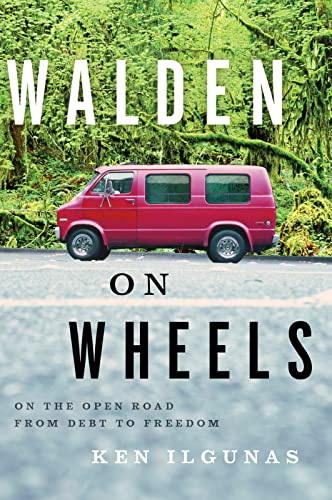
Walden on Wheels, by Ken Ilgunas

Walden on Wheels by Ken Ilgunas is many things. It’s a diatribe against student debt, an Alaskan adventure, a how-to on living simply, a reflection on the benefits of physical labor and liberal arts education, a tale of hitchhiking and characters encountered, a biting commentary on the typical American lifestyle and consumerism, and the documentation of a social experiment in which the author becomes an undercover van-dweller in order to obtain a master’s degree at Duke and come out debt-free. Also, it’s a glimpse inside the mind of a college-aged male as he comes of age and develops his voice as a writer, with a nod to Henry David Thoreau. 

Ken Ilgunas was raised in a caring, hard-working family in upstate New York. He did well in school and was both intellectual and athletic, but not particularly involved. He went off to college at the prescribed moment and earned a degree, but deeply regretted the amount of debt he incurred for it, without any palatable job prospects on the horizon. He felt victimized.  

Strapped by how much he owed and wanting to move forward on his own terms, he set out on a series of adventures in wild Alaska. There he lived very simply in exchange for room and board, and he did just about anything that was asked of him – washing dishes, leading tours, cleaning abandoned facilities – as long as he could shrink his debt with every check he sent home.  

Alaska was painfully lonely, with all his downtime spent on reading and one sketchy relationship, giving him space to clarify his thirst for education. His attention returned to college, but he knew he could not stomach the traditional costly living arrangement of grad school. Therefore, as a modern-day Thoreau might have done, he mustered all his spartan Alaskan training and went to the outskirts of campus to live deliberately in a cheap Ford Econoline van that he purchased on Craigslist and outfitted at Walmart. By day he was able to attend classes and use the campus facilities at the library and the gym; by night he cooked, slept, and studied in the van. In the end, he accomplished the goal of obtaining his master’s degree from Duke, debt-free. 

At the outset of his van-dwelling experiment, Ilgunas started a blog. In a series of posts during his two and a half years engaged in Liberal Studies at Duke, he wrote on practical and anecdotal topics such as “Dealing with the cold,” “What’s that smell?”, “So my mom knows about the van…”, “Of Mice and Ken,” and many more. When he was finally ready to tell all, he was able to pull content from these posts and write a coming out (of the van) story for his creative writing class. It made a big hit and he was encouraged to publish it, which he did in Salon magazine. From there he received nudges from publishers to consider writing a book, and he returned to Alaska to do that. He documented the publishing phase too, in posts called “To get a book deal, part 1” and “…part 2”.   

In response to the article, Duke gave him the honor of speaking at his graduation, but they also clarified their parking and transportation rules to officially ban van-dwellers from anywhere on campus henceforth. 

Like the book itself, the voice of Ken Ilgunas is many things. At times he comes off as smug, arrogant, and holier-than-thou. But when he isn’t ranting, he is also self-deprecating and sensitive. A good example of this can be seen in the exchange of e-mails with his friend, Josh, some of which he includes in the book. They contain all the profanity and trash-talk you might expect between two 20-something guys talking privately, but they also shared “politics, religion, worries, dreams, anything and everything… the more personal, the more self-admonishing – the stuff that a person feels most inclined to bottle up.” They were interested in jobs and women, but also with the Holocaust, Armenian genocide, the African American civil rights movement, the gay rights movement, poverty, the environment, and how “corrupt governments are empowered by a complacent citizenry.”  

Inadvertently, while he intended to document and share his adventures in nature and time in the van, what he also does is let the reader observe the nebulous period of growth from boy to man. At times he is downright eloquent. Describing his view of the aurora borealis, he wrote:

The sky lit up with spumes of reds, pinks, purples, and blues that swooped, twisted and curled into each other. There was no sense, no order, no logic to the aurora’s movement. It moved wildly and swiftly, changing into a different shape from one moment to the next. It was a glowing, throbbing, sashaying curtain of color, a Rorschach test that looked like whatever you wanted it to look like: a heavyset grizzly, a woman’s hips, a highway climbing hills. The aurora was a powwow of ancestral spirits – writhing apparitions, conjured from the depths of a village bonfire. It was a desert storm, a million individual particles of light whipping over dunes in patterns that no human mind could comprehend or computer generate. The aurora is alien and unworldly, but it does not frighten or flabberghast; it is a tranquilizer that sprinkles down onto its onlookers an opiate from the heavens. It puts you at ease. 

The fact that he did not set out to write a book with Walden on Wheels makes the whole feel a bit cobbled together. But he developed as a writer in the process, and the book did get national attention. He went on to use these skills to create a writer’s life for himself, satisfying his ongoing needs for freedom, adventure and study. His subsequent books are more focused and organized than the first, but still retain a great combination of experimentation, fact-finding and storytelling. 

In a 2009 blog post entitled “Thoreau’s Disciple,” Ilgunas wrote: “The ascetic who immerses himself in nature or embarks on a holy pilgrimage wishes to thrust himself into the very throes of life. In so doing, he leaves the tidy, formulaic and unwavering character of conventional life to plunge into the very breeding grounds of the authentic experience. By relying on our instincts and wits rather than on our wallets and families, we test ourselves, learn, grow; we can, in this way, reinvent our identities.” 

A gap year right out of high school might have been a less costly way to go and equally clarifying for Ken Ilgunas, but the journey that resulted in Walden on Wheels was an authentic ride worth living and sharing. It was also well worth the read. 

— Julie Feirer

Braving the Wilderness, by Brene Brown

It may be worth noting up front that our group read Braving the Wilderness in January of 2021, with our first of two discussions taking place just after an attack on the U.S. Capitol to disrupt the process of ratifying Electoral College votes in the 2020 presidential election. This made it a very timely and relevant read for many of us who were struggling to see these acts as anything other than “us versus them.” Having moved even deeper into the divisive and polarized culture that existed four years ago to acts of violence in 2021, Brené Brown’s words from 2017 now seem rather prophetic.

“The flags are flying from every porch and the social media memes are trending, all while fear is burrowing and metastasizing. What feels like a rallying movement is really a cover for fear, which can then start spreading over the landscape and seeping into the fault lines of our country. As fear hardens, it expands and becomes less of a protective barrier and more of a solidifying division. It forces its way down in the gaps and tears apart our social foundation, already weakened with those delicate cracks.”

In this short but powerful book, through her characteristic mode of vulnerable storytelling from her own emotionally raw experiences, Brown lets the reader know she’s seeking truths to help us all cope – not telling us she has all the answers. She challenges us to take a hard look at our responses in the face of fear and anger and whether, in our quest for belonging, we’re doing more than surrounding ourselves with like-minded others and pointing fingers for blame. While her suggestions for moving out of our own bunkers to find a greater sense of belonging absolutely make sense, they’re also no easy tasks: moving in and listening to people with whom we disagree, speaking truth to B.S. in a civil and non-dehumanizing way, and keeping a strong back, soft front and wild heart. 

A paradoxical quote by Dr. Maya Angelou, which Brown wrestles to understand throughout the book, is this: “You are only free when you realize you belong no place – you belong every place – no place at all. The price is high. The reward is great.” If the key to belonging is feeling bold enough to live authentically in every place, it opens up a lot of questions about how we raise our kids, how we form our identities and relationships, and even how we act as a church. The idea transcends any notion that one way of thinking is “correct.”  

Braving the Wilderness sparked a lot of reflection and conversation in our group of like-minded friends, but I can also see it being used as a starting point for open discussion among people who disagree. At any rate, it’s worth reminding ourselves to stay open to that conversation, and that fear of the other must be confronted in order to heal.  

— Julie Feirer