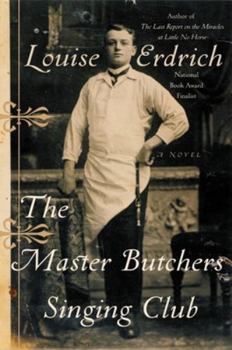
The Master Butchers Singing Club, by Louise Erdrich

The Master Butchers Singing Club is a mouthful of a title. But read closely, and you’ll see how the role of songs is critical to the book’s message. This is a book about a community in which music is a connector, bringing together people who have grown up in the town, but nevertheless are outsiders, immigrants who are building businesses and relationships, and native Americans who live nearby yet worlds apart.

The traumas of two world wars and of Wounded Knee, of family loss and community estrangement permeate the ground. Songs heal. Songs of patriotism, of war, of love and belonging pervade the book as this engaging cast of characters seeks belonging and a sense of home, not always sure where that is.

The book starts after WWI, as Fidelis Waldvogel leaves Germany for the United States, planning to take a train to Seattle, paying his way selling sausages. He runs out of money in Argus, North Dakota, and ends up making a life there. When his can afford it, he brings his wife Eva and her son Franz to join him. Fidelis and Eva run a successful butcher’s shop and he leads the men’s singing group, which includes Roy, the town drunk, a competing butcher, the sheriff, a doctor, and poor Porky Chavers whose singing might have gotten him killed.  

While the men are singing, the women are talking. Eva, by now the mother of four sons, nurtures Delphine, who grew up a motherless misfit in the town, but left for a brief stint as a table in a balancing act with Cyprian, her gay unmarried husband with whom she shares a strong emotional bond. Delphine is close friends with Clarisse, the town undertaker, who is shunned by men because of her occupation. Hock, the sheriff, thinks he’s a prize because he wants her no matter what. The “no matter what” wasn’t what he was expecting. Franz’s girlfriend Mazarine lives in poverty, which makes her the butt of jokes until Delphine helps her with a new wardrobe. And Step and a Half keeps walking and watching, helping from the sidelines.

Fidelis and Eva’s sons are vital to the story as World War II looms and Franz learns to fly, marries Mazarine, and heads to Europe to be a hero. Markus becomes bookish and leans on Delphine to fill the void left by his mother’s death, either trapping Delphine or offering her sanctuary—Delphine’s not too sure. And the twins, Emil and Erich, move back to Germany with their stern aunt, Tante, becoming Hitler youths ready to fight their American brothers.

Then there’s the mystery of the bodies in Roy’s basement—and the beads embedded in an odd sealant that kept the cellar door shut. What was Roy’s role in their deaths? Was Clarisse involved? How did the beads get there? And why won’t the sheriff move on and acknowledge it was a tragic accident?

Erdrich explains some of this, but not all. She leaves crumbs for us to find in careful reading. But she isn’t there to answer all our questions, or to leave all plot points neatly tied up. That’s neither real life nor a good book, and she masterfully gives as both.

— Pat Prijatel

The One-in-a Million Boy, by Monica Wood

Ona is 104 when she first meets the boy, who comes on Saturdays to work for her as part of a Boy Scout project. He fills her birdfeeders and does odd jobs around her house. She is impressed that he always shows up and does what he says he’s going to do. But then he disappears.

Three weeks later, his father, Quinn, comes over to help finish the boy’s job. He offers no explanation for the boy’s absence. He has seven more weeks of work to do for Ona, which he does competently but distractedly at first. But Ona charms him with card tricks, animal cracker treats, and honesty; the two develop a relationship that fills a need neither have had the courage to face before.

Quinn never tells Ona the boy has died; she learns through a newspaper story. The boy got up very early one morning, went on a bike ride, and his heart gave out because of long QT syndrome. But the boy, who is never named, remains ever present in this beguiling story of belonging; of memories lost then regained; and of people picking up the broken pieces of their lives and gluing them together with one another into a messy but marvelous collage.

The boy is 11, small for his age, and has no friends. He’s anxious, and counts actions, plans, and thoughts off on his fingers in groups of ten to calm himself. He is obsessed with The Guinness Book of World Records. His mother, Belle, knows he’s not like most other boys, and has sought treatment for him. Rather than seeing him as odd and labeling him as having a disorder, she sees him as one-in-a-million. The reader might conclude that he has OCD, but author Monica Wood presents him not as a diagnosis, but as a treasure.

Quinn, who is in his 40s, has made a living as a roving guitarist, always with his eye toward his big break. Several years before, he’d provided guitar backup one magical evening to musician David Crosby, who had said, “Look at this guy!” while Quinn played. He was sure Crosby saw him as a rare talent. But working through the boy’s death helps Quinn see more clearly and he realizes that he completely misunderstood Crosby‘s comment. It was a starry night, and Crosby had said, “Look at the sky!” He was in awe of nature, not Quinn. Finally, Quinn can face that he is a good, not great, guitarist and he needs to face reality and grow up.

Belle shows the grief Quinn can never face. Quinn and Belle have been married twice—they truly appear to love one another—but Quinn is just not up to marriage and fatherhood. Music is more vital to him. He has been an absent father, and Belle has had to shoulder the responsibility of raising the boy. Only after the boy dies does Quinn realize he loved him.

Throughout the book, Ona tells the story of her life through a series of interviews with the boy. When the boy learns how old she is, he begins his quest to get her into The Guinness Book of World Records. But she is not old enough, plus she doesn’t have the documents to prove her age. This sets off a quest in which Ona faces her own life while Quinn grows into his.  Bit by bit, words from her native Lithuanian start coming to her, vestiges of long-buried memories of a brother, her two sons who died, and a third son who is now in his 80s. And she unearths the truth of people who loved her, disappointed her, and betrayed her.

Wood tells us the story with one exquisite scene after another falling together precisely and often unexpectedly. She breaks the narrative throughout with parts of the boy’s interview with Ona and with random snippets from The Guinness Book of World Records, both presented in lists of ten. His presence is especially palpable in these interruptions, which also serve as connections. When the boy gets to Part 10 of the interview and realizes he has more story to tell, he simply calls it “also Part Ten.”

Included in the lists of world feats: largest gathering of clowns (850); harriest family (the Gomez family of Mexico, with 98 percent body hair); fastest time nonelectric window opened by a dog (11.34 seconds); and heaviest bus pulled by hair (17,359 pounds).

Throughout the interviews, the boy searches for ways to get Ona into the Guinness book. Ona calls him “my steadfast little fellow” for his efforts.  Maybe she could be the oldest person to fly in an airplane? he asks. Ona scoffs—prematurely, as it turns out. Or she could be the oldest person who still drives, a record currently held by “Fred Hale.109. Country of USA.” Ona has a car but no license, although she nevertheless drives to the store weekly. The boy sets out to help her pass her driving test. He doesn’t finish, but Quinn does.

Also making appearances are a Christian boy band and their hard-driving manager Sylvie, who offers Quinn a chance for a different life and another way of belonging; Ted Ledbetter, the upstanding Scout leader who woos Belle, gives her comfort and offers Quinn a glimpse into  a responsible relationship; Ona’s first husband who wrote a song she considered a failure, but which the boy band loves and which shows he loved her; and Quinn’s local band, which consists of manager-level childhood friends who envy him while he envies them.

The ending is heartbreaking—and uplifting. While Quinn thought he and the boy never connected, the boy saw him as the one person who could bring beauty and music back into Ona’s life. And he was right, although it happened differently than he expected.  His loss is tragic, but he remains alive in these beautiful, lost characters who discover themselves through one another, and create a makeshift family because of him.

He was one in a million. Maybe that should get him into The Guinness Book of World Records.

— Pat Prijatel

Love is My Favorite Flavor, by Wini Moranville

Early in her career, Wini Moranville decided her lifetime goal would be “to rearrange a modest but sweet life” around small moments and great meals. She was in the Rhine River valley on a backpacking trip through Europe, where she discovered food and wine that “tasted like the joy of knowing something good had settled into your soul and will be there forever.” These were the moments to live for, she realized.

And so she did. She became a food and wine writer, summer resident of France, and restaurant critic for the Des Moines Register. And now, she shares this sweet life in her memoir, Love is My Favorite Flavor, an engaging book that demonstrates how food is all about love—growing it, preparing it, serving it, and sharing it.

She started waitressing when she was 13 at Baker’s Cafeteria, a family-run, family-focused place with plenty of mashed potatoes, gravy, and cream pie. For the next ten years, through high school and college, she worked at some of Des Moines’ iconic restaurants——Younkers’ Tea Room, the Meadowlark, and Parkade Pantry— building the foundation on which her career was forged.

She still remembers instances in which she failed a customer in need of sustenance, like the woman in the houndstooth suit who wanted a tuna salad sandwich at The Soup Kitchen, one of Des Moines’ earliest vegetarian restaurants. In hindsight, rather than turning the woman away, Moranville wishes she had encouraged her to try one of the restaurant’s satisfying alternatives and helped her enjoy her lunch. Or the little boy whose family mocked him for mispronouncing pecan to the point he couldn’t enjoy the pie he had been savoring. The memory of somebody being deprived of the joy of a meal still rankles.

And she remembers a fussy customer who wanted her tea in a teapot so she could brew it just the way she wanted. First, the woman seemed unsufferable, but then Moranville caught a glimpse of her “staring contemplatively into space and sipping tea brewed just the way she liked it. She simply looked so…happy.”

She realized the woman, like most customers, had her own drudgery, and the treat she allowed herself was her afternoon cup of tea.  “And it took so little to make her happy: hot water in a teapot, tea bag on the side, two packets of honey.”

In the best restaurants, the staff shares a meal together before their shift begins, testing menu items, but also bonding, creating an atmosphere in which serving feels like a calling, not a job. She saw this in full color on a trip to France, when she and her husband Dave came upon a raucous group on a restaurant terrace, finishing a meal and enjoying the food and one another. They learned this was the staff, which was just about ready to go to work, after finishing the espresso being served by the restaurant owner.  They talked to a chef, who encouraged them to return later, which they did, enjoying their own delicious and convivial meal. Moranville observes:

It occurred to me that the staff seemed to operate from a kind of pact: they had their turn sitting down at the table and being nourished and cared for. When it was our turn to sit at the table, the promise was that we would be in equally good hands.

The book charts Des Moines’ growth from a meat-and-potatoes backwater to a place where chefs win James Beard awards. But the strain of being the town food critic eventually took the fun out of that job, so she resigned as the Datebook Diner. And the wine junkets to exotic places never were much fun because she seldom saw the beauty of the landscape but was stuck in a stuffy room with stuffier writers. She turned to writing books, several on French cooking; she blogs about food at Dining Well in Des Moines with Wini Moranville.

Perhaps the most enjoyable part of the book was the discussion, especially the stories book club members shared about their own relationships with food. We talked about the weirdness of carrot Jell-O salad, and learned how to make Jell-O in England without a refrigerator, about a picnic with salmon and peas, and about our own experiences as young, energetic and occasionally not sober wait staff. This was a relaxing read in a stressful time, reminding us that our tables can be sanctuaries, sacred places for friends and family, and that through food we build community.

— Pat Prijatel