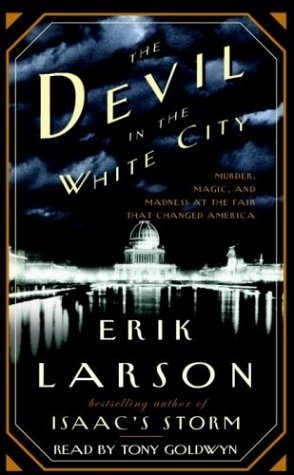
The Devil in the White City, by Erik Larson

Many of Erik Larson’s books explore the intersection of technological brilliance and human evil. In The Devil in the White City, he recreates the Chicago of 1893, where the nation’s foremost architects build the Chicago World’s Fair on Lake Michigan while a serial killer creates his own grotesque haven just blocks away.

It’s a city teeming with creativity, filth, growth, and chaos, which Larson captures so thoroughly that I could almost smell the stockyards and see the muck oozing down the Chicago River.

With meticulous attention to detail and storytelling prowess, Larson introduces us to chief architect Daniel Burnham, his partner John Root, and his talented team, including Louis Sullivan, with whom Burnham most often clashed; Frederick Law Olmsted, whose landscaping plans caused him nearly as much grief as his aching teeth; and Sophia Hayden Bennett, the lone woman, who was just 21 when she designed the Women’s Building.

And then there was H.H. Holmes, aka Herman Webster Mudgett, who built the horrifying World’s Fair Hotel, complete with a gas chamber and chute to smoothly dispose of bodies, which included those of three wives and one fiancée. He even sold a good many of their skeletons to a scientist who cleaned them and used them for research, conveniently expressing little curiosity as to their origins.

Larson intersperses the drama and delight of the fair with the horror of Holmes’ Murder Castle, both being built walking distance away from one another. The book’s tagline: Murder, Magic, and Madness at the Fair That Changed America.

The fair, also called the World’s Columbian Exposition, to celebrate the 400th anniversary of Columbus’s arrival in the United States, needed a show-stopper, a feature to compete with the Eiffel Tower, built for the 1889 World’s Fair in Paris.  Planners rejected several brilliant ideas, including an 8,000-foot elevator that would take riders to a toboggan run from which they would slide all the way to Boston (details to come later). After months of stressful searching, they finally found the solution: the first Ferris Wheel. This behemoth was 254-feet tall, with a capacity of 2,160 riders at a time. Riders were enclosed in 36 wooden cars the size of boxcars, which could hold up to 60 persons and included their own restaurants and bars. (The latter would probably come in handy for some riders.)

And to make the structures and landscaping work together, designers painted all buildings white, creating a magical city in the purest of colors, another contrast to the darkness blocks away in Holmes’ evil world.

It’s a wonder the fair opened at all, with constant squabbling between its architects, plus the unreceptive Chicago weather and boggy location in Jackson Park, which was largely a swamp before Burnham and Olmsted visited and saw the possibility of a lakeside wonder.  And it’s a wonder Holmes was ever caught, given the ineptitude of local police, the lack of any national data collection of missing women, and Holmes ability to lie brilliantly.

Most structures of the fair were covered essentially with papier-mache, so they were destroyed after the fair. Today’s Museum of Science and Industry is the only major building remaining; it had been the Palace of Fine Arts. Pat Prijatel

To see how the fair might have looked, check out this three-dimensional recreation.


An Invisible Thread, by Laura Schroff


In this true story, Laura Schroff befriends a homeless boy, Maurice, and he gradually becomes central to her life. We asked whether we would have had the courage to act as Laura did. We acknowledged that we would have considered the “what if”s and “why”s and “oh no”s of bringing such a boy—and his family— into our lives. Schroff did it with only minimal hesitation and with a wholehearted welcome, and she faced a stunning learning curve she shares with the reader. 

Maurice lives within feet of Laura’s comfortable apartment in midtown Manhattan, but they might as well have been in different countries. Laura even has to teach Maurice how to blow his nose because he has never done it, and she ends up making him school lunches in a plain brown paper bag so he can fit in with the kids at school. 

Laura is honest about how her relationship with Maurice eventually foundered as she tried to build a life with a new husband, and her backstory helps explain why she might have taken the chances she did with Maurice and also defines her need to have a child of her own. 

The writing is a bit weak—Schroff wrote the book with friend and colleague Alex Tresniowski,  which may have reduced some of the immediacy and power of the memoir. It is an easy read, though.

—Pat Prijatel


Mudbound, by Hillary Jordan


Winner of the Bellwether Prize, awarded to a first literary novel that promotes social justice.

Two men return to the Jim Crow world of the Mississippi Delta from World War II; one is black, one is white. Both have lived a life far freer than the one they now face. Ronsel Jackson is the son of sharecroppers, and Jamie McAllan is the brother of the owner of Mudbound, the cotton farm that ties the two men and their families together.

It’s a miserable place, the owner’s house little more than a shack, the people mired both in mud and a system of rules that keeps everybody—blacks, whites, men, women— in their narrowly defined space. Ronstel’s father works a grueling schedule to maintain his status as a tenant farmer, which means he gets half of the crops he and his family harvests. When a storm kills his mule, he can no longer keep up and faces returning to sharecropper status, meaning he gets only 25 percent. So a mule is the difference between making a living wage and being forever indentured.

Ronstel’s mother Florence is a midwife who saves the lives of the farm owner\’s daughters and helps the wife, Laura McAllan, turn her hovel into something of a home.  Yet, her thanks is to be treated as less than, because she is black.

The nonchalant racism of the farm’s owners is chilling. Laura notes that, while she appreciates Florence’s help, she is careful not to let the help cross the invisible line between black and white. She uses Florence’s first name, but Florence must call her “Miz McAllan.” And Florence and her daughter Lilly can’t even use the family’s outside toilet—they have to use the woods behind it. (Hard to see that as anything but an improvement, but rules are rules.)

Laura’s husband Henry is so in love with his land that he ignores the real dangers in his family, primarily those caused by his father, Pappy, who is evil incarnate and the catalyst for the disastrous events that end the novel.

Author Hillary Jordan writes each chapter in the voice of one of the main characters, giving insight into their hopes, fears, and justifications. She does not let Pappy speak, perhaps because he does not survive—which we learn in the first chapter, so no spoiler there. It would have been a challenge to hear such a nasty character explain himself, though. Such is the nature of his personality, however, that we all enjoyed the book a bit more knowing he would not survive.

—Pat Prijatel