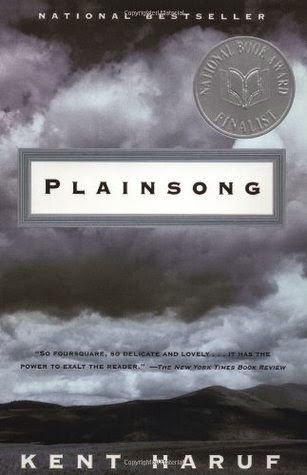
Plainsong, by Kent Haruf

A “plainsong” is a simple, unadorned melody, a Christian worship song without instruments, sung in unity. And it’s the fitting title of Kent Haruf’s lyrical novel about mythical Holt, Colorado, its flawed citizens and the angels that help save those most in need, especially the children.

Plainsong, the book, is truly a plainsong, unadorned and melodic. It is a gentle, calm story of human failings and redemption that matches its setting: the quiet plains of windswept northeastern Colorado. The cast of characters includes Maggie Jones, the catalyst who connects lost souls with their saviors; Tom Guthrie and his sons Ike and Bobby, whose mother is not up to the challenge of day-to-day parenting and moves to Denver, leaving the boys to find mothering where they can; the McPheron brothers, bachelor farmers who fill a hole in their lives by informally adopting Victoria Roubideaux, a pregnant teenage whose mother locks her out of the house; and a troublemaking high school student and his obnoxious parents.

At times, I felt like hugging this book because of the goodness of some of its characters, its authenticity and subtle humor.

Haruf is from my hometown of Pueblo, Colorado. Every year when we drive to our Colorado cabin, we pass Yuma, Colorado, which is the model for Holt. And Haruf ended up building a home in Salida, Colorado, one of my favorite places. So this novel had special connections for me. Sharelle Moranville has written about her admiration for Haruf. But we all enjoyed the book and look forward to reading more by Haruf, especially Eventide, which follows the characters five years later.

In a final interview just days before he died in November, 2014, Haruf said, “I want to think that I have written as close to the bone as I could.” He did indeed.

— Patricia Prijatel

Little Wolves, by Thomas Maltman

Is there actually a mountain on the eastern Minnesota prairie? Did a young man who lived near it intend to commit a murder? Did he intend to kill himself? Did he actually kill himself? Was the man he murdered saint or sinner? How and why did the young priest’s wife end up reliving her mother’s last act?

We wrestled with these and a batch of other questions as we discussed this intriguing book, and were mixed in our reactions to it. The myths of early Anglo-Saxon literature fit in nicely—the coyote (Maltman calls them “little wolves”) who rescued the human baby, the man who turns into a wolf—and become intertwined with the reality of lost souls in the tiny prairie town, where people still blame dark deeds on the ghosts of the Native American who settled here first.

But some of the themes work, some don’t.

Our overriding question was: Where have all the editors gone? This is not the first time we asked this question—many of the books we have read have suffered from the need of an impartial expert to cut unnecessary details and story lines, to help the writer focus.

This could have been a brilliant book—and with more time from an editor, it should have been. Much of the writing is beautiful and the imagery is elegant.  It was an enjoyable read, but not completely satisfying afterward.  Too many themes were only loosely resolved; others were  introduced then dropped, leaving us to wonder what to make of it all. Likewise, some of the characters were weakly drawn, including the teenager Seth, who is at the center of things; the newly minted priest Logan, who could have been fascinating with just a bit more focus; and Clara, who is looking for her own roots by studying ancient literature.

The setting was wonderfully imagined and Maltman makes the community itself a central character, which gives the book much of its strength. The father-son bonding throughout was compelling, especially in the ending, which was far lovelier than we could have expected.

We recommend the book, despite the above reservations, and would love to hear others’ reactions to it.

—Patricia Prijatel

Orange Is the New Black, by Piper Kerman

Piper Kerman could be your neighbor, your daughter, your best friend, or you. After graduating from Smith College, Kerman longed for an adventure, and she found it as a courier for a drug lord. She was a small part of an international operation, but ten years later, her youthful lark landed her in prison in Danbury, Connecticut, close in miles to her friends in New York and Boston, yet eons away in the life she faced.

Stripped of her clothes, belongings, and dignity, Kerman learned what it is like to be a prisoner in 21st Century America.

Our favorite part of the book was Kerman’s acceptance of her fate and empathy for the women she lived with—she seemed to completely enjoy many of them, while acknowledging impatience with those who kept making poor choices and endangering their entire families. Kerman writes with wisdom about her own poor choices and how they not only hurt her and those she loved, but ultimately hurt the women she was living with, many of whom were caught in the drug trade she joined just to have fun.

She shows how dehumanizing and pointless prison sentences are for many of these women who were given minimal rehabilitation or education and treated like they were less than human, often because of crimes in which they were more victim than criminal.

As part of the discussion, we tasted Kerman’s version of prison cheesecake and agreed it was surprisingly tasty.

We recommend the book, and those of us who have seen the Netflix series recommend it as well, although it often wanders away from the storyline of the book. Seeing the filmed version helped us visualize the prison and its women.

— Patricia Prijatel