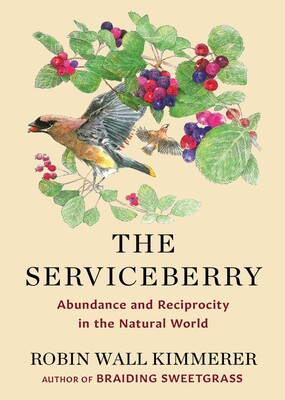
The Serviceberry: Abundance and Reciprocity in the Natural World, by Robin Wall Kimmerer

This is an exquisite book—112 lovingly designed pages of thoughtful commentary, elegant language, and engaging drawings. It’s essentially an essay packed with a call to reconsider capitalism by injecting it with what Robin Wall Kimmerer calls the gift economy.

The back cover, with a luscious drawing of hands brimming with purple and red fruit, carries the message we’re to take with us: “All Flourishing is Mutual.”

Kimmerer uses a simple springtime fruit, the serviceberry (also called a juneberry, shadbush, wild plum, saskatoon and a litany of other names), as a metaphor for the difference between indigenous beliefs and capitalism. (Kimmerer is a member of the Citizen Potawatomie Nation, professor at the State University of New York’s College of Environmental Science and Forestry, and director of its Center for Native Peoples and the Environment.)

A gift economy, she writes, is built on sharing and recycling. When the serviceberry produces too much fruit for one family, the tradition is to give the remainder to neighbors and friends. In a capitalist approach based on concerns of scarcity, the rest might be hoarded or sold. There is no room in a gift economy for hoarding; great wealth is frowned upon because indigenous societies value reciprocity over accumulation.

It’s a system in which everybody gets a bit of the bounty, nobody goes hungry, but all involved—insects, birds, humans—reciprocate. “Just as all beings have a duty to me, I have a duty to them,” she writes.  “If an animal gives its life to feed me, I am in turn bound to support its life. If I receive a stream’s gift of pure water, then I am responsible for returning a gift in kind.”

Kimmerer uses multiple examples of current gift economies, including Little Free Libraries, and the larger public version on which they are based; sites such as Buy Nothing, which digitally connect neighbors who give away household items they no longer need; and recycling stores like The Freestore in Des Moines.

She acknowledges problems in the system, and points to the Tragedy of the Commons, in which those wishing to make a profit take control of community resources. In one case, a neighbor puts up a “free farm stand” full of fresh produce to share, and somebody steals the entire stand. (Kimmerer acknowledges that it was, in all fairness, advertised as free.) In response, an Eagle Scout replaces the stand and organizes other members to build similar structures in their communities.

The book is an easy, pleasant read that allowed us to dip our toes in economic theory, making it accessible and almost fun. It’s an antidote to the greed that is currently the operating philosophy in our government.

— Patricia Prijatel

Solito, by Javier Zamora

It would take a hard heart not to fall in love with nine-year-old Javier Zamora, with his head full of superheroes, love, and deep concerns about bodily functions. How, for example, can he trust modern plumbing, instead of the outhouse behind his grandparents’ home in El Salvador? What will keep him from being flushed down the toilet and into the ocean?

At the beginning of this memoir, he has a seemingly comfortable life in the tiny village of La Herradura, with his grandparents, aunt, and cousin. But he misses his parents, who immigrated to the United States to escape the political violence and gangs of their home country. In his dreams, Javier flies like Superman and greets his parents in California at their front door. A superhero could then fly back home.

When Javier turns nine, Don Dago, the coyote who helped his mother successfully cross the Mexican border thinks he is old enough to make the harrowing journey to reunite with his parents. But he is not a superhero. He’s just a little boy.

Zamora, who was in his late 20s when he began writing the book, tells the story from the perspective of his nine-year-old self, with the naivete and confusion of a child who had to put his life in the hands of people he didn’t even know and embark on a trek that many others did not survive.

In April 1999, he sets out for what he and his family expect to be a two-week trip. Instead, it stretches to nine weeks, as things begin to go wrong immediately, with unexplained delays, new coyotes coming and going, and confusing route changes. His grandfather goes with him for the first two weeks of the trip, along with a group of others fleeing the country.

After his grandfather leaves, Javier has no way to contact his family in El Salvador or in California. For seven weeks, his parents and grandparents have no idea where he is, or if he is even alive.

He forms a family bond with a young mother, Patricia (also his mother’s name), her young daughter Carla, and Chino, a tattooed teenager escaping gang life. In the book’s dedication, he says he owes his life to them. In searing details, he shows this to be true.

Zamora is at heart a poet, and he brings us along on his journey with writing so clear and poignant we hear, smell, see, taste, and feel with him. The hot and smelly hotel rooms full of people who cannot leave or even open the windows, the delight of his first taco, the feel of water when he can finally wash the sand and sweat away in a shower, the glint of a gun aimed his way. 

He’s a shy bookish boy, self-conscious about his weight and nervous about everything from the size of his penis to the cleanliness of his underwear and his crush on Carla. That he has to go through this experience for his own safety is appalling. That he is judged for it is heartless. 

When Zamora was 18, he began to write poetry about his journey, at the suggestion of his therapist. He wrote from the perspective of a coyote in “Looking at a Coyote.” He shared his love for, but distrust of, his home country in “El Salvador,” the home that can never be home again. In “Citizenship,” he watches others who look like him but who can cross the border easily and wonders how they are different from him. In “Second Attempt Crossing” he writes about Chino, who was like a life-saving older brother on the journey, but whose fate is uncertain in the United States. The poems stand beautifully on their own but offer heartbreaking depth if read after finishing this memoir.

Zamora earned citizenship through an Employment-Based Extraordinary Ability visa (EB-1), sometimes called a genius visa, and then a green card because of his writing. And, though grateful, he says refugees should not have to be geniuses to come to the United States. They should be accepted just because they are humans.

The book’s cover is a work of art in itself—an outline of a downcast boy filled with an image of the Mexican desert. The title—Solito, which means solitary—is placed above the image in a sea of white. The austerity shows how alone this dear little boy felt. The book ends on a poetic note—showing us a hint of his reunion with his parents but leaving the details for our imaginations. Our group we had one recommendation—that Zamora write a second book about his life in this country, his fraught reunion with his parents, and the reality of living in a country that will never be home.

— Patricia Prijatel

Doppelganger, by Naomi Klein

Naomi Klein walks into a bathroom and overhears women condemning her for spreading conspiracy theories as one of the loudest voices in far-right media. The women ask “What’s happened to Naomi Klein? I used to like her.” Klein says nothing to the group—she’s heard it before, and she knows they’re not talking about her. They’ve confused her with the Other Naomi, her doppelganger, Naomi Wolf.

This is the start of Klein’s Doppelganger: A Trip into the Mirror World, which tells the story of the two Naomis and unravels the many ways we have become such a broken society.

Klein and Wolf once shared the same political territory, critiquing how capitalism and the politicians it supports have sucked the meaning, energy, and money from our lives. Klein’s Shock Doctrine: The Rise of Disaster Capitalism argues that those in power often exploit even our darkest moments—Hurricane Katrina, the invasion of Iraq— to derail democratic norms and increase profits. Her No Logo: Taking Aim at the Brand Bullies argues that, in a corporate culture, we’re encouraged to express our individualism by creating personal brands that make us all alike, broke, and hollow.

Wolf’s The Beauty Myth: How Images of Beauty Are Used Against Women makes much the same argument—that corporations are getting rich exploiting women’s insecurities about how they should look. The result: women focus on external qualities at the expense of their professional success.

The two Naomis comfortably coexisted in the same sphere, often being confused with one another, but both headed the same direction.

But when Wolf became a voice of the anti-vax, anti-mask movement during Covid, Klein began to take notice. Wolf was using the same message she and Klein had once shared but was skewing it to reach far different conclusions. Klein saw the government and pharmaceutical companies reacting responsibly to help citizens survive Covid through security measures and vaccines. Wolf saw these same entities as the enemy, defying our individual freedoms by forcing us to mask and invading our bodies with vaccines. The feminist position advocating bodily autonomy was turned on its heels in defiance of vaccines. Klein began to feel she was living a parody. “It was an out-of-body experience,” she writes.

Klein had a doppelganger, a shadow self, and as she shows, doppelgangers are seldom good news. They are our evil twins, representing our dark side. And they have unique power against us. (Doppelganger is a German word meaning “double walker.”)

For a time, Klein didn’t know how to respond, because Wolf could use any evidence Klein provided to make conclusions that served her own contrary position. She planned an essay criticizing Bill Gates for taking a position during the pandemic that she felt robbed the needy of essential vaccines, but stopped herself because she realized Wolf could use this same argument to tie Gates to those she felt were denying us our freedoms.

Klein takes this premise, expands it, then peels it back, layer by layer by layer, to show that what has happened to her has happened to our entire country. The meanings of words has been turned upside down. Choice, once used to define a woman’s right to make her own health decisions, now is used to argue against masks. Politicians charge their opponents with immoral and unethical acts they themselves are committing, and their words are echoed enough that they take on their own reality. What are we to believe?

Klein asks: “Am I who I think I am or am I who others perceive me to be?”

Klein covers this mirror world through multiple iterations, including political protests, racism, eugenics, conspiracies, and political ideologies. She offers an intriguing analysis of the Israeli and Palestinian conflict written before the current war. The two sides are doppelgangers, she says. The same yet totally different. Which is the evil twin? Both and neither.

This is a complex, deeply researched and eye-opening view of our divided culture and how we got here. Klein concludes with a call to action and advises us to remain calm. Our current problems are hundreds of years in the making, she shows, and have flourished because of our sense of individualism, while our support of and reliance on community withers. The result is a tribal society in which we no longer trust members of other groups, our reflex being to disagree with them without listening to their very real concerns.

It’s a world in which conspiracy theorists like Wolf thrive until, perhaps, we use our words and call them what they are: weird.

This was nobody’s favorite book, including mine—and I recommended it. Some BBBers reread passages, trying to squeeze the meaning out of them; others skimmed entire sections, eyes crossing with mental fatigue; many never finished. Those who did finish agreed that the book’s final sections, Part Three and Part Four, are its strongest. And the Epilogue is well worth reading even if you skip the rest. 

— Pat Prijatel