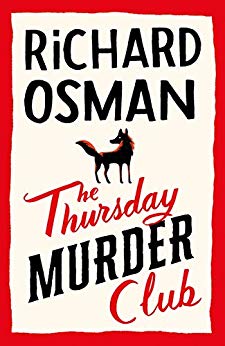
The Thursday Murder Club, by Richard Osman

At first, The Thursday Murder Club seems like a light read—charming and witty, with a murder or two thrown in for flavor. But below the fun façade lies a poignant and thought-provoking story about aging, love, loss, and hope.

The plot revolves around four “pensioners”—the book is set in Kent, England— who live in a countryside retirement home. They meet every Thursday to discuss cold cases and, as the plot progresses, they solve a few recent murders that stymie the local police. Elizabeth, a retired spy, is a catalyst for chaos who has a few tricks, plus a gun, up her classy sleeves. Joyce, a retired nurse, sees the humanity that Elizabeth can sometimes miss. She’s the book’s diarist, an outsider who couldn’t afford to live in Coopers Chase if her wealthy daughter hadn’t bought the place for her. Ibrahim still works as a psychologist and is the group’s data collector and analyst. Ron, a former labor organizer, provides a working-class perspective and a certain dim-witted clarity.

When a murder happens close to home, the group grinds into gear to find the murderer and, perhaps, report them to the police. Or not. As Joyce muses at one point:

“After a certain age, you can pretty much do whatever takes your fancy. No one tells you off, except for your doctors and your children.”

At the local police station, Donna longs to get into the detective squad, but doesn’t see it happening until Elizabeth intervenes. Chris, the DCI in charge of the murder investigation, is man enough to see Donna’s strengths, even if his skills as a detective fall far short of those of the murder club. (But whose don’t?) He’s preoccupied with a longing for a fantasy life he fears has escaped him. Good thing he takes to Donna so well, as she’s not only a solid investigator, but an impressive matchmaker.

The backstories and side characters give the book its depth. Steven, Elizabeth’s husband, is in the initial stages of dementia. Joyce is in deep grief over the loss of her husband and keeps looking for a replacement. Bernard, one option, has a grief he cannot live with. Ron’s son might be a murderer or at least a gangster. And Ibrahim fights racism with a sad aplomb.

The characters consume large quantities of wine and cakes as they plot their strategies and ensnare the bad guys. It keeps them young. As Joyce writes in her diary:

“In life you have to learn to count the good days. You have to tuck them in your pocket and carry them around with you.”

Author Richard Osman says he was motivated to write about senior citizens after visiting an upscale retirement home in England and meeting its accomplished residents who no longer went to work every day, but whose brains were still alive and quite well. This is the first book in a series; the fourth and most recent was published in mid-2023.

— Pat Prijatel

Skinny Dip, by Carl Hiassen

In this lighthearted romp through the Florida Everglades, author Carl Hiaasen creates an intricate and inventive plot replete with flying bears, errant skydivers, bed-ridden pythons, endangered wetlands, and imperiled Pomeranians. 

We meet a murderous and supremely moronic “scientist”; his multimillionaire, champion swimmer wife; one bad guy who finds redemption, except for that one murder; another bad guy who is killed by a highway memorial cross; the buff middle-aged former cop who has retired to his own island and ends up getting the girl (an author can fantasize);  a current cop who channels his inner Columbo; and an Australian sheep farmer who runs away with the hairdresser who apparently is smarter than she was first written.

Hiaasen is a former investigative journalist who might have faced so much governmental corruption and environmental havoc he needed to take a break from serious into silly. He obviously had fun here—the book can be laugh-out-loud funny and outrageously witty. Plus, it has its educational moments about how the Everglades have been destroyed and how money for their revival has been squandered by shady local bureaucrats. It’s a beach read, and perhaps those of us who weren’t total fans of the book were just lacking a beach.

— Pat Prijatel

Demon Copperhead, by Barbara Kingsolver

Demon Copperhead is about six when we first meet him, as he and his cousin Maggot ramble happily around the mountains and streams of rural Appalachia, contented residents of Lee County, Virginia, a community that is both solace and trap. Demon lives in a trailer with his mother; Maggot lives next door with his grandparents. The book follows Demon for the next 15 years as he becomes an orphan, tobacco picker, foster child, football star, drug addict, husband, widower, friend, lover, grandson, cartoonist, and nascent graphic novel author. It’s a life mirrored after Charles Dickens’ David Copperfield, but with foster homes in place of orphanages, oxycontin instead of gin. Poverty, powerlessness, and child exploitation are much the same.

Our group had varied responses to the novel. At 548 pages of intense prose and chaos, it is daunting. Some found it mesmerizing and were sucked into the story, eager to keep reading to see how Demon approached his next trauma. Others needed to regularly take a breather, not wanting to face another bad decision and more destruction of Demon’s brittle life.

The book’s voice is its biggest strength. Demon narrates with the angst of a child, the naivete of a teen, and the hope of a young adult. He shares humor, pain, wisdom, and cluelessness in what is essentially a journal in which he is trying to figure himself out.  Kingsolver nails it, showing us how a life of deprivation and degradation can lead to what more privileged people consider poor choices; for those in the middle of the storm, they simply feel like the best of multiple bad options. As the story builds and Demon’s life destructs, we begin to understand why he is how he is, why he does what he does, and how he ultimately becomes who he is. His voice is full of heart, but it is also heartbreaking.

The book won the 2023 Pulitzer Prize for fiction.

This is the seventh Kingsolver book we have read as a group, and we have watched as she has grown as a writer, starting with The Bean Trees, published in 1988. Most of her books contain themes of social justice and environmental stress. The villains in Demon Copperhead are the mining companies that degraded the land, extracting what they wanted and leaving the residents to live with their mess; the drug companies that knew how addictive pills like oxy were, but pushed them anyway; a frayed social network that has no place for kids in poverty; and a healthcare system that doesn’t reach rural America.

Lee County is its own social ecosystem in which you can’t hide from your past. Old acquaintances pop up in Demon’s life, some for the better, others for the worse.  The Peggots are always somewhere in the background, showing Demon how home looks.  Aunt June leaves the Doom Castle (her apartment in Knoxville) to practice medicine “back home,” and helps Demon find the care, and cure, he needs. Fast Forward, the football star who first introduced Demon to drugs, returns and causes one of the book’s most traumatic events. Emmy follows Demon on a downhill spiral. Tommy, the lost foster kid who seemed destined for a dead-end life, helps Demon discover his future. Mr. Armstrong and Miss Annie never waver in their support of Demon. And, of course, Angus is Demon’s truth.

For Demon, Lee County is home. He cannot envision living anywhere else, especially in a city apartment where people don’t even have lawns, let alone woods and mountains. His people may be a mess, but they are his. He loves them and learns that they love him too. Throughout the novel, he strives to belong and, finally, at the end he does. And we assume he will finally see the ocean—because Angus is in charge.

— Pat Prijatel