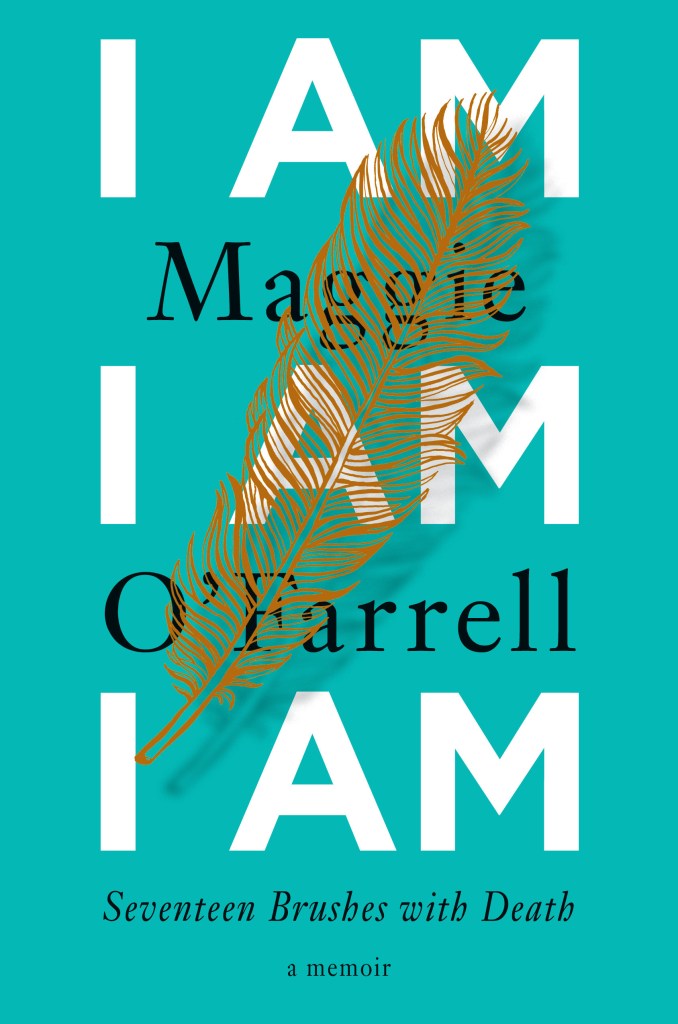
I Am, I Am, I Am: Seventeen Brushes with Death, by Maggie O’Farrell

This is not your average memoir. With stark self-awareness and insight, novelist Maggie O’Farrell throws us into the middle of her life through 17 essays about life-threatening and often harrowing events that define how she became who she is. She lightly weaves her biography throughout, giving us enough of a glimpse of her personal trajectory to understand as much as we need to know about how she got from point A to point B and why. But the book is primarily a sensory exploration of how it feels to be Maggie O’Farrell.

Much of what happens in O’Farrell’s life stems from a case of encephalitis when she was eight, the effects of which she shows throughout the book. But she waits until the penultimate chapter to explain the disease, trusting her reader to stay with her. She shows before she tells. It’s risky, but it works.

Because of encephalitis, her brain can’t accurately place her in her environment, so she often fights for physical balance, her muscles cannot provide enough strength for childbirth, she can stutter at book readings, and simply walking up to the stage at an event is a feat in itself.  

Her life sometimes defies belief, and she seems to take questionable risks, but she says being so ill so young changed her and made her embrace life with a passion few possess:

I am desperate for change, endlessly seeking novelty, wherever I can find it. When you’re a child, no one tells you that you are going to die. You have to work it out for yourself.

She has survived assaults that could have killed her—one of her attackers murdered another young woman shortly after he put his camera strap menacingly around O’Farrell’s throat. O’Farrell outwitted him by doing what she does with remarkable power: using her words.

Other brushes with death include three near-drownings, two more assaults, a child with deadly allergies, and multiple “missed miscarriages” in which the baby dies, but the mother has no symptoms of the loss. All this both forms and is a result of a personality that embraces risk, requires change, and is deeply introspective. In a relatively short book, O’Farrell shows how she was molded into a woman, a mother, and a writer of courage and intensity.

— Pat Prijatel

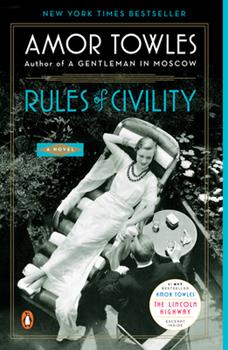
The Rules of Civility, by Amor Towles

We first meet Katey at an art exhibit in 1966. It’s a show of photographs by Walker Evans from 1938 — portraits of New Yorkers riding the subway, a mix of that city’s rich, poor, well dressed, haggard, harried, hurried. Katey is there with her husband, Val. We know she has done well for herself because an aspiring novelist is also at the opening with his agent. When the agent sees Katey, his eyes light up, and he motions for her to come over. She nods politely and starts walking—and she and Val go right out the door.

That little scene tells us much of what we ultimately get to know about Katey—driven to inevitable success, living her life on her own terms, with no patience for anybody trying to take advantage of her.

At the exhibit, she notices photographs of an old friend, Tinker, and shows them to Val. In one photograph, Tinker is well dressed, looking like the affluent young banker she knew. In another he’s in threadbare clothes, even a bit dirty, but most important, happy. Katey tells Val she knew Tinker but the two don’t talk very much about it. Val can sense that there is more to the story, but he knows his wife, and doesn’t push. He thinks the scruffy photograph came first, but Katey clarifies that Tinker’s looks changed for the worse as the year went by. 

The rest of the book goes back to 1938 and tells us that story. Towles evokes images of pre-war New York that feel like old black-and-white movies—the light, the sounds, the energy of that city. It’s an especially vivid portrait, as seen primarily through the eyes of  Katey, 24 at the time; her friend, Evie; and of course Tinker. Nobody is who we think they are. They may not even be who they think they are.

Even though Katey is the narrator, this is Tinker’s story. As Katey’s trajectory points toward success, Tinker’s takes a turn away from glamour and toward a more honest, connected life. Judging by the photographs, a happier life.

The novel takes place almost entirely in 1938 with these young vibrant New Yorkers drinking remarkable amounts of alcohol and having witty Spencer-Tracy- Katharine-Hepburn-type conversations as they wander to speakeasies, bars, and fancy homes. We learn the least about Katey. As the narrator, she can tell us as much or as little as she wants. We get a sense of who she is professionally, but not a clear understanding of her personal background.  

The novel is a delight to read, even though at times you might challenge some of its assumptions. The images and the characters, including New York itself, will stay with you long after you finish the book.

To add authenticity, Towles uses photos from Evans’ exhibit throughout the book.

The book takes its title from George Washington’s Rules of Civility, 110 pieces of advice the future president wrote when he was 14. Tinker uses them to try to fit into a society to which he feels he does not belong. The last rule may say the most about his life choices as the year progresses:

Labour to keep alive in your Breast that Little Spark of Celestial fire Called Conscience.

— Pat Prijatel

The Great Believers, by Rebecca Makkai

“We were the great believers.
I have never cared for any men as much as for these who felt the first springs when I did, and saw death ahead, and were reprieved—and who now walk the long stormy summer.”
— F. Scott Fitzgerald, “My Generation”

Rebecca Makkai’s great believers are those who faced the trauma of the AIDS epidemic in Chicago in the mid-1980s, part of a lost generation of men who were the first to be affected by the deadly disease that decimated the gay community. With gentle honesty, she shows us these men — their lives, and their dreams of love, a family, a home of their own. They faced the cruelty and stigmatism of a mysterious disease that brought loss after loss of loved ones, with no hope of a cure.

The main character, Yale, has a rewarding career as an art curator, but his life is thrown into chaos after a brief encounter with a young man and a major betrayal by his partner. Then he meets Nora, an elderly woman who was part of the art world in Paris in the 1920s, who offers a valuable trove of original art that could make Yale a major player in the 1980s art world.  

If he can pull it off.

If he survives to pull it off.

A second story line follows Nora’s great niece Fiona into middle age and is a conduit for the stories of another lost generation, the survivors of World War I. Fiona is also the sister of the first man to die of AIDS in the novel and is the figurative little sister of his entire group of friends. In Paris, she reconnects with other survivors of that Chicago group while she searchers for evidence of Nora’s history as a muse, model, and artist. She uncovers the stories of the men who died in the war, or who survived mentally and physically damaged. She’s also there searching for her daughter, who had joined a cult, but escaped and then disappeared.

That’s a lot of stories for a reader to digest.

Makkai says her initial goal was to write a book about Nora looking back at her own history, but the 1980s section took on a life of its own. Ultimately the AIDS story line became the book’s primary focus, but Makkai didn’t want to give up on Nora. The result, though, is a novel that goes in so many directions with so many characters the reader sometimes loses the narrative.

Still, Makkai did remarkable research and her writing is so strong we feel the 1980’s characters’ trauma, appreciating the horror they faced in a way we might not have done in real time. Makkai gives AIDS a staggering humanity.

She says the book is in many ways a war novel. As one character in 1980s Chicago notes, “This is a war, it is. It’s like you’ve been in the trenches for seven years. And no one’s gonna understand that. No one’s gonna give you a Purple Heart.”

— Pat Prijatel