Born A Crime: Stories from a South African Childhood, by Trevor Noah

When a book begins with a nine-year-old getting pushed out of a moving bus by his mother and ends up twenty years later with him hosting The Daily Show, you want to see what mysteries unfold in the middle. 

Trevor Noah’s mother, who he calls a “force of nature,” is the one who shoved him out of the speeding minibus, jumping out with him—to protect both of them from a driver who showed serious intent to harm them both. And so begins the book about a young man who took after the mother he adored, refusing the rules intended to keep her, and him, in their proper places—whatever that was in South Africa’s system of apartheid that separated people by race to a degree that few understood. Chinese were colored, but Japanese were not, and Trevor, who had a white father and a Black mother, wasn’t considered colored, but mixed, an entirely different category, with different rules. Their union was illegal, so he literally was born a crime.

Obviously a bright child, Trevor learned to master the many languages and accents of his complex and diverse neighborhoods, including English, Zulu, German, Afrikaans, and Sotho, which gave him an advantage when getting mugged, cheated, criticized, conned, or when just wanting to communicate with somebody different. 

Language, he writes, is part of a shared identity and “even more than color, defines who you are to people.” Language can unify and divide us, he says. This makes the story of his high school matric dance (prom) even more ironic. He wooed a girl for a month, considering her the most beautiful girl he had ever seen. When she agreed to go to prom with him, he spent a fortune getting the right outfit and planning the perfect night. He was late picking her up, then got lost, and they were two hours late to the dance. Once there, she refused to get out of the car, and he had no idea why. It turned out she was terrified of the whole chaotic situation, something she could not communicate because she did not speak English and her language, Pedi, was one of the few he couldn’t speak, a fact that somehow eluded him in his ill-fated courtship.

Much of the book is about how he tried to find his place as a light-skinned Black man, finally turning to comedy to try to make some sense of it. He was such a misfit, in fact, that at one point neighbors used him as a guidepost when giving directions: “The house on Makhalima Street. At the corner you’ll see a light-skinned boy. Take a right there.”

Noah’s mother, Patricia, had no interest in remaining a subjugated woman and living her life defined by White culture and Black men. She chose to have a child with a man of German-Swiss descent, with no plans of ever marrying him; she trained as a typist at a time when women were supposed to stay at home; and she moved into neighborhoods that were alternately dangerous or above her “station,” all to avoid staying in a small village or a small life.

Patricia was Trevor’s guiding light, foil to his escapades, greatest love and greatest challenge. His biological father remained in his life, even though that was not part of the original agreement and offered a touch of support from a distance. His stepfather Abel provided a model of the kind of man he did not want to be.

For her part, Patricia saw Jesus as her guide, and she and Trevor spent most of each Sunday going to three different churches—White church, Black church, and colored church, providing a framework for her faith, but demonstrating the divisive society in which they lived.

Trevor countered constant bullying with humor, which became his defense and led to a high- paying career. As a teenager, he was eating caterpillars to keep from starving, which he describes in appalling detail, while living in a garage or sleeping in cars every night and wearing clothes too big for him so they didn’t have to replaced so often. Now, at the age of 36 he is making $8 million a year.

The book is essentially an interwoven series of monologues that are harrowing, insightful, terrifying, sad, and, because of the telling, often funny. But there is nothing funny about the system of apartheid under which Trevor was born and the racism and classism in which he lived. Perhaps there will be a sequel to this, explaining how he ended up where he now is. Better yet, maybe his remarkable mother will write a book.

Joe Kucera and Pat Prijatel

Virgil Wander, Leif Enger

This quiet, gentle story is remarkable for the artistry of it words, the realistically oddball characters, and its touch of Northwoods magic realism. The main character, Virgil Wander, almost drowns when his car slides off the road and into Lake Superior. The accident damages his brain and, as a result, he quietly and gradually reinvents himself, leaving behind his hesitant, staid self—the “former occupant” of his apartment, clothes, and life. In his place is a man willing to take a few risks.

Comparing his flight into the lake with his new life, he says:

“A person never knows what is next—I don’t anyway. The surface of everything is thinner than we know. A person can fall right through, without any warning at all.” 

Virgil owns a down-on-its-luck movie theatre, the Empress, and is also Greenstone’s city clerk. (When he explains this latter job, he addresses the reader directly asking, “Did you think I made a living at the Empress?” It’s a delightfully engaging moment.)

After his plunge into the lake, Virgil has a unique mental quirk: He cannot remember adjectives. But no matter, Enger demonstrates the power of all parts of speech, in quote-worthy paragraph after paragraph, as Virgil creates a new life from the leftovers of his old one. The language alone makes the book a wonder to read.

For example, when Virgil first meets the mystical Rune, he describes how the old man smoked his pipe: “The smoke ghosted straight up and hung there undecided.” Who needs fancy adjectives when you can create an image so economically and so powerfully?

And when Virgil finds the ominous Adam Leer burning clothes behind his house, he again evokes the smoke-in-need-of-direction image, this time using an adjective in a way that makes the reader wonder why other writers haven’t used this description: “Tendrils of tea-colored smoke uncurled to explore the immediate region.”

Some lines are laugh-out-loud funny, as when Virgil observes, “The evidence of my life lay before me, and I was unconvinced.” 

Virgil, who narrates the book, introduces us to his community in the bad luck town of Greenstone, Minnesota, north of Duluth. Residents have landed there by chance, as Virgil did, lured by a lake view and cheap real estate; others were born there, as was the mysterious and sinister Leer; and then there’s the elfin Rune, who shows up on the shore of Lake Superior flying kites. 

But these are no ordinary kites—they’re so mystical that people passing by stop and wait their turns to fly the giant dog, or the bike with wheels that turn, a burning fireplace, or even an anvil. Rune is in town looking for stories of his son Alec, whom he never met, and who flew out over Lake Superior one day in a tiny old plane, never to return. Nadine, Alec’s widow, takes over his neon sign business, creating pieces of art she sells nationally; Virgil loves her from afar, assuming he has no chance with her, until he does. When the two finally connect, he observes, “She kept looking away then back to me, as though at a nice surprise. This was maybe best of all. I never once expected to be someone’s nice surprise.” 

Two fatherless boys, Bjorn and Galen, help pull Virgil toward himself and away from the previous tenant, aided by Ann and Jerry, married but not really, who are trying to move beyond the margins of their lives.  Then there’s a giant sturgeon, a bomb, a festival called Hard Luck Days, and a cameo by Bob Dylan, who wrote a song about Greenstone, but Virgil can’t remember which one. And a priceless set of old movie reels Virgil refers to as imps in a jar, and which get the Empress a new roof.

Like the kites, the characters’ lives move with slow precision and eventually reach a conclusion that ties the story lines and loose strings together. A few bits are left hanging (What actually did happen to Leer?) and some are tied up with a bit of sadness (Jerry’s luck gets harder, although he might have left the city better off).

Toward the end of the book, the community comes together for Virgil, who does not expect it, and he says, poignantly, “Your tribe is always bigger than you think.” 

At the very end, in Rune’s city of Tromsø, Norway, Nadine and Virgil face an unknown future, but with a fresh outlook that mirrors the theme of the book: “We all dream of finding but what’s wrong with looking? When the sun rises we’ll know what to do.”

—Pat Prijatel 

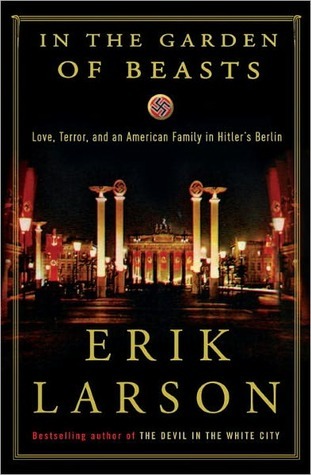
In The Garden of Beasts:Love, Terror, and an American Family in Hitler’s Berlin, by Erik Larson

This solidly researched account of Germany and the U.S. before World War II reads like a novel full of intigue, love affairs, disloyalty, honor, dishonor, evil, and power. Erik Larson tells the story from the unique perspective of the American ambassador from 1933-1938, William Dodd, and his family. Dodd was a scholar who was looking for an ambassadorship simply because he wanted to finish his three-volume book on the Old South. He ended up in Berlin because nobody else wanted the job—a fact he didnt realize until he was committed to the position.

Dodd was a Jeffersonian Democrat who chose to live on a budget and walk to work instead of being chauffered about in a giant gas guzzler, as was the custom of ambassadors. He remained a misfit during his entire time in Germany because he was not one of the wealthy elites who normally fill such posts. Initially, he argued away the threat of Hitler and the Nazi party, but ultimately he tried to warn the Roosevelt administration of the reality of Hitler’s danger to Germany and to the world. He was deemed an alarmist by his “colleagues” in Washington, and his warnings were dismissed as the work of an academic unqualified for diplomatic work.

Larson demonstrates how America and the German people might have stopped the pure evil that descended on Germany, but they chose to leave it to others, thinking it would get better on its own. Worse, many Americans at the time excused Hitler’s most despicable acts, reasoning that Jews caused their own problems.

Larson researched hundreds of books, artices, and newsreels, but relied heavily on Dodd’s papers and on his and his daughter’s autobiographies. The daughter, Martha Dodd, was a notorious partier who had affairs with Germans, Russians, and anybody in between. She was blindsided by Nazi charm, until their crimes became too obvious for her to ignore. Her story is a juicy counterpoint to her father’s more staid approach.

Larson shows the complexities of the era, creating in Dodd a character who has the guts to publicly decry Nazi policy, but who remains somewhat naive about the political web he’s caught in.  Likewise, Larson makes clear that, while many Germans remained complacent and complicit in Hitler’s evil, some even within the Nazi hierarchy tried to work against Hitler.

After Dodd was replaced as Ambassador, he toured the country, warning Americans of the true evil of Hitler’s regime. Even then, he was often seen as exaggerating.

Pat Prijatel