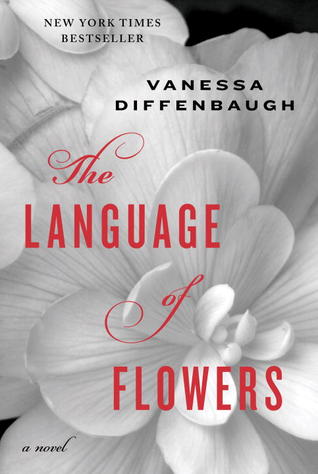
The Language of Flowers, by Vanessa Diffenbaugh

In an author interview at the end of The Language of Flowers, Vanessa Diffenbaugh says of her inspiration for the novel, “I’d been a foster parent for many years, and I felt it was an experience that had not been described well or often…. With Victoria, I wanted to create a character that people could connect with on an emotional level—at her best and at her worst—which I hoped would give readers a deeper understanding of the challenges of growing up in foster care.” As someone who worked for seven years with kids in foster care, some of whom aged out like Victoria, and as someone who was briefly a foster parent, I think Diffenbaugh does a terrific job.
We meet Victoria on her way to her “last chance” placement with Elizabeth. “I pressed my forehead against the window and watched the dusty summer hills roll past. Meredith’s car smelled like cigarette smoke, and there was mold on the strap of the seat belt from something some other child had been allowed to eat. I was nine years old. I sat in the backseat of the car in my nightgown, my cropped hair a tangled mess. It was not the way Meredith had wanted it. She’d purchased a dress for the occasion, a flowing, pale blue shift with embroidery and lace. But I had refused to wear it.”
Diffenbaugh’s language as she tells Victoria’s story is full of this kind of rich sensory detail that puts the reader in the backseat with Victoria when she shows us the mold on the strap of the seat belt. And that one tiny, dirty, carefully observed detail suggests larger truths about the foster care system. For that trip to her “last chance” Victoria is still in her nightgown. Because we all feel vulnerable in our nightgowns, we take Victoria’s vulnerability into our own sensibilities.
Victoria is a very specific girl; she’s not a type, and that’s where the charm and intelligence of the story lies. She is memorable. She speaks the language of flowers. She burns down the vineyard and lies to the judge. Against all odds, she becomes a successful business person with her language of flowers. She lives in weird places. The scene where she wraps her baby in moss to give to Grant is such a wonderful, fresh, memorable scene. As is her almost Homeric battle with Hazel to get nursing routine under control. I will never forget Victoria, just as will never forget Dellarobbia in Flight Behavior. 
Yet Diffenbaugh also achieves her goals of giving readers an understanding, generally, of the hardship of growing up in foster care. Victoria’s anger (which is really a mask for terror), her ravenous hunger (a sign of her emotional emptiness), her inability to learn in a normal school setting are normal behaviors of foster kids. The kids are usually terrified, emotionally drained, and unable to concentrate. Victoria makes these generalities specific in the most compelling way. 
We say goodbye to Victoria when she’s a mother and a small business owner and on the cusp of beginning a new and hopeful life with Grant, Hazel, and Elizabeth. And the journey from hello to goodbye is steered by the language of flowers. Victoria finds that language clear and unambiguous—Hazel means reconciliation; moss means maternal love; purple hyacinth means please forgive me. And where there is ambiguity, Victoria sorts it out, nails it down, and records it on two cards. One for her; one for Grant. The language of flowers, which Elizabeth introduces her to, connects Victoria to Elizabeth, Grant, Hazel, and her customers. And that’s where her hope lies at the end of the story. —Sharelle Moranville

Everything I Never Told You by Celeste Ng

Everything I Never Told You is the story of a Chinese-American family and how they try so hard to do well and do good. But first one thing goes wrong and then another and then another, and to protect themselves and each other, they amass secrets that can’t be sustained.

Lovely Lydia, with her silky black Asian hair and her beautiful blue Caucasian eyes is the heart of the story. And we know from the first sentence that Lydia is dead.

Lydia is dead because her grandmother was left without a man in a time and place where a woman was supposed to be a home ec teacher (or nurse or secretary) and have a man. Lydia is dead because her dad is Asian and feels like a misfit in 1977’s Ohio. Lydia is dead because her mother, rebelling against her mother, disappears from the family, leaving them in mortal terror for months.

Lydia is dead because, like most young children, she assumes she is the cause of the family’s misery. She has surely been bad, or at least lacking, and driven their mother away. And so she makes a deal: if her mom comes home, she (Lydia) will be perfect. She will say yes to everything asked of her.

When her mother returns, Lydia accepts the burden of being the perfect child to save the family. Her loving siblings (and the characters in this story really do love each other) know she is faking so many things, but don’t dare tell because they too feel Lydia is the glue that holds the family together with her Chinese hair and American eyes.

Near the end of the story, when too many pressures are building on Lydia (when she is failing not only physics but drivers ed, and she is terrified of her brother Nath’s going away to college), she is forced into an epiphany:

[S]he had been afraid so long, she had forgotten what it was like not to be – afraid that one day, her mother would disappear again, that her father would crumble, that their whole family would collapse once more. . . . Anything her mother wanted, she had promised. As long as she would stay. She had been so afraid.

She connects this fear with the time in childhood she almost drowned and her brother saved her.

His fingers caught hers and right then she had stopped being afraid.

Kick your legs. I’ve got you. Kick.

It had been the same ever since. Don’t let me sink, she had thought as she reached for his hand, and he had promised to not when he took it. This moment, Lydia thought. This is where it all went wrong.

It was not too late. There on the dock, Lydia made a new set of promises, this time to herself. She will begin again. She will tell her mother: enough. She will take down the posters and put away the books. If she fails physics, if she never becomes a doctor, it will be all right. . . . And Nath. She will tell him that it’s all right for him to leave. That she will be fine. . . . And as she made this last promise, Lydia understood what to do. How to start everything over again, from the beginning . . . What she must do to seal her promises . . . Gently she lowered herself into the rowboat and loosed the rope.

The ending is painful but truthful. Families are nurturing; families are damaging. And not everyone survives the damage.

But the ending is also hopeful. The family slowly, gently rebuilds itself without the keystone of Lydia. Years later, when Nath is in space he stares down at the silent blue marble of the earth and thinks of his sister, as he will at every important moment of his life. He doesn’t know this yet, but he senses it deep down at his core. So much will happen, he thinks, that I would want to tell you.

Ng writes with a distinctive technique of exaggerating characters and events – pushing out curves farther than they naturally go, chipping usually smooth edges, and sharpening points almost to invisibility.

For example: James, a slightly-built Chinese man, teaches a college course on the American cowboy. Marilyn, his student, kisses him on the first day of class and beds him not long after. Later, she abandons her family without a word. Lydia has chatty phone conversations with non-existent friends. Loving, insightful little Hanna is so inconsequential they sometimes forget to set a place for her at the dinner table.

These are extreme, stylized images. Like burrs that cling, they won’t be forgotten anytime soon. Ng walks a fine balance with this technique. The distortions have to be strong to claim a lasting hold in the reader’s mind, yet believable enough to be realistic. Otherwise, the reader won’t identify with the characters or care what happens to them.

The book’s cover anticipates this stylized realism. The title, Everything I Never Told You, is handwritten – seemingly with a dried-out brush dipped in ink, or with an iffy-nibbed pen. The writing suggests the person holding the brush or pen is determined to finally tell the true story, as ragged and uneven and tender and unique as it necessarily is. And that we’ll probably remember it.

—Sharelle Moranville

Prodigal Summer, by Barbara Kingsolver

“Prodigal” is from the Latin prodigus – meaning “lavish.” Barbara Kingsolver’s novel Prodigal Summer is a lavish story. The characters, in their slightly over-the-top ways, are lavish. Even the cover design is lavish.

The novel cycles through three stories, all set in fictional Zebulon County, near the border of North Carolina and Tennessee. There’s the story of Deanna Wolfe and Eddie Bondo and their passion for each other–their relationship stressed by her resolve to save the coyotes and his quest to kill them. There’s the story of Lusa and Cole Widener–their relationship strained by opposite views of how to husband the land. And there’s the story of Garnett Walker and Nannie Rawley–he a conservative curmudgeon who would like to deny feelings, she a happy and generous soul who welcomes change.

Each of the three stories has a distinct narrative voice. For fun, I randomly opened the book to sample each one.

From Deanna’s story: She went to bed with Eddie Bondo all over her mind and got up with a government-issue pistol tucked in her belt.

From Lusa’s story: . . . when she married Cole and moved her life into this house, the inhalations of Zebulon Mountain touched her face all morning, and finally she understood. She learned to tell time with her skin, as morning turned to afternoon and the mountain’s breath began to bear gently on the back of her neck. By early evening it was insistent as a lover’s sigh, sweetened by the damp woods, cooling her nape and shoulders whenever she paused her work in the kitchen to lift her sweat-damp curls off her neck.

From Garnett’s story: In a springtime as rainy as this one, snapping turtles strayed from their home ponds into wet ditches, looking for new places to find their hideous mates and breed their hideous children. Of course there would be one waiting for him in that weedy ditch under all those briars – that swamp that had been created by Nannie Rawley – and if he happened to have a turtle on his foot now, it was entirely her fault.

Kingsolver creates discrete syntax, vocabulary, and tone for each of the three narrators so that their voices reveal their characters: Deanna’s voice is terse, literal, and solitary. Lusa’s emotional, romantic, and sensual. Garnett’s pessimistic and lonely.

The couples are contradictions, which Kingsolver connects with and instead of the customary but. Deanna wants to live alone with nature, and she’s sexually drawn to a coyote hunter. Lusa wants to cherish and preserve nature, and she’s sexually drawn to a conventional tobacco farmer. Garnett wants to be dismissive of all Nannie’s hippie ways, and he wants to slay her scarecrow to protect her.

The characters of Prodigal Summer will stay in my mind for a long time because they are lavishly made and lavishly thrown together. I find myself wondering how Deanna’s baby is being loved in Nannie’s patch of paradise, if Garnett has loosened up a little, where Lusa will get her next bright idea for making the Weidener farm profitable.

The last narrator in the novel is a coyote, meditating on the foolishness of people. Solitude is a human presumption. Every step is thunder to beetle life underfoot, a tug of impalpable thread on the web pulling mate to mate and predator to prey, a beginning or an end. Every choice is a world made new for the chosen.

—Sharelle Moranville