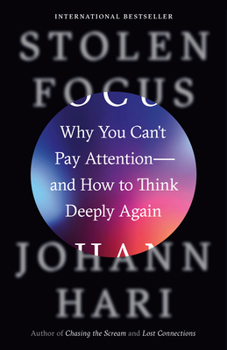
Stolen Focus: Why You Can’t Pay Attention — and How to Think Deeply Again, by Johann Hari

In Stolen Focus, Johann Hari argues that elements of our existing culture are eroding our ability to concentrate and stealing our ability to truly enjoy life. Hari makes clear that this is not a self help book with an easy recipe for personal improvement. To be sure, there are practices that we all can take up to battle this assault on our focus. However, much of the challenges we face are societal and need a society-wide movement to address them.

Hari explores his own recognition that his focus was being stolen. In an attempt to reclaim it, Hari took a personal months long screen-free technology detox in Provincetown. While somewhat successful in helping Hari reclaim the ability to read books, creatively write, daydream, and sleep again, the effects did not last long past the end of the detox. Hari also recognizes that such an exorcise is not feasible for most of us, and it does not address the root causes of our focus being stolen.

From processed food to environmental pollutants to a lack of unsupervised play, Hari takes us on a tour of factors impacting our attention. In particular, Hari takes a long look at how social media actively uses subconscious techniques to covertly keep us engaged online. Such online engagement is used to feed the profits of the existing “surveillance capitalism” business model. Silicon Valley designers use various tools such as building virtual “voodoo doll” models of individuals to predict our future behavior. Likewise, they use “negativity bias” to keep us engaged by feeding us increasingly negative or fringy content. However, many of these Silicon Valley designers have come to regret their long term impact on society.

“One day, James Williams–the former Google strategist I met–addressed an audience of hundreds of leading tech designers and asked them a simple question: “How many of you want to live in the world you are designing?” There was a silence in the room. People looked around them. Nobody put up their hand.”

But, if this is not the world we want to live in, then what can we do about it? One of the interesting concepts discussed in the book is “cruel optimism.” In our society, we have a tendency to lean on rugged individualism to face problems. While such self-reliance may be admirable in some circumstances, it can be “cruel” when faced with challenges that have deeply rooted societal causes.  Such deeply rooted societal causes often go beyond the ability for us to address on an individual-by-individual basis. With our focus, it is tempting to believe that we are completely in control of our own fate, but Hari argues that there are tremendous societal forces acting against us that need society wide solutions.

— Jim Lynch

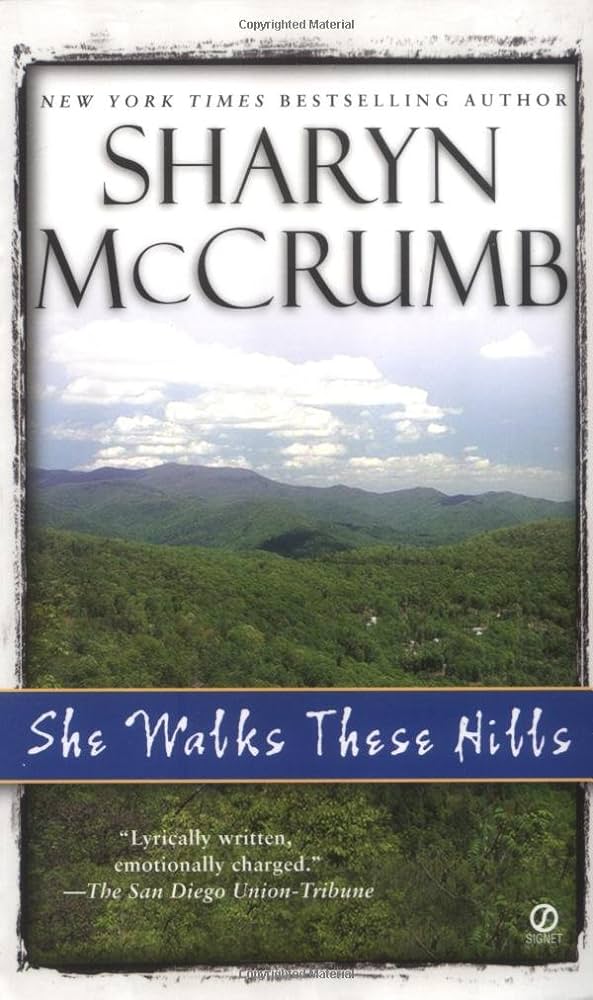
She Walks These Hills, by Sharyn McCrumb

Katie Wyler began her trek through the Appalachian Mountains in 1779, escaping from the Shawnee warriors who had abducted her and killed most of her family. Now, nearly 250 years later, she’s still wandering, showing herself mainly to Nora Bonesteel, the wise woman who lives at the top of the mountain and has second sight. Katie‘s trek creates the backdrop of this book, which is about journeys of love, life, nature, justice, and retribution.

Hiram Sorley, given the unfortunate nickname Harm, has just escaped from prison, where he was serving a life sentence for a murder he does not remember. He has Karsakov syndrome, a memory disorder that is caused by alcohol poisoning, no doubt from the moonshine he consumed in his mountain home. Harm has no fear of being caught because doesn’t realize he’s an escapee. He thinks he has been out hunting or logging, and is eagerly returning home to his beloved wife, Rita, and their daughter Charlotte. 

One thing Harm is sure is that the Lord will take care of him, and the Lord oddly does provide Dinty Moore stew, a can opener, peanut butter, and even a backpack to carry it all in. In less biblical reality, these are all courtesy of Jeremy Cobb, who is also walking the hills tracing Katie steps as part of his doctoral work. He’s a better philosopher than hiker and is not so good at paying attention to regional experts, so he heads out with a pack far heavier than he can carry. To lighten his load, bit by bit he throws things along the path. Harm, following behind him, picks them up.

Jeremy doth provideth.

Author Sharyn McCrumb weaves together multiple stories of love—real, flawed, life-affirming, and dangerous—through the centuries. There’s Katie returning to a disastrous reunion with her fiancé Rab. Harm reuniting heroically and tragically with Rita and Charlotte. Deputies Martha and Joe, struggling with Martha’s new job and Joe’s PTSD from the Vietnam war. Sad Chrystal$ is looking for a warm body. Poor Sabrina, ensnarled in a miserable relationship and looking for a way out, responds to violence with violence.

Rita is living life enclosed in plastic with her second husband, the perfectly named Euell. Charlotte, now in graduate school, is becoming an expert on the geology of the Appalachians, which impresses her mother not at all, but gives McCrumb a vehicle for showing the richness of the land, even though Charlotte naively ignores its significance to the humans living on it.  

Toward the end, Nora puts much of this into perspective, telling Jeremy that Sabrina is a modern embodiment of Katie. Despite centuries of folklore, Katie is not the beautiful, clear-skinned woman we might envision, but was poor, underfed, with stringy hair and sallow skin.

As with all of McCrumb novels, the mountains are a significant character. And their degradation, through environmental abuse and development, is a key plot driver. Nothing grows on Harm’s land, 30 years after toxic chemicals were callously dumped onto it.

This is the third of McCrumb’s 13 ballad novels. It was published in 1994, but it has lost little relevance.  BBB has read two others in the series: The Hangman’s Beautiful Daughter, and The Songcatcher.

— Pat Prijatel

Can We Talk About Israel? by Daniel Sokatch

Can We Talk About Israel?: A Guide for the Curious, Confused, and Conflicted was written by Daniel Sokatch, an American Jewish activist and CEO of the New Israel Fund since 2009. His aim with this book, as he states in the first chapter, is to break down the conflict between Israel and Palestine into a thorough but understandable narrative so that the average uninvolved (but interested) person can understand it enough to participate in discussion to some degree.  

Based on the fact that our group had several interesting discussions about it, I think he achieved that goal.  

The first half of the book starts at the very beginning – God telling Abraham of Canaan – and steps through the full history of the conflict, highlighting the major incidents, competing interests and philosophies, milestone events, and most notable leaders on both sides to the present day. Though it was definitely engaging, this part was so full of facts that it was hard to stay focused and keep the details straight. Overall, it left us with a better understanding of the motivations and emotions behind both sides.  

The second half went into greater detail about the “current” state of the conflict, such as it was in 2021 when the book was published. Sokatch stated that he endeavored to present it in a balanced way, and we felt that he achieved this also (or as our Bill Smith said, as even-handed a resource as we’re likely to find). We learned about the carved-up and walled-off map of the territory, the political climate and living conditions of the major hubs, the bond between America and Israel, the creeping Israeli Settlements, the debates around apartheid and BDS (Boycott, Divestment and Sanctions against Israel), what constitutes antisemitism versus fair criticism of Israel, and so much more. None of it told us how to feel, which is not a comfortable place for Americans who are used to being able to claim one position or another for every issue.  

Much has happened since the book was published, most notably the attack on Israel by Hamas on October 7th, 2023, which is still a full-scale conflict at this moment. Sokatch continues to weigh in on the subject on the website for The New Israel Fund, an organization which was established in 1979 and “designed to expand the work that the United Jewish Appeal was then doing … to protect Israel’s strength by protecting democracy, human rights, justice, and equality for all Israelis – Jews and Arabs” (from jewishvirtuallibrary.org). His latest post can be found here: https://www.nif.org/blog/finding-light-in-the-darkness/. In it, he makes a statement that I find to be somewhat more hopeful than the last chapter of the book, which was titled “The Case for Hope.”  

President Biden has offered us a light in this darkness. But there is another light, one that shines today in the darkness in Israel: Activists in Israeli civil society—regular Israelis, Arab and Jews, seeking a better, shared future—are leading the way towards a different path—especially grantees like Standing Together, Combatants for Peace, Bereaved Parents—Families Forum, Breaking the Silence, and Yesh Din—who either are co-led by Arabs and Jews or have worked hand in hand with Palestinians for years.  

They know that Israelis share the responsibility for envisioning a horizon where tomorrow is better than today—for everyone. 

On December 20, 2023, my daughter came home from college on Christmas break and we didn’t get through one full day before the issue of Israel/Palestine came up at the dinner table. I was glad to be able to understand her fervent opinion and offer thoughts of my own, which I would not have been comfortable doing if not for this book. I would definitely recommend it to anyone who is interested in learning more. 

— Julie Feirer