Sea of Glory, by Nathaniel Philbrick

Exploration! Adventure! See the world! The U.S. Exploring Expedition of 1838-1842 offered all that. With a task force of six sailing ships and 346 men, the Expedition discovered Antarctica, mapped much of the South Pacific and the Pacific Northwest, and circled the globe. It returned with materials that formed the basis of the collections of the Smithsonian Institution and the U.S. Botanic Garden, and sparked the formation of the U.S. Hydrographic Office and the Naval Observatory. 

Why is this Expedition not ranked alongside Lewis and Clark in our history?  Nathaniel Philbrick, noted for histories of Washington, Custer, and the whaling ship Essex, takes on that question through a review of the journals and correspondence of the principal officers of the Expedition and other historical records. 

Those records revealed a corking tale of the inner turmoil of the commander of the Expedition, Charles Wilkes, and the resulting tension among the officers and crew.  Throughout the voyage, Philbrick traces the deteriorating relations between Wilkes and his officers, particularly William Reynolds, who started as an admirer of Wilkes and by 1842 was his adamant opponent. Wilkes was at once supremely self-confident and supremely insecure. This internal tension (Philbrick quotes Thoreau’s description of “the private sea”) was reflected in inconsistent and ineffective leadership of the Expedition’s officers and crew, unwarranted transfers, unnecessary and brutal floggings. 

Our group’s discussions kept coming back to Wilkes’s tragic character flaws. Was it arrogance and self-conceit? Yes, but the accomplishments of the Expedition deserved high regard. Would Wilkes have been better balanced and more tolerant if he had been given the recognition he thought was deserved? Melville is quoted: “All mortal greatness is but disease.” Could another commander have managed the personnel better? Maybe, but no senior officer of the Navy wanted to take this command. And maybe a more collaborative commander would not have achieved as much as Wilkes did. The title “Sea of Glory” comes from Shakespeare’s Henry VIII as Cardinal Wolsey laments his loss of office: “I have ventured . . . this many summers in a sea of glory, but far beyond my depth.” These are universal questions, but they are magnified by small ships, large oceans, and four years at sea. 

Ah, but the adventure. The Expedition brought together threads of scientific investigation, the commercial needs of traders and whalers, and the U.S. diplomatic expansion of the Jackson and Van Buren era. It visited Antarctica twice, once from the tip of South America, and a year later from Australia. The seamanship needed to take sailing vessels through the fog and ice of the high southern latitudes was a real adventure, which Philbrick tells skillfully. Between and after the Antarctic visits, the Expedition surveyed hundreds of Pacific Islands, had a hostile encounter with Fijians, climbed through the climate changes of Mauna Loa in Hawaii to make pendulum observations which would increase scientific understanding of the earth’s gravity, shape, and density. After completing that task, the Expedition moved to the Pacific Northwest, surveyed the coast from California to Vancouver Island and the Puget Sound, and entered the mouth of the Columbia River, traversing some of the most dangerous waters in the United States. 

The Expedition returned to the United States in 1842 to a Tyler administration whose interests had shifted to westward expansion, the annexation of Texas, and conflict with Mexico. In the naval culture of that time, after-action disputes were taken to courts martial. Wilkes, Reynolds, and three others were given suspensions and reprimands that gave no sense of vindication for anyone, and undercut the public image of the Expedition. Over the next few years, its scientific output gained greater appreciation as books, memoirs, and findings were written. But the public had moved on to other interests and the Expedition missed the moment of accolade that Wilkes and his crew had expected. But what an adventure they had.

— Bill Smith

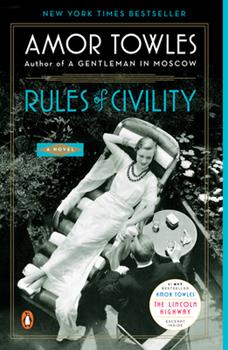
The Rules of Civility, by Amor Towles

We first meet Katey at an art exhibit in 1966. It’s a show of photographs by Walker Evans from 1938 — portraits of New Yorkers riding the subway, a mix of that city’s rich, poor, well dressed, haggard, harried, hurried. Katey is there with her husband, Val. We know she has done well for herself because an aspiring novelist is also at the opening with his agent. When the agent sees Katey, his eyes light up, and he motions for her to come over. She nods politely and starts walking—and she and Val go right out the door.

That little scene tells us much of what we ultimately get to know about Katey—driven to inevitable success, living her life on her own terms, with no patience for anybody trying to take advantage of her.

At the exhibit, she notices photographs of an old friend, Tinker, and shows them to Val. In one photograph, Tinker is well dressed, looking like the affluent young banker she knew. In another he’s in threadbare clothes, even a bit dirty, but most important, happy. Katey tells Val she knew Tinker but the two don’t talk very much about it. Val can sense that there is more to the story, but he knows his wife, and doesn’t push. He thinks the scruffy photograph came first, but Katey clarifies that Tinker’s looks changed for the worse as the year went by. 

The rest of the book goes back to 1938 and tells us that story. Towles evokes images of pre-war New York that feel like old black-and-white movies—the light, the sounds, the energy of that city. It’s an especially vivid portrait, as seen primarily through the eyes of  Katey, 24 at the time; her friend, Evie; and of course Tinker. Nobody is who we think they are. They may not even be who they think they are.

Even though Katey is the narrator, this is Tinker’s story. As Katey’s trajectory points toward success, Tinker’s takes a turn away from glamour and toward a more honest, connected life. Judging by the photographs, a happier life.

The novel takes place almost entirely in 1938 with these young vibrant New Yorkers drinking remarkable amounts of alcohol and having witty Spencer-Tracy- Katharine-Hepburn-type conversations as they wander to speakeasies, bars, and fancy homes. We learn the least about Katey. As the narrator, she can tell us as much or as little as she wants. We get a sense of who she is professionally, but not a clear understanding of her personal background.  

The novel is a delight to read, even though at times you might challenge some of its assumptions. The images and the characters, including New York itself, will stay with you long after you finish the book.

To add authenticity, Towles uses photos from Evans’ exhibit throughout the book.

The book takes its title from George Washington’s Rules of Civility, 110 pieces of advice the future president wrote when he was 14. Tinker uses them to try to fit into a society to which he feels he does not belong. The last rule may say the most about his life choices as the year progresses:

Labour to keep alive in your Breast that Little Spark of Celestial fire Called Conscience.

— Pat Prijatel

Prague Winter, by Madeleine Albright

Full Title: Prague Winter, A Personal Story of Remembrance and War, 1937-1948

We found Prague Winter engaging on many levels. Albright tells personal and family stories that play out across the mid-20th Century history of Central Europe, with a focus on the ethical choices that confronted her family, their friends, professional colleagues, and national leaders during this tumultuous time. Prague Winter is not a conventional history book, but it explains a large sweep of history in these personal contexts.

The family story is an absorbing one of her parents’ slow motion courtship in the Czechoslovakia of the 1930s, her father’s development as a professional diplomat, and the family’s relocation to Belgrade, London, back to Prague, and eventually to the United States. (Albright’s own professional story as a diplomat and Secretary of State is told in other books).

The European history is anchored in the familiar elements of World War 2 and the Communist takeover of Central/Eastern Europe. But Albright’s telling of her family’s story gives us a highly personal and accessible view of the historic events. She explains the emergence of Czechoslovakia, its sacrifice on the altar of world peace at Munich, its suffering during World War 2, its brief democratic resurgence, and the bungling that took it into the Communist fold in 1948. 

Albright lets us see the personalities of Masaryk, Beneš, and other key players in the story, and many people who weren’t in positions to drive history but nevertheless had to navigate it. This is Albright’s real theme in this book: the painful personal and ethical choices people had to make throughout this period. What did Nazi occupation look like from Prague? From the concentration camp? And from exile in London? How did people weigh international peace with national integrity? How do people take political positions that risk the welfare of family and friends? These are questions with no easy answers, and often with no good answers. But they provide great discussion, and that’s what we enjoyed so much about this book.

— Bill Smith