Bury Your Dead, by Louise Penny

Good writers build a strong story arc that sustains their novel. Better writers manage double arcs. It takes a Louise Penny to create three separate story lines, braiding them together seamlessly around a complex theme.

Bury Your Dead is a mystery masterpiece in which Penny shows confidence in her craft and in her reader. We’ll be deep in one storyline when she abruptly, with little or no transition, drops us into another a second story, then a third. We follow because we’re living the stories with her. We need no transition. We’re there.

The book includes one current and one past murder, plus a recent police raid that went horribly wrong, and from which both Chief Inspector Armand Gamache and his second-on-command, Inspector Jean-Guy Beauvoir are recovering. In all three storylines, the title comes into play as characters bury their dead in multiple ways, sometimes unsuccessfully.

The current case is the murder of a man who has been in search of the body of the explorer Samuel de Champlain. He thinks he has found Champlain in the basement of the Literary and Historical Society of Quebec. As Gamache is recovering at the home of his mentor in Quebec City, the Lit and His, as the society is nicknamed, has become one of Gamache’s favorite spots, and he is among the first on the scene when the murder is discovered. This plotline takes us into the history of Quebec and the centuries-long conflicts between the English and the French. Where is Champlain’s body? Nobody knows for sure, but Penny offers some suggestions. Under the Lit and His? You’ll have to read the book to find out. Here, the dead clearly include Champlain, but also the casualties of the Seven Years War of the mid 1700s between the French and English. Focusing on the ongoing conflict between the Quebecois and Quebeckers, Penny shows that those dead remain much among us in political tensions that still divide the people of Quebec.

The second story line is in Gamache’s head, as he relives the disastrous case that left him and Jean-Guy seriously wounded and killed several of Gamache’s agents, including Paul Morin, a young man with a talent on the violin and a gift of storytelling. Gamache maintains a 24-hour phone conversation with Morin while the entire Sûreté du Québec tries to find where the agent is being held. He has been kidnapped and attached to a bomb that will detonate in 24 hours—sooner, if the line goes quiet. Whoever planned this wants Gamache to stay at his desk. He doesn’t, of course. This is a seminal case in the series and influences several of the subsequent books. Yet the story is told only in flashbacks. On first reading, you think you missed a book somewhere, but no, this is the first mention of the case, told as Gamache mentally recreates it. Penny trusts us to get it, and we do. The burial of the agents who died under Gamache’s command was so traumatic that his grief-stricken face ended up on magazine covers.

The third story arc is perhaps the most tragic, ending the novel with a twist of family loss and revenge. It’s a continuation of the previous novel, A Brutal Telling, in which Olivier Brule, co-owner of the bistro in the mythical and magical Three Pines, was convicted of murder. Gamache begins rethinking the case and asks Jean-Guy, who is also on medical leave, to re-investigate. The resolution is the stuff of Greek tragedy, and leaves behind a devastated family. In this case, the dead aren’t who we think they are, nor are they buried where we think.

This is a heady book that gets better with multiple readings. It has Penny’s trademark charm and wit. One English character knows French well as a written language, but when she tries to speak it, she encourages people to become umlauts and calls the night a strawberry. Gamache wanders the streets of Old Quebec City in the quiet of the night, his steps crunching in the snow, with Henri, his beloved German Shepherd who is so full of love it doesn’t matter that he’s far from the world’s smartest dog. The Three Pines characters all make an appearance, and the ragged and rugged old poet, Ruth, builds a unique bond with Jean-Guy. It’s cold in Quebec, but these characters stay warm with one another, settled into comfy chairs in front of the bistro fire, watching through mullioned windows as the snow falls onto the three pines in the town center.

— Pat Prijatel

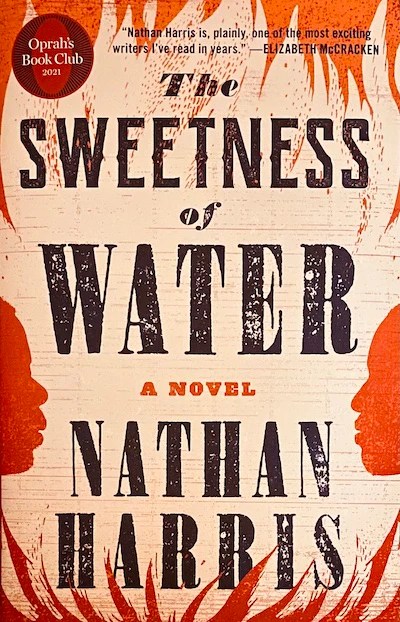
The Sweetness of Water, by Nathan Harris

In The Sweetness of Water new author Nathan Harris spins an incredibly complex tale of the post-Civil War South, and tells it in a humane and intimate way, by exploring the interpersonal relationships of all kinds in and around the rural Georgia town of Old Ox.

The story primarily revolves around Prentiss and Landry, two formerly enslaved black brothers, the white farmer George Walker who hires them, and his wife Isabella. It opens with landowner George  walking his fields and stumbling across Prentiss and his silent brother Landry who were camping in the woods. They had left the close-by Morton plantation after the announcement of the Emancipation – freeing of the slaves. They know that they’d rather be anywhere than back at the plantation, where the owner is in complete denial about Emancipation and still considers the brothers his rightful property.

Slightly disoriented and in some pain, George asks for their help getting back to his cabin and wife, and offers the brothers food and shelter in his barn. Later, George asks the brothers for help in restoring his farmland with a peanut crop. In return, he offers to pay them an honest wage. At first, Prentiss refuses. After having a brief taste of freedom, he’d rather not start toiling again for a white man. But after a bit of back and forth, each begin to realize that they can be useful to each other. The brothers agree to work to earn enough money to travel north to search for their mother who was sold when they were boys.

The Walkers, wracked by the apparent loss of their only son Caleb to the war, eventually discover that Caleb had deserted the Confederate Army and survived. He returns home, and although he is at first wary of the brothers, he soon begins to form a friendly rapport with them. Caleb is hoping to rebuild a relationship with his childhood friend August Webler, who served with Caleb and knows of his desertion.  Before the war, the two had a secret romantic/sexual relationship.

One day, Landry accidentally observes Caleb and August having sex in the woods. August sees Landry and kills him to keep the relationship secret. George and Prentiss find Landry’s body and call the local sheriff to investigate. The sheriff first refuses to investigate the death of a black man. When Caleb tells the sheriff that the killer was August, the son of Old Ox’s wealthiest resident Wade Webler, he becomes even more firm in his refusal, as he is obedient to the wealth and power of the Webler family.

Later, Wade arrives at the Walkers’ home and demands an apology for the allegations against August. Prentiss observes the scene and in a fury spits on Wade.  Then the sheriff arrests Prentiss. In the night, Caleb goes to the prison with a gun and frees Prentiss. George then accompanies Prentiss and Caleb northward through the woods, helping them flee Old Ox. Afterwards, the sheriff shoots George in the leg.

Emancipation or not, the agreement between George and the brothers represents a breach of centuries-old social arrangements in the community. And so, even though the Walkers’ business doesn’t directly affect any other person in Old Ox, every white person in proximity has an opinion on it, as though Landry and Prentiss’s mere existence is yet another affront and attack on their lives.

Meanwhile, the Walkers become pariahs in Old Ox. Some townspeople set fire to the Walkers’ farm. The fire spreads and badly damages the whole town. George is brought back to town and dies a few days later. All this unleashed convulsive repercussions on the entire community. However, in the aftermath of the turmoil, it is Isabelle who emerges as an unlikely leader, proffering a healing vision for the land and the newly freed blacks in Old Ox. She decides to divide up her farmland and rent it out at fair prices to people in need of such opportunities, regardless of race.  Isabelle eventually receives a letter from Caleb, stating that he and Prentiss made it safely to the north.

In conclusion, Harris’s characters are multi-faceted, absorbing and extraordinarily well-developed. They transport the reader into a difficult time of complex social problems, with situations that elevate with each turn of the page. The Sweetness of Water is a story in which black and white people find salvation together, bonding in the face of egregious extreme racism of others.

I would say that those characters of George, Landry, Prentiss, Caleb and particularly of Isabelle are meticulously drawn. The portrayals of Isabelle and George’s lengthy marriage and of Isabelle’s platonic relationship with Mildred are exceedingly well done. I was incredibly impressed with the way it probes themes of historical importance about race, sexuality, violence and grief – through carefully drawn characters and examination of their relationships. Ultimately, this is a book about how differences need to be set aside and replaced with empathy if our nation is to be healed of racial divides – something that is true for America now.

— Kenn Johnson

Saving Us: A Climate Scientist’s Case for Hope and Healing in a Divided World, by Katherine Hayhoe

Nine percent of Americans are dismissive of climate change—they don’t believe it is even happening. By contrast, 58 percent are either alarmed or concerned about the problem, according to the Yale Program on Climate Change Communication. In the middle, 17 percent are cautious—they haven’t made up their minds.

Yet, the Dismissives take up much of the air in climate change discussions, airing their disdain with assurance whenever and wherever they can.

What to do about these people? Don’t try to convince them—you’re asking for defeat if you do, says Katherine Hayhoe in Saving Us: A Climate Scientists’s Case for Hope and Healing in a Divided World. Focus instead on those who might listen—the other 91 percent, she says, and she packs a book full of ideas of how to speak of climate change, to whom, when, and how.

This is a book as much about communication as it is about climate. Hayhoe provides us with plenty of facts to use, but she recommends we tell our stories rather than bombarding people with facts. Show what worries us, and why, and engage others by finding common ground in things we care about. It’s a book to keep on your bookshelf for reference when you’re not sure where to go next in the climate debate.

Specifically, she says:

• Start with something you have in common—gardening, knitting, hiking, cooking. Talk about how climate change is affecting the foods we grow, the pests we fight, the trails we hike. Then show what people are doing to fix this. Often, she says, you can find excellent examples and solutions—cutting food waste, electrifying public transport, supporting the use of solar power in poor nations that often grow our food. These improve the economy, clean up the air and water, and make our lives easier.

•Don’t shame. Look instead for common moral goalposts. Empathize with others. Hayhoe quotes social psychologist Jonathan Haidt:

If you really want to change someone’s mind in a moral or political matter, you’ll need to see things from that person’s angle as well as your own. Empathy is an antidote to righteousness.

• Social contagion is real and can be an asset and a liability. Misinformation can spread quickly. But so can good practices. Once somebody in a neighborhood gets solar panels, others follow, and soon you have a cluster. Same way with electric vehicles, low-water gardening, composting and just about anything we might do as individuals that can cause a ripple effect in our community.

• Talk about it. The Dismissives are often loud and insistent, whereas the rest of us don’t want to ruffle feathers. But, she says, you don’t need to be militant. Just tell your story—how climate change has affected you, and what’s you’ve chosen to do about. People listen to and remember stories. Facts turn them off or confuse them.

• Practice hope:

Real hope doesn’t usually come knocking on the door of our brains univited…. If we want to find it, we have to roll up our sleeves and go out and look for it. If we do, chances are we’ll find it. And then we have to practice it.

How? Search for and collect good news, success stories, inspiration. We can’t avoid the impacts of climate change—many are already here. But, she says:

The research I do is clear: it is not too late to avoid the most serious and dangerous impacts. Our choices will determine what happens….Together, we can save ourselves.

— Pat Prijatel