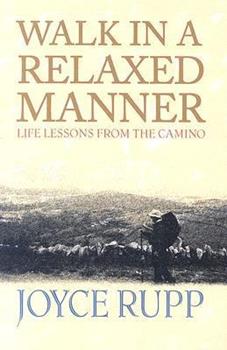
Walk in a Relaxed Manner, by Joyce Rupp

I know Joyce Rupp a little because we’re both part of casual, ever-changing local writers’ group. She is a keen world traveler; I’m a stubbornly reluctant traveler. Once at a writer’s gathering, she took me aside to give me quiet advice about packing for a trip to Italy. I would describe her as elegant, yet sturdy. Reserved, yet kind and willing to share.

The fact that she did not plan to share her experience of walking the Camino de Santiago de Compostela, but meant it to be a very private pilgrimage for her own spiritual growth, is perhaps what makes the book feel so authentic and accessible. If she had walked all of September and most of October over five hundred miles of northern Spain knowing she was going to write a book at the end, surely she would have been shaping and filtering as she went. She would have been taking photos and making notes. Documenting. Planning. Instead, she kept a small, private, journal.

In her introduction she shares how her determination to keep her Camino experience private changed. In a moment of synchronicity after her return, right after she had expressed once again her determination not to write about it, she was confronted with Joseph Campbell’s—whom she admires—conviction that the returning pilgrim (hero) has an obligation to gift the community with an account of the journey.

And so she did.

In the Contents, she lists 25 life lessons she learned from the Camino: Go Prepared, Live in the Now, Experience Homelessness, etc. These lessons are learned from the cacophony of snores of fellow pilgrims, the beauty of the Pyrenees, and vineyards heavy with purple and green grapes. From blisters wrapped in duct tape, bathroom noises, poetry, and puddles of vomit. From a fox running through the chestnut trees and a cockroach swimming in the hot chocolate. From sharing scarce food, taking the time to watch ants, and finding fellow pilgrims who also love Barbara Kingsolver books.

From her privations and blessings, she feels what it means to be food insecure, to be suspected of being a shoplifter, to live without being clean as the homeless sometimes must do. From her exhaustion comes clarity. From a September 15 journal entry: Today I realized it has taken me many days of walking to finally reach a clearness inside that is allowing me to contemplate all I see. It was gradual—beginning with the magnificent grapes in the vineyards. Now I can look at this old bench I sit on, rusted green, bird poop, highway noise nearby, and I can be still inside. I can look at the shape of the bench, the holes, the patches of corrosion and “see” it with my “special eyes.” I need to “see” people’s faces more, to read the sacredness there, too.

Over the years, I’ve recommended and/or loaned this book to several people who are neither particularly spiritual nor adventurous, and it has been valued by all as a good and important read. As a reluctant traveler, I will never walk the Camino de Santiago de Compostela. But echoing Thoreau 😄 : I have travelled much in West Des Moines because of wonderful books like this. I’ve come to know we are all pilgrims, every day. And it is good to Embrace Beauty, Live in the Now, and Walk in a Relaxed Manner.

— Sharelle Moranville

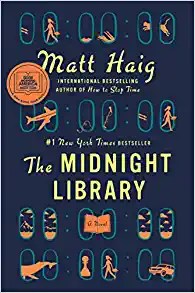
The Midnight Library, by Matt Haig

Nora Seed can no longer face the missed opportunities and unfulfilled potential that define her life, and she tries to kill herself. But rather than dying, she ends up in the Midnight Library, a zone between death and life, in a building full of books that contain her alternate lives. But first, she must read her own Book of Regrets, a thick volume of panic-inducing shoulda, coulda, wouldas. Her list consists of dropping out of a rock band just as it was about to sign a recording contract, calling off the wedding to the man of her dreams, backing out of competitive swimming, being a bad cat owner, and not becoming a glaciologist. The latter niggles on Nora’s consciousness after her beloved high school librarian, Mrs. Elm, suggested it decades ago as a possible career path.

Nora, who is 35 when we meet her, has more talent than the average human, but that means more chances to miss. At the Midnight Library, she meets Mrs. Elm again, who offers her a world of parallel universes in which she can embrace lives that erase her regrets. Mrs. Elm helps her decide which books she might open first, based on the mistakes she feels are her biggest. She opens a book and is off—to the remarkable success, happiness, and fulfillment her “root life” lacked. Or not, otherwise what kind of book would this be?

The chance to relive your life and overcome perceived failures is a popular theme in movies (It’s a Wonderful Life), television (Quantum Leap) and literature (Kate Atkinson’s Life After Life). It’s a means of offering the main character a way to redefine success, happiness, and fulfillment into digestible bites. Why did Nora pass up her chance to become an Olympian with such an obvious happy ending? As we learn, it’s for good reasons, but she’s forgotten them. In her backward glance, she sees only rosy promise, not the barriers that stood in her way. She thinks she had power and control that never existed.

As Nora experiments with one life after another, author Matt Haig shows that all decisions operate within a fluid environment, creating a context that we tend to simplify in our memories. We believe we could have done things we shouldn’t or couldn’t have. In Nora’s case, parents die, friends and family disappoint, people she loves mess with her head, and fate sometimes simply stinks.

But, as she learns, the winds that swirl around her also include real love and support, which she must first recognize and then accept. Basically, Nora has to recognize that perfection has never been in her grasp.

This is a book about shedding regret by gaining perspective. It’s full of quirky plot lines, with glimpses of opportunities and potential in unexpected places and people. Nora pays attention to the characters who populate her stories, who show up in multiple lives, and realizes that her life begins when she starts looking at her people and at the small details that create meaning and kicks the blame to the side. Is happiness defined by medals and albums and quaint English pubs? Or by simple, calm contentment?

It remains midnight in the library until Nora realizes that life in general is usually a mess and always uncertain and that humans, including her, are incurably flawed. This frees her to turn away from the dark and toward her own light.

— Pat Prijatel

The Sound of a Wild Snail Eating, by Elisabeth Tova Bailey

I started this book with a bunch of trepidation because of the strange title. Who would have thought of a story about a snail? Who would have thought that watching a snail go about its daily life would help someone get through a devastating illness? Who, also, would have completed so much excessive factual research into a small, relatively insignificant animal?

I mean, how interesting can a snail be? Entirely captivating, as it turns out. Enjoying reading the book slowly, I found that perhaps there’s something to be said for moving at a snail’s pace. I found the book to be a fascinating glimpse into the life of an animal most of us ignore or even dislike, and ended up with a new-found appreciation for a miraculous little creature that I never thought much about before — except that I hated them eating my hostas every Spring. 

In a work that beautifully demonstrates the rewards of closely observing nature, The Sound of a Wild Snail Eating is Elisabeth Tova Bailey’s account of her uncommon encounter with a common woodland snail (she never gave it a name) when she is bedridden with a mysterious pathogen she contracted during a trip to Europe. She withstood long months unable to even turn over in bed without exhausting herself, spending those months in a room with a window she couldn’t see out of and surrounded by plain white walls.

But, one day a friend brings her a pot of wild violets with—of all things—a snail in it. The mere idea of the responsibility for this is almost overwhelming for Elizabeth, but the quiet, slow, peacefulness of the snail gradually wins her over. What started as a bizarre unwanted gift became her main focus and companion.

Spending long hours watching the snail, Bailey becomes an astute and amused observer, providing a candid and engaging look into the curious life of this underappreciated small animal. She found that a snail’s world is far more interesting than one might imagine as they get by with only three senses—smell, taste, and touch. She became fascinated and intrigued by the snail’s molluscan anatomy, clear decision making, hydraulic (slimy) locomotion, and mysterious courtship activities (e.g. Romantic encounters between a pair of snails can take up to seven hours from start to finish!)

Set over the course of one year, she and the snail share an intimate journey of survival and resilience. With a naturalist’s curiosity, and told with wit and grace, Bailey delves into a wealth of gastropod literature, filling her chapters with fascinating mollusk biology (They have thousands of teeth! They can mate with themselves!)

Author Bailey reminds us that every living creature is here for a reason. Her book is well-written and is one of those sleeper books that could become a classic. The only thing that would have made it better would have been color photographs.

— Kenn Johnson