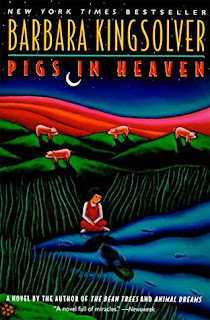
Pigs in Heaven, by Barbara Kingsolver

Pigs in Heaven (1994)is a sequel to Kingsolver’s debut 1988 novel The Bean Trees—in which Taylor, a young woman whose driving ambition is to graduate high school without getting pregnant, finds herself traveling alone cross-country in a car with serious needs. She falls into sudden, unexpected, and unwitting possession of a Cherokee toddler who has been badly abused. Taylor names the toddler Turtle and sets about forming a chosen family to raise Turtle and help her heal from the abuse she suffered. This involves getting “legal” adoption papers with the collusion of a young central American couple who are in the U.S. illegally. Readers can’t help but love adorable Turtle and spunky Taylor and the whole supporting cast. And the novel ends happily with Turtle having been saved by a bunch of white people (plus Esperanza and Estevan). 

But. And there needs to be a but.

What happens in The Bean Trees is good, but perhaps needs a second, more nuanced look. Is it in Turtle’s best interest to separate her from her Cherokee roots? Could Turtle endure the second trauma of being taken from the white mother with whom she has bonded?  Pigs in Heaven is a moving and beautifully written “second thought” about The Bean Trees. 

Young, smart attorney Annawake Fourkiller decides early on that a tribal injustice has been done, and she resolves to undo it –which naturally strikes terror in Taylor’s heart. So she goes on the run with Turtle, living on the edge, meeting fascinating characters like Barbie and the goose man and Jax. Taylor’s mother, Alice, with largely unacknowledged—up to this point—Cherokee roots, gets drawn into a quest to find her own happiness and broker a peace for Taylor and Turtle. 

Kingsolver shows the differences between the expansive tribal family structure and the constricted nuclear white family structure brilliantly. And through all the characters, but especially through the character of Alice, who has a foot in both worlds, the reader is given a more thoughtful look at what might be best for Turtle. What might be best for everybody.

I quote the novel’s ending because it is such a perfect example of Kingsolver’s inimitable style. Cash, who is conveniently both Alice’s soul mate and Turtle’s grandpa—andnow Turtle’s legal guardian—as a token of his deep and true love of Alice, leans the TV against a stump and shoots it.

“The woods go unnaturally still. All the birds take note of the round black bullet wound in the TV screen, a little right of center but still fatal. Alice’s heart performs its duties strangely inside her chest, and she understands that her life sentence of household silence has been commuted. The family of women is about to open its doors to men. Men, children, cowboys, and Indians. It’s all over now but the shouting.”

A truly righteous ending of sweet Turtle’s story.

— Sharelle Moranville

Songs of America, by Jon Meacham and Tim McGraw

In Songs of America, Pulitzer Prize-winning historian and biographer of Presidents Jon Meacham and Grammy-winning country singer Tim McGraw teamed up to trace America’s history through patriotic songs that shaped and reflected the country’s mood amid wars, social movements, and other times of conflict from before the American Revolutionary War up to the election of President Obama. Anyone who enjoys reading history or listening to music – or better, both – will find it irresistible. 

Meacham writes a celebration of the history and songs of the eras while McGraw reflects, as an artist and performer, on the songs selected in a series of sidebars. The two form an irresistible duo, connecting us to music as a force in our nation’s history. They begin their narrative early on, when tensions first arose between England and the 13 colonies. From there, they recount the next two-and-a-half century journey over our history’s rocky road.   

From the Star Spangled Banner and Yankee Doodle Dandy, to I Wish I was in DixieAmerica The Beautiful,This Land is Your Land and He’s Got the Whole World in His Hands, in early years, to the more current We Shall OvercomeBlowin’ in the WindOkie From Muskogee, and Born in the USA, to name a few, they connect us with music as an unsung (no pun intended) force in our country’s development.   

McGraw’s engaging commentary fits well with Meacham’s artful delivery in writing about each song and how it fits into the era. Rarely do such diverse talents mesh in a way that produces a result of a whole greater than the sum of the parts.  

In summary, they have written a wonderful and moving account of how the sounds of America have inspired us and contribute to our understanding of our past.   Toward the end, Meacham quotes Shakespeare:

The man who has not music in his soul
Or is not touched with Concord of sweet sounds,
Is fit for Treasons, Stratagems, & Spoils,
The Motions of his mind are dull as Night,
And his affections dark as Erebus.
Let no such Man be trusted.  

Perhaps this is why the authors halt their story just before the 45th President….  

p.s. A personal note of a segment of my early history and music. While a ninth-grader in 1956, I joined a group of boys who were skipping school to travel to Memphis to hear Elvis Presley at the Cotton Carnival, an event much like the Mardi Gras. Elvis had recently made the scene with his hit “Heartbreak Hotel”, and we were entranced by his sideburns, swiveling hips, ducktail haircut – all of which we quickly tried to emulate. We got back home well into the wee hours of the morning, and of course my parents had been extremely worried and now mad, but glad I was safe.  I think I was grounded forever. Several years later, Elvis and I were both serving in the Army at the same time in Germany.  

Ken Johnson

The Bean Trees, by Barbara Kingsolver

I knew I was going to get some good chuckles out of the book when I read the opening paragraph of Bean Trees:

“I have been afraid of putting air in a tire ever since I saw a tractor tire blow up and throw Newt Hardbine’s father over the top of the Standard Oil sign. I’m not lying. He got stuck up there. He wasn’t killed, but lost his hearing and in many other ways was not the same afterwards.” 

And I kept chuckling throughout the book. It’s funny but it also is a good story, really a series of good stories from beginning to end. The stories are intriguing, clever and wise.  Barbara Kingsolver has written a number of books but this is her first.  The “heroine,” Taylor Greer is a determined, spirited, and very likable young woman.  She has two goals in life: To move away from her home in rural Kentucky and not to get pregnant.  She heads off on her getaway adventure in her newly-purchased 1955 Volkswagen bug which, besides being unreliable mechanically, has no windows. No starter either, so it has to be push-started, preferably on a hill. She stuffs all the money she has into one pocket of her jeans and heads off.  

Taylor grew up poor, but she is resourceful. Her plan is to drive west and never look back until her car stops running, then settle wherever that takes her. She lands on the outskirts of Tucson, Arizona on a Cherokee Indian reservation. She manages to drive her wobbling car off the highway and find a much-needed auto repair shop with the interesting name of “Jesus is Lord Used Tires.” Somewhere along the way, her trip takes a very unexpected turn. A woman places a small child wrapped in a large pink blanket into Taylor’s car, insisting that she must “Take this baby.” Taylor is too stunned to refuse and so becomes the instant mother of a three-year-old Native American Cherokee girl, a round-eyed child with a “cereal bowl haircut.” The child’s tiny hands grab and hold tightly onto everything she can reach, especially her new mother’s long braid. She also realizes that the child has been horribly physically and sexually abused. Perhaps because Turtle needs security as the result of the fear and pain she has suffered, her tiny little hands grab and hold tightly onto everything she can reach, especially her new mother’s long braid.  So Taylor names her little girl “Turtle” after mud turtles who also hold tightly to everything they can grab. 

Turtle becomes fascinated with beans, especially the purple beans from Wisteria trees and loves to collect and plant the beans, then dig them up. The little girl is also fascinated with horticultural magazines and books, anything that pictures vegetables and plants. Her quick mind helps her memorize the names and types of vegetables. In Tucson, Taylor meets and becomes good friends with Lou Ann Ruiz, whose husband has lost a leg in an accident. Lou Ann also has a child and the two women agree to move in together with their families.  From there on the book is filled with the sometimes touching and always humorous lives of the two women, their families and the events and everyday miracles in their lives. The Bean Trees is witty and wise and funny – a good read from start to finish.  I did not want it to end.

Gail Stilwill