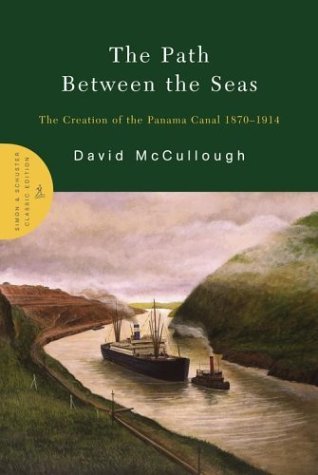
At the outset, I have to admit that I’m biased, as McCullough is probably my favorite author, and I recommended reading the book to our Books, Brew and Banter Club. That said, The Path Between the Seas won the National Book Award and several other awards, so I feel confident that it would be next to impossible for me to oversell his work.
The book is a first-rate drama of the bold engineering feat that was filled with both tragedy and triumph. It is the story of the men who fought against all odds to fulfill a four-century dream of constructing a passageway between the Atlantic and Pacific oceans, which includes astonishing engineering undertakings, tremendous medical accomplishments, political power plays, tragic failures and heroic successes.
When Europeans first started to explore the possibilities of creating a link between the oceans, cutting off the long and dangerous journey round the southern tip of South America at Cape Horn, Panama was a remote part of Columbia. That changed when, in 1848, prospectors struck gold in California, creating an urgent need for quicker passage for California-bound ships. Thus, the United States built the Panama Railroad to serve that traffic and soon became the highest-priced stock on the New York Exchange.
Initially, building the canal appeared to be an easy matter, but the construction project eventually came to involve the efforts of thousands of workers from many nations, taking over four decades to complete.
In the beginning, French entrepreneur Ferdinand de Lesseps, secured capital to begin work on the canal, based on his recent success in constructing the Suez Canal between the Mediterranean and Red Seas. However, at the time, he had not set foot in Panama and had only a vague idea of the topographical setting, nor did he believe that the heat, humidity, insects, and snakes were a large problem. In less than a decade, however, the scheme had collapsed, and his company went into receivership with only a third of the canal having been excavated. Over 25,000 people died, including 5,000 Frenchmen, mostly succumbing to malaria, yellow fever, poisonous snakes and industrial accidents.
After a quarter century, President Theodore Roosevelt began a campaign of intervention, and negotiated a treaty to access to the Isthmus of Panama, allowing the US to buy-out the French interests. However, the Americans led a bloodless revolt after Columbia objected to the treaty, allowing for the creation of the Republic of Panama. Americans then set work along the French route using their equipment and the Panama Railroad, before shipping in more modern equipment to move billions of cubic yards of dirt and rock, to harness savage rivers, and to initiate an unprecedented lock system, that has lasted over a century, only recently being remodeled and opened again to larger ships.
Aside from President Roosevelt, two other Americans were heroes in this process. Dr. William Gorgas found that mosquitos were the carrier of malaria and yellow fever and led efforts to destroy their breeding grounds, substantially reducing deaths from disease. Engineer John Stevens took charge of the canal project and quickly understood the French inability to remove rock and dirt was not a problem with digging, but transportation. So he led efforts to rebuild the Panama Railroad to transport not only people, but equipment and materials, and recruited the greatest engineering minds of the period to tackle the tremendous challenges.
Completing the canal was an impressive trial, but it got done. Eventually, the canal opened to traffic ahead of schedule and under budget, and became the useful waterway of commerce envisioned for centuries.
This comprehensive and captivating story is a must-read for anyone interested in American history, the history of engineering technology, international intrigue, advance of medicine and human drama. Clearly, McCullough wrote a story you won’t want to put down.
—Ken Johnson


 Books, Brews & Banter