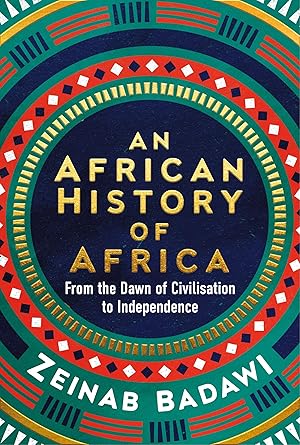
One book can lead to another. When our group recently read River of the Gods, by Candace Millard, some members commented how little knowledge they had about African history. Zeinab Badawi’s book provided an antidote. We came away with a much better appreciation of the size and diversity of Africa’s geography, the breadth and depth of its history, and its economic and cultural potential.
Professor Badawi, president of the University of London’s School of Oriental and African Studies, and with roots in Sudan, wrote the book she wished she had when she was young, a relatively complete comprehensive history of the continent, told from an African viewpoint. Most available work on Africa comes from an outside perspective, usually European or American. Badawi’s academic credential gave her access to colleagues across Africa who gave local input to her extensive research for this book.
The format follows a geographic loop around Africa, beginning in Egypt, moving through Sudan and Ethiopia, across North Africa, circling through West Africa, and finishing in Southern Africa. For each region, Badawi gives a basic chronology, with names and dates of kingdoms, cities, artistic highlights, and wars. Each regional discussion is personalized by picking out one or two people (men and women) with noteworthy accomplishments of leadership. She tells these stories from available evidence, sometimes writings, but more often tradition, jewelry, sculpture, artistic work, and architectural remains. The book includes photos of some of these items, but we thought more maps would also be helpful.
A few chapters leave the geographic loop to explore the slave trades from an African perspective – both the Atlantic trade we know, and the less-familiar Arab trade to the Middle East and India. Her focus is on the costs to Africa of the loss of so much human potential and the lingering angst of the involvement of so many Africans in those trades. The book closes with a survey of successes and failures during the post-colonial independence period and an optimistic look into the future of the continent as new generations gain leadership with more internally developed confidence and capability.
— Bill Smith

