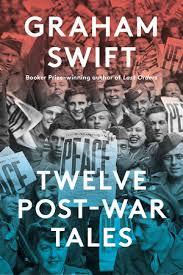
Reading British author Graham Swift’s short stories in Twelve Post-War Tales is a little like eating a small bowl of dulce de leche ice cream. Each bite is rich and complex, leaving an intriguing after-taste, calling us to read and re-read. To savor each story.
A paradox of literary fiction is that its extreme specificity is what allows it to feel universal. I, for instance, have nothing in common with seventy-year-old Dermot, a Cork man from York, who banters in a pub with his mates on a rainy night about a sweet girl he once knew who worked in chocolate. Innuendo, wink-wink, laughter. But who among us can read the closing passage of the story “Chocolate,” without sighing Ah yes. I have felt that way. Surely everyone has felt that way. Thank God we can feel that way.
Everything had an inky sheen. On the strip of pavement, on the kerbstones and gutter, on the surface of the street and the droplet-covered bodywork of parked cars, the reflections from the streethlights shone and shimmered. From inside looking out, before you had to go back out into it, and with two pints inside you, it all had a way of even looking quite appealing.
Who can read “Hinges” without recognizing Annie’s grief, the pointless ubiquity of the best poems to read at a funeral, and the mother’s limp, unresponsive hand Annie tries to hold? Who hasn’t had bizarre memories pop up at such times, like the one Annie has as her dad’s funeral begins, of Joe Short, a man she “fancied” when she was little, who fixed a door she later realizes has similarities to the coffin in which her dad lies.
Who, of a certain age, hasn’t imagined losing their mind (and their memories) as Anna-Maria Anderson does on her eighty-second birthday in “Passport?” Swift treats this character—and all his characters—very tenderly, but uncompromisingly.
It was 6:30 a.m. Still dark. She sat, looking forward, braced and prepared, clutching the proof of her identity, but she was really somewhere else already and she knew, as well as she ever would, who she was. She sat and she waited. She waited. She waited for the light to flash.
Our group spent three weeks discussing these twelve tales, having our favorites and least favorites, but we agreed each story was, in its own way, a remarkable capture of what it means to be a human among humans. To grow older, to be formed by memory, to wait—knowing who we are—for the light to flash.
We equivocated a little over the title and cover since—together—they imply the stories will be about the aftermath to World War II, and that’s not true of all of them. But Swift touches on various other times of turmoil (the Cuban missile crisis, North Ireland, President Kennedy’s assassination, the riots of the sixties, the pandemic) as if to argue it’s always post-war somewhere, thus a tale may be told.
— Sharelle Moranville

