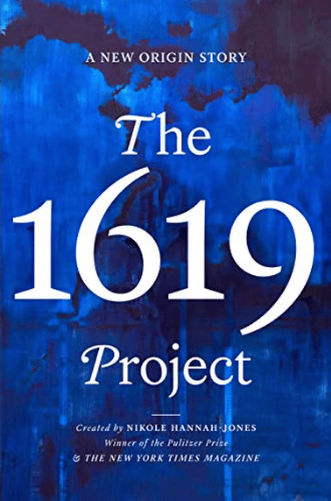
The 1619 Project reframes the American origin story by placing slavery at its foundation and tracing how that legacy continues to shape American institutions and society. Expanding on an earlier issue of The New York Times Magazine, the anthology combines essays, poetry, and brief historical interludes to connect the nation’s past to its present.
Across its opening chapters, the anthology argues that slavery shaped not only America’s racial hierarchy but also its democratic ideals and economic practices. The book opens with an essay that partly focuses on the 1619 arrival of a slave ship in Virginia. This arrival marks the beginning of the system of chattel slavery in America. This system would continue for some 250 years, ending in the Civil War, but whose effects would linger long beyond that.
In “Democracy,” Nikole Hannah-Jones contends that Black Americans, rather than the nation’s founders, have repeatedly compelled the United States to honor its stated principles of equality and liberty. In “Race,” Dorothy Roberts examines how racial categories prevented solidarity between white and Black workers and helped preserve slavery, while in “Sugar,” Khalil Gibran Muhammad links the harsh labor practices of American capitalism to the industrial discipline of chattel slavery.
The remaining chapters extend this analysis to politics, citizenship, self-defense, punishment, inheritance, medicine, and other areas of American life. They examine whether Black Americans’ votes are still treated as legitimate, whether the right to self-defense is applied equally, and how racial disparities persist in law enforcement and punishment. The anthology concludes with an essay advocating reparations as a means of redressing the enduring burdens imposed by centuries of slavery and racial oppression.
The 1619 Project challenges the completeness of the conventional American origin story by showing how slavery and racial oppression have shaped the nation’s current political, economic, and social institutions. Its central contribution is to connect that history to persistent inequities, asking readers to reconsider not only how the United States began but also how its founding contradictions continue to influence the present.
— Jim Lynch

