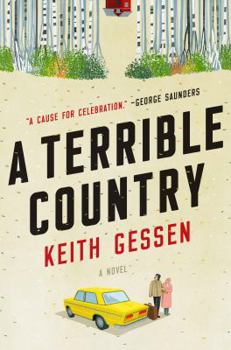
Though it reads very much like a memoir, A Terrible Country is really a semi-autobiographical novel. Author Keith Gessen’s first-person narration sounds so genuinely descriptive that I confess I both loved it and found myself constantly distracted by wondering what was real and what was not. It stuck with me enough that I recommended it to my book club — even though it meant I had to read it a second time — just so I’d have someone to talk about it with. I think they found it to be a mixed bag, too, with responses ranging from depressing to maddening to admirable to compelling. If nothing else, most of us found it engaging and eerily relatable.
The story follows Andrei Kaplan, a struggling Russian-born American academic who returns to Moscow to care for his elderly grandmother, Baba Seva. Seva Efraimovna was closely based on the real grandmother of Keith Gessen and his brother, M. Gessen, Rosalia “Ruzya” Solodovnik. In the novel, Andrei also returns to Russia because he has nothing keeping him in New York. His girlfriend has left him, and his academic career is floundering. He goes to Russia thinking he may be able to find something to write about. He struggles with that, as well as with joining a hockey team, fitting in, speaking the language, connecting to Wi-Fi, getting groceries, and every single other thing. It’s oppressive, but told with self-deprecating wit. I cared for Andrei as a character and rooted for him to succeed.
The parts of the book that portray everyday life are clearly based on Gessen’s real experience caring for his own grandmother in Moscow, and that’s what I found most compelling. The book provides a real slice-of-life view of Russia (or at least that part of Russia in 2008), especially through the eyes of someone who has a strong connection there but is also accustomed to the relative comforts of the US. That’s a rare perspective.
I had always imagined everyday Russian life as stark, and this filled in some details: the brutal cold, expensive goods, difficulty accessing services, imposing blocks of buildings, the feeling of being surrounded by a brutal history, and constant paranoia about people’s motives and intentions. As Baba Seva says repeatedly, it’s “a terrible country.”
And yet, amid the corruption, the tension in the book comes from Andrei’s (and Yulia’s, and Sergei’s, etc.) love for and commitment to the place, and desire to fix it despite all its flaws. We can relate. They eek out a feeling of home and find comfort where they can: camaraderie with fellow dissenters, parties where people share meager food and supplies to create a little joy, and friends finding ways to share cramped living spaces. There are also games of Anagrams, old movies, and cooking lessons. I dare say some of it is heartwarming.
Andrei is a complex character. At times he seems bumbling and clueless, with bad situations continually befalling him, along with plenty that he creates himself. At other times, he seems redeemed by his determination to keep his grandmother in her home despite his scheming brother’s wish to sell out. His good intentions are real, but they don’t keep him from being selfish. And without spoiling the ending for those who haven’t read it, suffice it to say that he never really “gets” what it means to live in a culture of surveillance and fear on the same level as his friends do, and the ending is pretty bleak.
George Saunders said about the book, “A cause for celebration: big-hearted, witty, warm, compulsively readable, earnest, funny, full of that kind of joyful sadness I associate with Russia and its writers.” Our group didn’t have enough experience with Russian literature to make that comparison and didn’t fully agree with calling it funny. For me, the humor was often of the sad variety, where something is so sad that all you can do is laugh. When Baba Seva continually forgets who Andrei is but remembers his absent brother with affection, what else can you do? But it was good fodder for discussion about the characters, the setting, the economics, the politics, and even the writing itself. A unique read, for sure, and I liked it even more the second time I read it.
— Julie Feirer

