The Unlikely Pilgrimage of Harold Fry, by Rachel Joyce

The characters and events in The Unlikely Pilgrimage of Harold Fry are indeed unlikely: Harold makes a spontaneous decision to walk the length of England in yachting shoes to keep his old friend Queenie alive. He gradually abandons structure and convention as the journey progresses—finally paying no attention to night or day or weather or food or where he sleeps. He is utterly shocked at the grotesque deathbed disfigurement that has come from Queenie’s waiting for him. None of these things seem quite realistic or likely, yet the overall story comes to feels universally true and important.

At the beginning, we meet Harold and Maureen: “Harold Fry sat at the breakfast table, freshly shaved, in a clean shirt and tie, with a slice of toast that he wasn’t eating. He gazed beyond the kitchen window at the clipped lawn, which was spiked in the middle by Maureen’s telescopic washing line, and trapped on all three sides by the neighbor’s stockade fencing.” Maureen is cleaning, which she does a lot. She likes her toast cold and crisp. And she is dismissive of everything Harold says and does.

Immediately, Queenie’s letter arrives with the news that she is dying, and before long Harold is off on his unlikely pilgrimage to hand carry his inchoate written response to her news, believing that the long journey will delay her death.

At first, Harold and Maureen feel pathetic in their dysfunction—like characters only the author could love. But as they open up to the reader (but not to each other), they begin to feel like survivors who may deserve our understanding, instead of victims who need our pity. As the revelations land, we learn of parental abandonment and indifference. Of a brilliant, but troubled, addicted son who hangs himself.

A universal story begins to unfold of childhood tenderness and trauma, of young adulthood with its peaks and perils. If we’re lucky, true love strikes and makes us dance crazy. But even then, our past nags at our present. Shortcomings show themselves. Mistakes are made, hearts are broken, memories are wrenched into false truths. We blame, we feel guilty. We ache. We mourn. We deny.

Harold’s pilgrimage on a narrative level is about keeping Queenie in this world as long as possible, but his real pilgrimage is to fall in love with Maureen again, and have her fall in love with him again. And for them to share good, true memories of their son who, like everyone, ultimately made his own choices.

At the end, when Harold and Maureen are leaving the nuns after Queenie’s funeral, they find themselves laughing about something one of them said at their first meeting. What was said isn’t shared with the reader. It’s just their memory, which enhances the new sense of intimacy between them. “They caught hands again, and walked toward the water’s edge, two small figures against the black waves. Only half way there, one of them must have remembered again and it passed like a fresh current of joy between them. They stood at the water’s edge, not letting go, and rocked with laughter.”

— Sharelle Moranville
The Likeness, by Tana French

“Some nights, if I’m sleeping on my own, I still dream about Whitethorn House.” 

The first line of Tana French’s The Likeness tells you much of what you need to know about the novel: The house is key to what happens, as are ideals of home, family, and belonging. But it all revolves around protecting the house while its spell controls and defines the lives of those who live under its graceful roof.

Central to life inside Whitethorn is Daniel, who inherited the house from his bachelor uncle, and the friends he has chosen in graduate school: Abby, Rafe, Justin, and Lexie. He’s carefully curated his friendships to build his own family, with one unbreakable rule: No pasts.

When Lexie gets murdered, her doppelganger, Detective Cassie Maddox, takes her place in the house to try to solve the crime. Adding to the mystery is the fact that, when she worked in undercover, Cassie invented Lexie. She knows that whoever this woman is, she’s not Lexie because Lexie is not real.

 What follows is a French-style psychological thriller, with an emphasis on character development, showing how people who are broken damage themselves and one another while searching for belonging. To the five main characters in this compelling narrative that means complete fealty to their homemade family. When that bond breaks, nothing else can hold.

Some of this is difficult to buy. Do the people who spend all day, every day with Lexie not notice that Cassie is a different person, no matter the physical resemblance and preparation? But it’s easy to dispel disbelief and just dig into this deeply-told tale.

A conversation between Daniel and Cassie-as-Lexie shows that Daniel understood the bargain he was making with his friends and his house:

“There’s a Spanish proverb,” he said, “that’s always fascinated me. “Take what you want and pay for it, says God.'”

“I don’t believe in God,” Daniel said, “but that principle seems, to me, to have a divinity of its own; a kind of blazing purity. What could be simpler, or more crucial? You can have anything you want, as long as you accept that there is a price and that you will have to pay it.” 

The Likeness explores that price. As in other books in the Dublin Murder Squad series, most of the pieces fall together at the end, but French leaves us to make our own sense of much of it. Just like life. 

Pat Prijatel


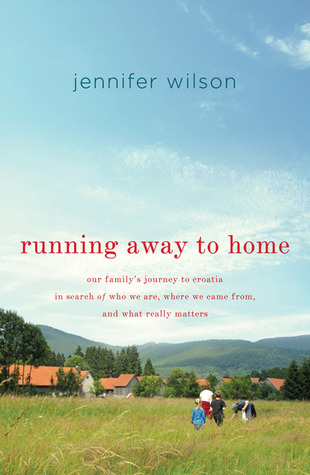
Running Away To Home, by Jennifer Wilson

A dinner of door mouse (it tastes like chicken), nights on an ancient futon in a randomly finished attic, a bathroom door that won’t shut, an annoying barking dog next door, drunken neighbors, and a solid language barrier. Such was the glamour that faced Jennifer Wilson and her family when they took a break from their stressful American life to move for four months to the home of Jen’s great-grandparents, Mrkopalj, Croatia. The family went looking for family and adventure and found both. Comfort? Not so much, at least not in the usual sense of the word.

Wilson recognizes physical characteristics that tie her to the people she meets, especially the deep-set eyes so like her own. She eats the food she remembers her beloved Grandma Kate making, such as povitica, a sweet nut bread. She shares local beer with local drinkers, learns to garden the Mrkopalj way, finds old roots and builds new ones.

In this funny and insightful book, Wilson shows us life in Croatia in 2008, and defines what we mean by family. She meets blood relatives, but bonds with an assortment of delightful, maddening, and perplexing neighbors who welcome her, her husband, and their two young children, providing food, advice, and research help. 

Initially, the kids, Sam and Zadie, miss their Iowa home and family, but when it is time to leave Mrkopalj, both mourn the loss of the community that embraced them as part of the tiny village where nothing much happens except at the local bar or the Catholic church. But to kids, that meant freedom to roam, to ride bikes on streets with few cars, to play games non-stop with the neighborhood kids, and to eat popsicles on hot afternoons.  

Wilson takes us on the family’s journey, peeling the onion of Mrkopalj to find the layers of tears below. Depending on their age, residents survived World War I, II, and the Balkan Wars of the 1990s. Many family members died, those who survived faced a life of trauma, the scars of which show in the men’s drinking, a sadness the falls over conversations, and the bad teeth from a lack of dental work and, possibly, bad water. 

After months of searching for her past, Wilson recognizes her own good fortune in being the descendent of those who left. But she sees the strength and goodness of those who stayed behind. Past and present blur as her definition—and ours—of home and family expands.

Pat Prijatel