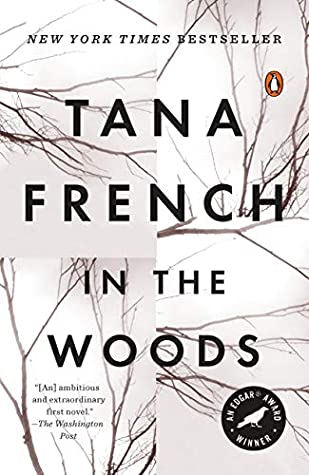
In The Woods, by Tana French


Tana French’s debut novel, In the Woods, is fascinating, complex and ultimately leaves its different readers with many different impressions of how we are to view the main characters and what actually happens in the story.

In literary genre circles, this book is classified as a “police procedural.”  The story takes place in and around Dublin, Ireland, where the weather, the atmosphere, the ethos of the place are almost characters in the plot.  The book is narrated by Murder Squad detective Rob Ryan who, we discover early in the book, has an unsolved mystery at the heart of his life. His memory of the incident is gone.  And he tells us, “Contrary to what you might assume, I did not become a detective on some quixotic quest to solve my childhood mystery.  I read the file once, that first day, late on my own in the squad room with my desk lamp the only pool of light….It was these arcana I craved, these near-invisible textures like a Braille legible only to the initiated.  They were like thoroughbreds, those two Murder detectives passing through Ballygobackwards; like trapeze artists honed to a sizzling shine.  They played for the highest stakes, and they were experts at their game.”

Rob and partner Cassie Maddox, the only person other than Rob’s parents who knows about his relationship to this old unsolved mystery, are assigned a murder case involving a 12-year-old girl from the same suburb where Rob grew up and where the old unsolved mystery took place.  Should he be investigating this new case?  His doing so is absolutely against department regulations, but he and Cassie proceed anyway.  Thus we begin a journey into the intertwining of these two stories.

We remember that Rob-the-narrator has also told us in the first line of the first chapter of the book:  “What I warn you to remember is that I am a detective.  Our relationship with truth is fundamental but cracked, refracting confusingly like fragmented glass.  It is the core of our careers, the endgame of every move we make, and we pursue it with strategies painstakingly constructed of lies and concealment and every variation on deception.”  So, is everything that follows somehow “fundamental but cracked truth”?  Are we part of a web of deception?  Is Ryan himself part of that web?

This first book in French’s “Dublin Murder Series” is a highly satisfying read, open to interpretation and re-interpretation.  Are there clues we have missed?  What is the significance of the object found in the remnant of the woods, now an archeological dig, at the end of the story?  Can we add up the brief flashbacks that Rob experiences during the course of the current investigation?

Read it yourself and see what you think.

Jeanie Smith

Braving the Wilderness, by Brene Brown

It may be worth noting up front that our group read Braving the Wilderness in January of 2021, with our first of two discussions taking place just after an attack on the U.S. Capitol to disrupt the process of ratifying Electoral College votes in the 2020 presidential election. This made it a very timely and relevant read for many of us who were struggling to see these acts as anything other than “us versus them.” Having moved even deeper into the divisive and polarized culture that existed four years ago to acts of violence in 2021, Brené Brown’s words from 2017 now seem rather prophetic.

“The flags are flying from every porch and the social media memes are trending, all while fear is burrowing and metastasizing. What feels like a rallying movement is really a cover for fear, which can then start spreading over the landscape and seeping into the fault lines of our country. As fear hardens, it expands and becomes less of a protective barrier and more of a solidifying division. It forces its way down in the gaps and tears apart our social foundation, already weakened with those delicate cracks.”

In this short but powerful book, through her characteristic mode of vulnerable storytelling from her own emotionally raw experiences, Brown lets the reader know she’s seeking truths to help us all cope – not telling us she has all the answers. She challenges us to take a hard look at our responses in the face of fear and anger and whether, in our quest for belonging, we’re doing more than surrounding ourselves with like-minded others and pointing fingers for blame. While her suggestions for moving out of our own bunkers to find a greater sense of belonging absolutely make sense, they’re also no easy tasks: moving in and listening to people with whom we disagree, speaking truth to B.S. in a civil and non-dehumanizing way, and keeping a strong back, soft front and wild heart. 

A paradoxical quote by Dr. Maya Angelou, which Brown wrestles to understand throughout the book, is this: “You are only free when you realize you belong no place – you belong every place – no place at all. The price is high. The reward is great.” If the key to belonging is feeling bold enough to live authentically in every place, it opens up a lot of questions about how we raise our kids, how we form our identities and relationships, and even how we act as a church. The idea transcends any notion that one way of thinking is “correct.”  

Braving the Wilderness sparked a lot of reflection and conversation in our group of like-minded friends, but I can also see it being used as a starting point for open discussion among people who disagree. At any rate, it’s worth reminding ourselves to stay open to that conversation, and that fear of the other must be confronted in order to heal.  

Julie Feirer

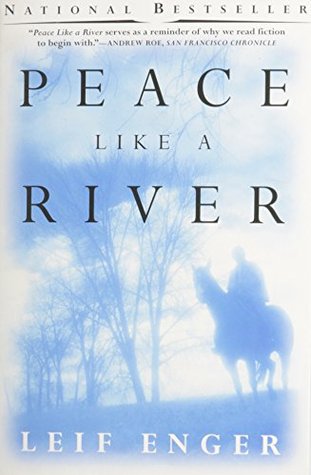
Peace Like a River, by Leif Enger

Leif Enger’s Peace Like a River is a delightful and discussable novel. The story of the Land family—
Jeremiah, Davy, Reuben, and Swede—is set in the early 60s in rural Minnesota and the North Dakota badlands.  

The narrator is Reuben as an adult, reflecting back on a childhood marred by severe and unpredictable asthma. Much of the tension of young Reuben’s story is his nervous, sometimes resentful, monitoring of his dad’s miracles—always hoping for the big one: that his dad will cure him. Reuben knows his dad can perform miracles because he has witnessed them—curing an undeserving school superintendent of a skin condition, healing a flaw in Swede’s saddle, rendering the Land’s Airstream rig invisible to the Law. And ultimately, Jeremiah does cure his son’s asthma, by miraculously gifting Rueben with his own lungs—the occasion for this miracle, by the way, compliments of the evil, murderous Jape Waltzer. 

While young Reuben wrestles with his asthma, his little sister Swede—sidekick and foil—is pounding out a kind of parallel saga of Sunny Sundown and the wicked Valdez on a manual typewriter, often while riding a saddle on a sawhorse in an Airstream trailer heading West in search of fugitive Davy. Sunny Sundown’s saga is told in charmingly awful heroic verse. And significantly, Swede can’t kill Valdez—though if ever a fictional villain deserved death it is he. 

The novel explores very serious and weighty matters: life and death, good and evil, crime and punishment—all the while making us laugh at the most unlikely moments. For example, the gruesome hunting scene near the beginning of the story, rendered hysterical by Swede’s unwise enthusiasm to retrieve the downed goose. 

We see the transformative power of love in Roxanna who, when we meet her, is graceless and plain. But when she and Jeremiah marry, she is graceful and beautiful. And as she is transformed by them, so are they transformed by her: Jeremiah to health and the children from motherless to abundantly mothered. 

Enger’s characters, which are both types and utterly singular, push the boundaries of realism. But because they are so original and engaging, and because the pacing of the story is quick and the stakes are high, the reader cheerfully goes along for the ride. The oversize characters are easy to love, easy to despise, and easy to equivocate about. Jeremiah is Good. Almost like Christ. Jape Waltzer is Evil. Almost like Satan. And Davy, Reuben’s outlaw brother, is Morally Ambiguous. Almost like us. 

Enger’s poses a kind of Yin and Yang dualism. We can’t have life without death, or good without evil, or joy without sadness, or doubt without miracles. Perhaps the reason Swede can’t kill Valdez is because Sunny Sundown can’t live without him. Jape Waltzer needs to murder Jeremiah so Reuben can receive the miracle. And we can’t bear the grimness of it all without being able to laugh.

Sharelle Moranville