Songs of America, by Jon Meacham and Tim McGraw

In Songs of America, Pulitzer Prize-winning historian and biographer of Presidents Jon Meacham and Grammy-winning country singer Tim McGraw teamed up to trace America’s history through patriotic songs that shaped and reflected the country’s mood amid wars, social movements, and other times of conflict from before the American Revolutionary War up to the election of President Obama. Anyone who enjoys reading history or listening to music – or better, both – will find it irresistible. 

Meacham writes a celebration of the history and songs of the eras while McGraw reflects, as an artist and performer, on the songs selected in a series of sidebars. The two form an irresistible duo, connecting us to music as a force in our nation’s history. They begin their narrative early on, when tensions first arose between England and the 13 colonies. From there, they recount the next two-and-a-half century journey over our history’s rocky road.   

From the Star Spangled Banner and Yankee Doodle Dandy, to I Wish I was in DixieAmerica The Beautiful,This Land is Your Land and He’s Got the Whole World in His Hands, in early years, to the more current We Shall OvercomeBlowin’ in the WindOkie From Muskogee, and Born in the USA, to name a few, they connect us with music as an unsung (no pun intended) force in our country’s development.   

McGraw’s engaging commentary fits well with Meacham’s artful delivery in writing about each song and how it fits into the era. Rarely do such diverse talents mesh in a way that produces a result of a whole greater than the sum of the parts.  

In summary, they have written a wonderful and moving account of how the sounds of America have inspired us and contribute to our understanding of our past.   Toward the end, Meacham quotes Shakespeare:

The man who has not music in his soul
Or is not touched with Concord of sweet sounds,
Is fit for Treasons, Stratagems, & Spoils,
The Motions of his mind are dull as Night,
And his affections dark as Erebus.
Let no such Man be trusted.  

Perhaps this is why the authors halt their story just before the 45th President….  

p.s. A personal note of a segment of my early history and music. While a ninth-grader in 1956, I joined a group of boys who were skipping school to travel to Memphis to hear Elvis Presley at the Cotton Carnival, an event much like the Mardi Gras. Elvis had recently made the scene with his hit “Heartbreak Hotel”, and we were entranced by his sideburns, swiveling hips, ducktail haircut – all of which we quickly tried to emulate. We got back home well into the wee hours of the morning, and of course my parents had been extremely worried and now mad, but glad I was safe.  I think I was grounded forever. Several years later, Elvis and I were both serving in the Army at the same time in Germany.  

Ken Johnson

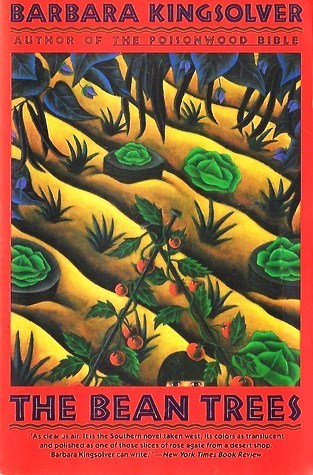
The Bean Trees, by Barbara Kingsolver

I knew I was going to get some good chuckles out of the book when I read the opening paragraph of Bean Trees:

“I have been afraid of putting air in a tire ever since I saw a tractor tire blow up and throw Newt Hardbine’s father over the top of the Standard Oil sign. I’m not lying. He got stuck up there. He wasn’t killed, but lost his hearing and in many other ways was not the same afterwards.” 

And I kept chuckling throughout the book. It’s funny but it also is a good story, really a series of good stories from beginning to end. The stories are intriguing, clever and wise.  Barbara Kingsolver has written a number of books but this is her first.  The “heroine,” Taylor Greer is a determined, spirited, and very likable young woman.  She has two goals in life: To move away from her home in rural Kentucky and not to get pregnant.  She heads off on her getaway adventure in her newly-purchased 1955 Volkswagen bug which, besides being unreliable mechanically, has no windows. No starter either, so it has to be push-started, preferably on a hill. She stuffs all the money she has into one pocket of her jeans and heads off.  

Taylor grew up poor, but she is resourceful. Her plan is to drive west and never look back until her car stops running, then settle wherever that takes her. She lands on the outskirts of Tucson, Arizona on a Cherokee Indian reservation. She manages to drive her wobbling car off the highway and find a much-needed auto repair shop with the interesting name of “Jesus is Lord Used Tires.” Somewhere along the way, her trip takes a very unexpected turn. A woman places a small child wrapped in a large pink blanket into Taylor’s car, insisting that she must “Take this baby.” Taylor is too stunned to refuse and so becomes the instant mother of a three-year-old Native American Cherokee girl, a round-eyed child with a “cereal bowl haircut.” The child’s tiny hands grab and hold tightly onto everything she can reach, especially her new mother’s long braid. She also realizes that the child has been horribly physically and sexually abused. Perhaps because Turtle needs security as the result of the fear and pain she has suffered, her tiny little hands grab and hold tightly onto everything she can reach, especially her new mother’s long braid.  So Taylor names her little girl “Turtle” after mud turtles who also hold tightly to everything they can grab. 

Turtle becomes fascinated with beans, especially the purple beans from Wisteria trees and loves to collect and plant the beans, then dig them up. The little girl is also fascinated with horticultural magazines and books, anything that pictures vegetables and plants. Her quick mind helps her memorize the names and types of vegetables. In Tucson, Taylor meets and becomes good friends with Lou Ann Ruiz, whose husband has lost a leg in an accident. Lou Ann also has a child and the two women agree to move in together with their families.  From there on the book is filled with the sometimes touching and always humorous lives of the two women, their families and the events and everyday miracles in their lives. The Bean Trees is witty and wise and funny – a good read from start to finish.  I did not want it to end.

Gail Stilwill

Pilgrim at Tinker Creek, by Annie Dillard

Dillard’s opening anecdote of the old fighting tom leaping through the window onto her bed at night and kneading her chest while she’s half-asleep is borrowed from someone else. But the reaction to the event is pure Dillard as poet and theologian. 

“I washed before the mirror in a daze, my twisted summer sleep still hung about me like sea kelp. What blood was this, and what roses? It could have been the rose of union, the blood of murder, or the rose of beauty bare and the blood of some unspeakable sacrifice or birth. The sign on my body could have been an emblem or a stain, the keys to the kingdom or the mark of Cain. I never knew. I never knew as I washed, and the blood streaked, faded, and finally disappeared, whether I’d purified myself or ruined the blood sign or the Passover. We wake, if we ever wake at all, to mystery, rumors of death, beauty, violence . . . ‘Seems like we’re just set down here,” a woman said to me recently, “and don’t nobody know why.”

In this opening, Dillard poses the question of the book very colloquially. Seems like we’re just set down here and don’t nobody know why. The opening also puts the reader on notice that her writing style is going to be poetic. She’s going to use words that need to be paused over and considered. And she’s going to use them abundantly in sentences with rhythm and repetition that convey feeling as much as they convey meaning. And she’s going to make lots of allusions to Scripture (just give a second glance to the quotation above as an example).

In her younger years, Dillard had turned away from organized religion because she couldn’t reconcile the easy, pious answers about Why? with the suffering she observed in the world. But in her mid-twenties, Dillard dared take a crack at answering the question of Why? herself. And she won the Pulitzer for her efforts. In Pilgrim at Tinker Creek, the young poet took on the absolutely biggest question of all, suspecting it was impossible to answer, but daring to try.

In her year-long, up-close observation of nature along Tinker Creek, Dillard does her best to show us “here” (as in Seems like we’re just set down here . . .) in blinding color, shifting shadow, ice and heat, big and small. Animal, vegetable, mineral. She serves up details of nature both adorable (the juvenile muskrat floating past with his feet over his stomach) and ghoulish. She observes the abundance of the natural world as something not altogether positive (all those parasites and predators). And trying to draw a conclusion about the nature of God from all this, she concludes merely “the creator loves pizzazz.” –which, honestly, made me laugh. And reminded me of the Psalmist claiming God made the great leviathan just for fun.

In her poetic, abundant way, in Pilgrim at Tinker Creek, Dillard show us nature in which the Creator must be because He is omnipresent, so He has to be in there, right? 

But questions linger. 

And in her later book, Holy the Firm, Dillard tries to answer them. That book was written while she lived on Lummi Island, off mainland Washington, where nature is sparse. She called Lummi Island “the edge of the known and comprehended world . . . the western rim of the real . . . the fringes’ edge . . . where time and eternity spatter each other with foam—a place, in other words, where nature stops and the darkness of Divinity begins.” Or, put more succinctly: “If God is in the abundance of creation, take away creation and get a better look at God.” Or, put a bit more esoterically, perhaps Creation was the fall.

Dillard invites us on a pilgrimage to understand God. But she also quotes Augustine: “If you do understand, then it is not God.” 

Or as Anne Lamott prays at the beginning of her day: Whatever.
Seems like we’re just set down here, and don’t nobody know why.

— Sharelle Moranville