A Gentleman in Moscow By Amor Towles

By the end of this novel, I admired the amount of information packed into this title.  

First, it places us in Moscow, a place somewhat mysterious to most of us, and immerses us in layers of Russian history from the end of the Czarist days, through the revolution, through the tenures of Lenin and Stalin, and into the infighting over the next period of leadership. Towles recreates the period effectively through details of furniture, books, menus, and meetings.  

Second, the title draws our focus onto the gentleman, Count Alexander Rostov. We grow to admire how he uses the more admirable traits of the old aristocracy to adapt to his lengthy house arrest in the fading glamor of the Hotel Metropol, which is richly developed as a setting. We come to know its layout, décor, and personalities.  Rostov maintains possessions and habits when they conform to his higher goals; he avoids letting ideology prevent him from cultivating friendships among many levels of the hotel’s staff and guests. His “gentleman’s” traits allow him to act as a mentor to two remarkable young girls. Without his established character, some of these relationships might seem improbable. But though these relationships, he seems remarkably to be engaged in society though physically limited to the hotel.  

Of course there is action in the novel, but its languid pacing echoes the decades of Rostov’s arrest and suits his expansive and reflective nature. He is allowed to express a philosophical digression from time to time. We always suspect the house arrest must come to an end, but that ending is brilliantly tight and pulls together a number of crumbs that have been left along the reader’s path – some carefully constructed by Rostov and others provided by opportunity but cleverly exploited. We are amazed how he contrives Sofia’s escape from Soviet Russia and his own escape from the Metropol, and we are left to speculate on his future. A surprising number of details are left for us to surmise, but I’d like to think that we are urged to emulate the gentleman and not ask too many unimportant questions and instead focus on the important ones. 

—Bill Smith

Everything I Never Told You by Celeste Ng

Everything I Never Told You is the story of a Chinese-American family and how they try so hard to do well and do good. But first one thing goes wrong and then another and then another, and to protect themselves and each other, they amass secrets that can’t be sustained.

Lovely Lydia, with her silky black Asian hair and her beautiful blue Caucasian eyes is the heart of the story. And we know from the first sentence that Lydia is dead.

Lydia is dead because her grandmother was left without a man in a time and place where a woman was supposed to be a home ec teacher (or nurse or secretary) and have a man. Lydia is dead because her dad is Asian and feels like a misfit in 1977’s Ohio. Lydia is dead because her mother, rebelling against her mother, disappears from the family, leaving them in mortal terror for months.

Lydia is dead because, like most young children, she assumes she is the cause of the family’s misery. She has surely been bad, or at least lacking, and driven their mother away. And so she makes a deal: if her mom comes home, she (Lydia) will be perfect. She will say yes to everything asked of her.

When her mother returns, Lydia accepts the burden of being the perfect child to save the family. Her loving siblings (and the characters in this story really do love each other) know she is faking so many things, but don’t dare tell because they too feel Lydia is the glue that holds the family together with her Chinese hair and American eyes.

Near the end of the story, when too many pressures are building on Lydia (when she is failing not only physics but drivers ed, and she is terrified of her brother Nath’s going away to college), she is forced into an epiphany:

[S]he had been afraid so long, she had forgotten what it was like not to be – afraid that one day, her mother would disappear again, that her father would crumble, that their whole family would collapse once more. . . . Anything her mother wanted, she had promised. As long as she would stay. She had been so afraid.

She connects this fear with the time in childhood she almost drowned and her brother saved her.

His fingers caught hers and right then she had stopped being afraid.

Kick your legs. I’ve got you. Kick.

It had been the same ever since. Don’t let me sink, she had thought as she reached for his hand, and he had promised to not when he took it. This moment, Lydia thought. This is where it all went wrong.

It was not too late. There on the dock, Lydia made a new set of promises, this time to herself. She will begin again. She will tell her mother: enough. She will take down the posters and put away the books. If she fails physics, if she never becomes a doctor, it will be all right. . . . And Nath. She will tell him that it’s all right for him to leave. That she will be fine. . . . And as she made this last promise, Lydia understood what to do. How to start everything over again, from the beginning . . . What she must do to seal her promises . . . Gently she lowered herself into the rowboat and loosed the rope.

The ending is painful but truthful. Families are nurturing; families are damaging. And not everyone survives the damage.

But the ending is also hopeful. The family slowly, gently rebuilds itself without the keystone of Lydia. Years later, when Nath is in space he stares down at the silent blue marble of the earth and thinks of his sister, as he will at every important moment of his life. He doesn’t know this yet, but he senses it deep down at his core. So much will happen, he thinks, that I would want to tell you.

Ng writes with a distinctive technique of exaggerating characters and events – pushing out curves farther than they naturally go, chipping usually smooth edges, and sharpening points almost to invisibility.

For example: James, a slightly-built Chinese man, teaches a college course on the American cowboy. Marilyn, his student, kisses him on the first day of class and beds him not long after. Later, she abandons her family without a word. Lydia has chatty phone conversations with non-existent friends. Loving, insightful little Hanna is so inconsequential they sometimes forget to set a place for her at the dinner table.

These are extreme, stylized images. Like burrs that cling, they won’t be forgotten anytime soon. Ng walks a fine balance with this technique. The distortions have to be strong to claim a lasting hold in the reader’s mind, yet believable enough to be realistic. Otherwise, the reader won’t identify with the characters or care what happens to them.

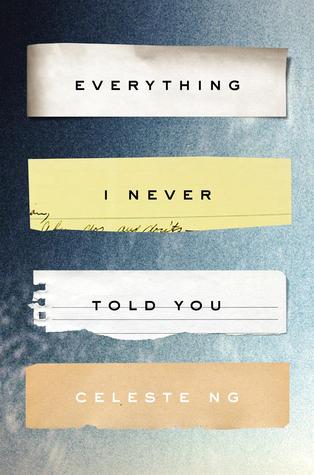
The book’s cover anticipates this stylized realism. The title, Everything I Never Told You, is handwritten – seemingly with a dried-out brush dipped in ink, or with an iffy-nibbed pen. The writing suggests the person holding the brush or pen is determined to finally tell the true story, as ragged and uneven and tender and unique as it necessarily is. And that we’ll probably remember it.

—Sharelle Moranville
The Opposite of Fate: Memories of a Writer’s Life, by Amy Tan

Amy Tan’s mother believed in ghosts and curses and lived her life expecting bad luck. A typical maternal warning:

“Don’t ever let boy kiss you. You do, you can’t stop. Then you have baby. You put baby in garbage can. Police find you, put you in jail, then you life over, better just kill youself.”

Her father was a Baptist minister who was guided by his Christian faith. His approach:

“Faith is the confident assurance that something we want is going to happen. It is the certainty that what we hope for is waiting for us even though we still cannot see it ahead of us.”

So Tan lived her life amid contradictions, in a home full of invited and uninvited ghosts, holy and otherwise.

After reading this compilation of essays about her life, it’s easy to believe that the connection between other worlds is far more tenuous than most pragmatic Americans like to believe. Tan has used bits and pieces of her life in her fiction, especially her relationship with her mother, But she was holding back some of the most bizarre elements of her story:

Her friend and classmate Pete was brutally murdered when they were in graduate school. Amy communicated with him in dreams so vivid she learned the names of his killers. And he told her to leave school and start a career in writing that ultimately led to her novels, which include The Joy Luck Club, The Bonesetter’s Daughter, and The Kitchen God’s Wife.

Tan’s mother spent three years in a Chinese jail for having an affair while she was married. When she got out, a chance meeting reunited her with the man with whom she had an affair, and the two got married and became Tan’s parents. Her father died young, of a brain tumor, only months after losing his son and Tan’s brother, also to a brain tumor.

Tan’s mother’s morbid obsession with death no doubt stemmed from watching her mother kill herself by eating raw opium.

Because the book was built out of existing work—magazine articles, speeches, introductions to other books, even long emails—it is a bit disjointed, with repetition of several stories and too little details on others. It came out a year after Tan was diagnosed with Lyme disease, which weakened her physically and mentally. Perhaps she felt she would not recover well enough to write a formal memoir.

She recently published Where the Past Begins: A Writer’s Memoir, another series of essays, although she’s not comfortable with being a memoirist. In an interview with The New York Times, she said:

“It’s like taking the mask off, taking your clothes off, and having people say, oh my God. It’s nonfiction, and people can make fun of the way you think or say, oh that was trivial.”

Clearly, her life has been remarkable and far from trivial, but it’s possible she might be accused of being unbelievable. As she notes in The Opposite of Fate, her truth is far stranger than fiction.

—Pat Prijatel