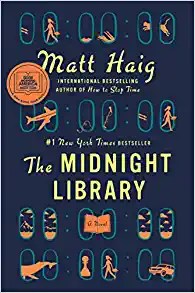
The Midnight Library, by Matt Haig

Nora Seed can no longer face the missed opportunities and unfulfilled potential that define her life, and she tries to kill herself. But rather than dying, she ends up in the Midnight Library, a zone between death and life, in a building full of books that contain her alternate lives. But first, she must read her own Book of Regrets, a thick volume of panic-inducing shoulda, coulda, wouldas. Her list consists of dropping out of a rock band just as it was about to sign a recording contract, calling off the wedding to the man of her dreams, backing out of competitive swimming, being a bad cat owner, and not becoming a glaciologist. The latter niggles on Nora’s consciousness after her beloved high school librarian, Mrs. Elm, suggested it decades ago as a possible career path.

Nora, who is 35 when we meet her, has more talent than the average human, but that means more chances to miss. At the Midnight Library, she meets Mrs. Elm again, who offers her a world of parallel universes in which she can embrace lives that erase her regrets. Mrs. Elm helps her decide which books she might open first, based on the mistakes she feels are her biggest. She opens a book and is off—to the remarkable success, happiness, and fulfillment her “root life” lacked. Or not, otherwise what kind of book would this be?

The chance to relive your life and overcome perceived failures is a popular theme in movies (It’s a Wonderful Life), television (Quantum Leap) and literature (Kate Atkinson’s Life After Life). It’s a means of offering the main character a way to redefine success, happiness, and fulfillment into digestible bites. Why did Nora pass up her chance to become an Olympian with such an obvious happy ending? As we learn, it’s for good reasons, but she’s forgotten them. In her backward glance, she sees only rosy promise, not the barriers that stood in her way. She thinks she had power and control that never existed.

As Nora experiments with one life after another, author Matt Haig shows that all decisions operate within a fluid environment, creating a context that we tend to simplify in our memories. We believe we could have done things we shouldn’t or couldn’t have. In Nora’s case, parents die, friends and family disappoint, people she loves mess with her head, and fate sometimes simply stinks.

But, as she learns, the winds that swirl around her also include real love and support, which she must first recognize and then accept. Basically, Nora has to recognize that perfection has never been in her grasp.

This is a book about shedding regret by gaining perspective. It’s full of quirky plot lines, with glimpses of opportunities and potential in unexpected places and people. Nora pays attention to the characters who populate her stories, who show up in multiple lives, and realizes that her life begins when she starts looking at her people and at the small details that create meaning and kicks the blame to the side. Is happiness defined by medals and albums and quaint English pubs? Or by simple, calm contentment?

It remains midnight in the library until Nora realizes that life in general is usually a mess and always uncertain and that humans, including her, are incurably flawed. This frees her to turn away from the dark and toward her own light.

— Pat Prijatel

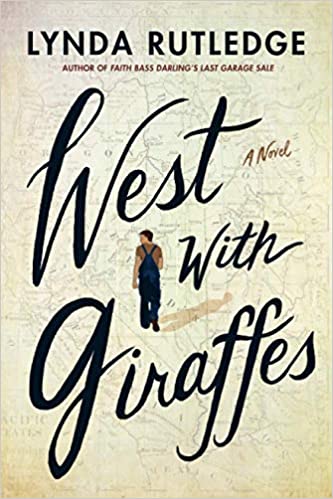
West With Giraffes, by Lynda Rutledge

West With Giraffes is a charming novel based on historical fact. Lynda Rutledge has taken the 1938 acquisition by the San Diego Zoo of two giraffes from Africa and told us their story. Belle Benchley, aka The Zoo Lady, was the first female director of a zoo, although she was not accorded her rightful title until she had been running the zoo for many years. She purchased two young giraffes from Uganda and had them shipped to New York. During their voyage, a massive hurricane nearly killed the female and destroyed people and property all along the eastern seaboard.

Our story begins with the journey of the two giraffes across a United States countryside mired in Depression. The giraffes provided much-needed excitement and entertainment as they proceeded through cities and small towns on their cross-country trip. Imagine trying to truck two giraffes across the country without any interstate highways!

That’s the factual part. The rest, while based on these historical facts, is both conjecture and delightful flight of fancy by Rutledge. She introduces us to Woodrow Wilson Nickel, whom we first see at the advanced age of 105 in a nursing home, trying to write the story of his youth. He remembers himself at 17 years old, starving, penniless, orphaned, arriving in New York from Dust Bowl west Texas in search of the only relative he knows. “Cuz,” though, has died in the hurricane. Woody spies the giraffes at the dock in New York harbor and is mesmerized. He steals a motorcycle and follows them to their quarantine location where he hides, steals whatever food he can find, watches and waits. When they begin their trip west, with their handler Riley Jones and a driver he has hired, Woody does whatever it takes to follow along.  

But so does “Red,” a young woman with a camera, a “borrowed” green Packard and a passionate longing to become a famous photographer like Margaret Bourke White.  She is hell-bent on taking photos of the entire journey that she will sell to Life Magazine. Woody is pretty mesmerized by Red, too! Not too long into the story, Woody is hired by Riley when the truck driver shows up drunk one day.

Adventure follows adventure as they meet up with various challenges (like mountain roads) and unscrupulous folks along the way. 

This book is not just a fun read, a good story engagingly told. It’s also a pretty clear picture of the state of the people of this country during the Depression. The description of Dust Bowl Oklahoma and Texas is wrenching. And the snapshot of “Okies” being turned away at the California state line is heartbreaking. More often than not, however, the resilience and determination of the characters – and their love of the giraffes – give the book a hook into our hearts that leaves us smiling.

— Jeanie Smith

The Magician’s Assistant, by Ann Patchett

In The Magician’s Assistant, Ann Patchett tells a wonderful story of real life. She shows us love, cruelty, joy, grief, reinvention, and revelation. The narrative is a delightful mashup of the dead and the living; the past and the present; Los Angeles and a tiny Nebraska town where the Walmart is a wonderland. As always, Patchett’s characters are notable in their particularity, and her settings (especially that rice paddy in Vietnam ☺) feel viscerally real. 

The book was published in 1997 and takes place in the nineties—a time when aids was a deadly scourge, homosexuals were often hated and feared, and the country was still dealing with fallout from the Vietnam war. Sabine, the main character, is paralyzed with grief because her beloved Parsifal (who married her only so she could be his widow) has died of an aneurysm in the footsteps of his Vietnamese lover, Phan, who died of AIDS. The Magician’s Assistant is a novel about grief. It also takes on homicide, domestic abuse, and family dysfunction. And by allusion, the holocaust and the Vietnam war. 

And yet. And yet, it is a remarkably loving story told with lots of glam, glitter, and hyperbole. 

The characters are kind to each other, with the notable exceptions of Guy’s father and Kitty’s husband, who become catalysts for transformation. The horrors of domestic violence motivate Guy to transform himself into Parsifal the magician. Howard’s meanness drive Kitty into Sabine’s bed. And Sabine and Kitty (we assume) will eventually find true love with one another. 

The story is realistically told, but with just enough razzle dazzle to make it feel like it’s about . . . well . . . magic. The opulence of Sabine’s house in Los Angeles; the incredibly fine detail of her architectural models, the huge, beautiful, pricey rugs. All those teeny beads Phan sews on Sabine’s wedding gown. The unsettling similarity in appearance of Parsifal and Kitty. The gorgeous androgyny of tall, thin Sabine wandering around in Phan’s silk pajamas. Plump, placid, omnipresent Rabbit. All a bit over the top, but so compelling—especially the dreams that feel more like travel in the afterlife. 

And then there’s Sabine’s card trick at the wedding. The morning before the wedding, “she found she could give the deck four extremely careless taps under any circumstance of noise with an utter lack of concentration and the aces still raced to the top of the deck like horses to the barn. That very morning, she had leaned out of the shower and tapped the deck four times with a soapy hand. Bingo. 

When she, in an act of faith that a magic trick with no trickery will actually work, performs this at Bertie and Haas’s wedding reception, the guests are underwhelmed. They would have preferred something flashier with baby chicks instead of a quiet card trick. But the bride intuits something special has happened. Perhaps the “trick” that is not a trick is a quiet but profound sign to Sabine. The Parsifal she adored for so many years—never suspecting how little she knew him, what a total trickster he was—has led her to his sister. He has made a miracle for her and Kitty. 

The Magician’s Assistant is the human condition revealed with pizzazz and affection. 

— Sharelle Moranville