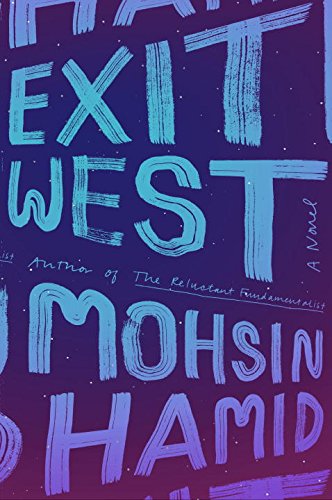
Exit West, by Mohsin Hamid

What if our borders weren’t physical? What if migrants could just suddenly show up in your living room or city park or backyard? Or in the church hall? No long lines, no showing papers, just displaced people popping up in your life after their own lives had disintegrated where they were?

In this intriguing book, Mohsin Hamid explores this question and, along the way, demonstrates what it looks like to become a refugee, to have your own world slowly fall apart as you try to live a normal life that becomes less possible every day.   

Two sweethearts, Nadia and Saeed, are young professionals in an unnamed Middle-Eastern country, typical middle-class citizens—she’s in insurance and he’s in marketing and they met at a seminar. But terrorists have taken over the city and it becomes increasingly unsafe. Hamid shows us the day-to-day changes, how the couple’s world gets smaller and smaller as terrorists gain strength. After Saeed’s mother is killed by a stray bullet, the couple decides to leave.

Their unique method of escape is through magical horizontal doors that take people from one country to another. It’s a difficult process—getting access to the doors is mysterious and entails knowing the right people and being able to pay the right fee. Going through them is turbulent and painful, looking a bit like being born, and in a way it is: Those who go through the doors become new people in lands new to them.

The idea for the doors, Hamid said in an interview with the PBS News Hour, was inspired by smart phone screens.

[R]ight now, most of us have a little black rectangle in our pocket or our backpack or our purse. And when we look at it, our consciousness goes far, far away from our bodies, like magically appearing somewhere else, looking at your phone, and suddenly you’re reading about the moon or Mars or Antarctica. And I thought, what would happen if your body could move as easily as your mind can move? I think technology is obliterating geographic distance. And so the doors in a way give life to that. 

 Hamid considers himself a lifelong migrant—from Pakistan to California, then back, then to London and back. He knows the migrant experience can be terrifying and, at times, deadly, because we do not focus on the fact that people who want to enter our countries are just that: people. But when migrants literally show up on our doorsteps we have to stop dealing with them as abstractions, as legal arguments and look them in the eye instead. Again, talking to the News Hour he says:

[W]e have become so focused on the story of how somebody crosses the border, how did you cross the Mediterranean in a small boat, or how did you cross the U.S.-Mexico border, crawl underneath the barbed wire? And we think that people who have done that are different from us. It makes us imagine that that’s all their life consisted of, and that’s very different from us.  

But once you take away that part of their story, you’re left with people who are just like us, actually, that any of us can have this experience. And so hopefully taking away that part of the story doesn’t minimize the importance in the real world that that happens, but reminds us that that is not what makes these people who they are. They are people just like us. 

Hamid also shows that we are all migrants in one way or another. In one of the many vignettes that pop up throughout the book he introduces us to a woman who has stayed in the San Francisco area her entire life, while the world has radically changed around her. His conclusion:

“We are all migrants through time.”  

Nadia and Saeed migrate through time and through space, facing anti-migrant attitudes in the Greek Island of Mykonos, London, and Marin County, California. Ultimately, the refugees are accepted, if not always welcomed, sometimes after riots, usually after chaos. Eventually the different cultures learn to live alongside one another, creating a new culture, which is a mash of the old. The initial acceptance comes, as usual, through foods.  

The book is not for those who want a literal and linear progression of plot and a clear sense of time and place. Hamid’s writing style can take a while to get accustomed to—most paragraphs are one sentence long, and the sentences can be a bit rambling. Yet this style matches the storytelling sense of the book and makes it more real. And the doors are shown before they are actually explained, so there are a few moments early in the book when the reader is not entirely sure what is going on. And the vignettes of unrelated people can be confusing.   

Hamid creates characters whose struggle is believable, relatable, and scary as hell. Every person who says migrants should go back to where they came from should have to read this book.

 Pat Prijatel

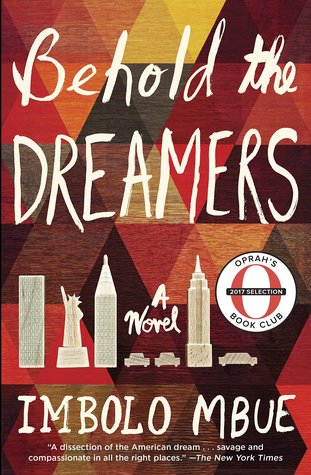
Behold the Dreamers, by Imbolo Mbue


Imbolo Mbue, herself an immigrant from Cameroon, has written a story focusing on two couples, one an immigrant family from Cameroon and the other, their upscale employers in New York City.  Mbue starts her story in the fall of 2007 and weaves a tale that combines the difficult decisions that many immigrants must face with the looming financial crisis.

As the book opens, Jende Jonga has just been hired as a chauffeur by Clark Edwards, a top executive for Lehman Brothers. This job enables Jende to bring his wife, Neni, and their 6-year-old son to New York, where Neni finds temporary work for Edwards’ wife, Cindy, at their summer home in the Hamptons.

All, of course, does not go smoothly.  Jende does not have his green card and has been assured by his “cousin,” acting as his immigration lawyer, that it is only a matter of time.  Together they craft an exaggerated story to document Jende’s claim of dire danger to himself – from Neni’s family in Cameroon — that will, hopefully, convince the immigration authorities to grant him asylum status.  In the meantime, Neni uncovers and documents Cindy’s drinking problem.

At the collapse of Lehman Brothers, Jende loses his job and with it, the Jongas’ ability to pay the rent on their modest apartment.  The financial squeeze leads Neni to take steps of her own that come as a surprise both to the reader and to Jende.

Throughout, Mbue shines her light on how these marriages work, and don’t work. Cultural differences play an important part, as we watch the Jongas through the lens of a strongly patriarchal background against the Edwards in a modern America where Cindy finds herself as a very wealthy stay-at-home mother/professional volunteer not quite in step with the times. Patterns of communication and non-communication, honesty and deceit, and saving face are woven together to craft a compelling story.

The ending was both disappointing to me and, strangely at the same time, inevitable. But however I was feeling at the time I read the conclusion of this book, I found the whole book eminently readable and insightful. Mbue has a strong voice and her characters are well drawn and true to human form, with their flaws and strengths, their compassion for one another and their casual disregard.  I cared about these people. And, for me, that’s one mark of a good novel.

— Jeanie Smith

An American Marriage, by Tayari Jones


Celestial and Roy have been married a little over a year when he is falsely accused of rape and sentenced to 12 years in prison. They’re both smart, educated, ambitious, highly focused, and African-American. He’s a marketing pro, she’s an artist. He’s her muse, she’s his inspiration.

In An American Marriage, Tayari Jones follows the couple through Roy’s incarceration, building up layers of background stories to question just what marriage is and how being American, especially African-American, defines it.

We learn about both sets of parents and their jagged paths toward one another, and we begin to understand how and why Celestial and Roy chose one another. Andre, who has loved Celestial since they were babies, is always a bit on the sidelines, adoring her even while introducing her to Roy and celebrating their marriage.

Eventually we meet Roy’s “Biological”—the ne’er-do-well drifter to whom he is biologically related, even though the man he calls Big Roy has always been his real father. Jones deftly shows us that there is more than one way to be a father.

Why do people choose who they marry? What draws people together and why do some marriages last and some not? Do we choose the partners we want or those we need? Does that matter?

This is a story of affluent Americans who face challenges typical of many couples, but who also have the issue of race as a threat in the shadows. Roy is clearly innocent, yet it takes his lawyer five years to work past the bigoted local justice system to get him cleared. Then he returns to find what home now looks like, to deal with a brittle spirit that has endured evils he never knew existed, and a life without the mother he adored.

Celestial has moved on and, in her defense, she asks Roy, “Would you have waited for me for five years?”

“This wouldn’t have happened to you,” Roy replies. She is, after all, not a black man. But what Roy doesn’t understand is the way in which being a woman has forced Celestial into a style of thinking and acting that confines her at the same time it defines her creative spirit. She is also broken.

Ultimately, they both find a level of comfort and, perhaps, end up where they should have been in the first place.

Celestial and Roy are alternately charming and annoying, selfish yet giving. An American Marriage offers plenty of questions but no easy answers. It’s worth reading twice—once to get the story, once to get the characters.

—Pat Prijatel