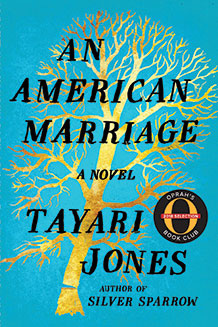
An American Marriage, by Tayari Jones


Celestial and Roy have been married a little over a year when he is falsely accused of rape and sentenced to 12 years in prison. They’re both smart, educated, ambitious, highly focused, and African-American. He’s a marketing pro, she’s an artist. He’s her muse, she’s his inspiration.

In An American Marriage, Tayari Jones follows the couple through Roy’s incarceration, building up layers of background stories to question just what marriage is and how being American, especially African-American, defines it.

We learn about both sets of parents and their jagged paths toward one another, and we begin to understand how and why Celestial and Roy chose one another. Andre, who has loved Celestial since they were babies, is always a bit on the sidelines, adoring her even while introducing her to Roy and celebrating their marriage.

Eventually we meet Roy’s “Biological”—the ne’er-do-well drifter to whom he is biologically related, even though the man he calls Big Roy has always been his real father. Jones deftly shows us that there is more than one way to be a father.

Why do people choose who they marry? What draws people together and why do some marriages last and some not? Do we choose the partners we want or those we need? Does that matter?

This is a story of affluent Americans who face challenges typical of many couples, but who also have the issue of race as a threat in the shadows. Roy is clearly innocent, yet it takes his lawyer five years to work past the bigoted local justice system to get him cleared. Then he returns to find what home now looks like, to deal with a brittle spirit that has endured evils he never knew existed, and a life without the mother he adored.

Celestial has moved on and, in her defense, she asks Roy, “Would you have waited for me for five years?”

“This wouldn’t have happened to you,” Roy replies. She is, after all, not a black man. But what Roy doesn’t understand is the way in which being a woman has forced Celestial into a style of thinking and acting that confines her at the same time it defines her creative spirit. She is also broken.

Ultimately, they both find a level of comfort and, perhaps, end up where they should have been in the first place.

Celestial and Roy are alternately charming and annoying, selfish yet giving. An American Marriage offers plenty of questions but no easy answers. It’s worth reading twice—once to get the story, once to get the characters.

—Pat Prijatel 
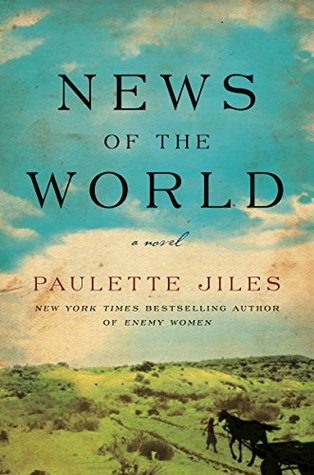
News of the World, by Paulette Jiles

In today’s world, we get our “news of the world” instantly, and literally, at the touch of our fingers—on computers, iPads, iPhones, TVs, car radios, and if you still read them, newspapers.

But a century before all that sophisticated, fun and sometimes overwhelming communications technology worked its way into our modern world, citizens were hungry for news of their states and of the world.

Enter Captain Jefferson Kidd, a grizzled elderly widower who has lived through three wars and  fought in two of them. He made his living in Texas as a printer until he lost his business during the War Between the States.  In 1870, at the age of 71, the Captain finds a new way to make a living and enjoy the freedom of the road. He travels from town to town and state to state, giving live readings from newspapers to audiences who are hungry for news of the world and who are willing to pay 20 cents to have him read it to them.

He enjoys his rootless, solitary existence. Then in Wichita Falls, he is offered a $50 gold piece to deliver a fiesty, 9-year-old orphan girl to her family. Four years earlier, a band of Kiowa raiders killed her parents and sister, but spared the little girl and raised her as one of their own. She was recently rescued by the U.S. Army. Now the grizzled old man and the lost little girl both have to learn to take care of each other and find their place in the world. Joanna tries to escape every way and every chance she gets, including throwing her shoes away. But slowly they begin to form a bond during their 400-mile journey, and begin to trust each other.

Jiles is a wonderful writer, telling an imaginative story. Her descriptions make both characters and their environment alive and believable. I loved every creative twist and turn of this book and couldn’t wait to see what happened to the Captain and Johanna.

— Gail Stilwill

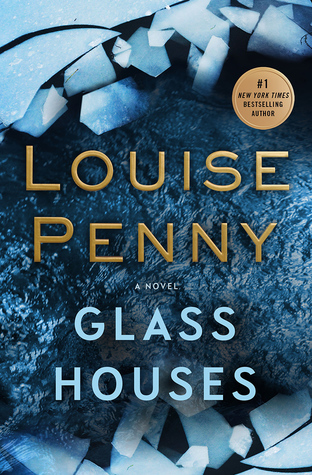
Glass Houses, by Louise Penny

For the thirteenth time, Louise Penny has written a number-one best selling mystery novel. And once again, Superintendent Armand Gamache (now promoted to Chief Superintendent of the Sûreté du Quebec) plays the leading role.  But this time Penny’s plot weaves two seemingly un-related stories together into an intricate mystery full of twists and turns, juicy details and humor. It’s a great read.  And, like all Penny’s Gamache mysteries, it is beautifully written.

The book opens on a steamy July day in an uncomfortably hot Montreal courtroom. Surprisingly, Gamache is the one on the stand.  We see a whole different side of his character as we watch and listen to his testimony about drug trafficking.  We learn that he is the courageous, behind-the-scenes leader of a secret, one-man very dangerous war against drugs.  It’s a war that could cost—or save—hundreds of lives. Including Gamache’s.

The second, seemingly un-related, story begins three months later on a cold, rainy November day in Three Pines with the sudden, mysterious appearance of a masked, cloaked figure.  He stands unmoving for hours, then days, on the Village Green thorough rain and sleet, staring at someone or something in the village.

Villagers come to believe that the figure is a Cobrador, a debt collector. According to history, they act as a conscience for someone who has committed a terrible crime.Villagers are curious, but soon become wary.  Gamache suspects the creature has a “dark purpose.” But he can do nothing but watch and wait for days, as his fears continue to mount. Then the creature vanishes as quickly and quietly as it arrived.  But the villagers’ relief quickly turned to fear when a body is discovered. And another murder mystery begins.

Penny toggles between the two stories, between the courtroom in Montreal and the village of Three Pines, putting her readers inside Gamache’s head as he slowly and meticulously unravels the mysteries.  She weaves an intricate plot, taking readers scene by tantalizing scene to the truth that finally solves the mystery.

— by Gail Stilwill