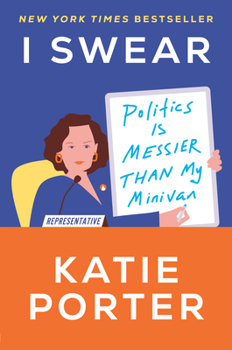
I Swear: Politics is Messier Than My Minivan, by Katie Porter

I Swear: Politics is Messier Than My Minivan is a memoir by Katie Porter, who was serving in her second term as the U.S. Representative for California’s 45th Congressional District in 2023 when it was published. While the book certainly highlights her accomplishments, it is also a window into the life of a woman trying to succeed at a highly demanding job in service to others while raising three children as a single parent.

Porter grew up in a very rural part of southern Iowa, and that background clearly informs her no-nonsense approach to both politics and family. Her childhood was spent on a small farm, sharing a tiny home with her parents and two feisty siblings. She looks back fondly on the simplicity of that life, but she also witnessed the anxiety and hardship of the 1980s farm crisis firsthand, including the day the town bank closed and the threat it posed to her family’s ability to continue their livelihood.

She must have stood out as a gifted student at her school, because she was invited by Iowa State University researchers to attend an elite academic summer program. That experience seems to have dramatically affected the trajectory of her life. Eventually she attended Phillips Academy, earned her undergraduate degree from Yale (writing her thesis on the effects of corporate farming on rural communities), and completed her law degree at Harvard, where she became a mentee of Elizabeth Warren.

After several years as a law professor, Porter notably testified before Congress in 2008 alongside Warren in support of the Credit Cardholders’ Bill of Rights, which was later signed into law. In 2012, Kamala Harris (then California Attorney General) appointed her as the state’s independent monitor for the $25 billion national mortgage settlement with major banks, such as Wells Fargo. She became internet-famous for making her points on a whiteboard – part of her crusade to stop predatory (and sloppy) practices that harm vulnerable homeowners. Her interest in running for congress was about gaining more power to continue this same work.

Although the book includes her professional achievements, it focuses a bit more on the reality of what it’s like to serve in Congress. She does not shy away from sharing personal foibles and things she learned the hard way. She writes openly about escaping an abusive marriage (at the urging of her campaign staff but at the consternation of her children), managing an intense travel schedule, and navigating the financial strain of public service without a spouse’s additional income or time. The book makes clear how challenging, if not impossible, it can be for an “ordinary” person with a family to serve in Congress, especially compared to candidates who can self-fund campaigns or rely on investment income.

Our group found ourselves wondering whether the criticisms she receives for being strident would land the same way if she were a man. Similarly, questions about whether she should have run for office while raising three young children alone seemed hard to separate from gender expectations.

Porter’s memoir is structured as a series of essays and short, nonlinear vignettes. Some in our group disliked the choppier format, but we felt that her voice throughout is real, direct, and accessible. Overall, Porter’s grit, humor, and unapologetic honesty make for an interesting read.

— Julie Feirer

The Anxious Generation, by Jonathan Haidt

If your child were given an invitation to join a colony living on Mars, would you let her go? What if she begged and pleaded? What if she reassured you that all her friends’ parents were allowing their children to go? What if several well-respected scientists chimed in, saying that it was probably safe, but they weren’t really sure because they hadn’t done any long-term studies about how life on Mars might affect her future growth and development? Would you let her go? Of course not, explains author Jonathan Haidt, in his compelling introduction to The Anxious Generation: How the Great Rewiring of Childhood Is Causing an Epidemic of Mental Illness.

Haidt goes on to explain that children, of course, were never being sent to colonize Mars, but that we took a comparable gamble with our children’s mental health and social development when we handed them smartphones in the early 2010s. And our children are the ones who have lost.     

Haidt, a social psychologist and professor at NYU, has amassed a staggering amount of research into an absorbing and highly readable book. He argues that the generation born since 1995 are experiencing a mental health crisis, citing alarming statistics about increased loneliness, isolation, anxiety, depression, and rates of suicide and self-harm.

Although his statistics are terrifying, Haidt’s examination of the cause of this mental health crisis is fascinating. He effectively argues that the linchpin of this mental health epidemic came in the early 2000s, when we became overzealous in the protection of our children in the real world, while simultaneously underprotecting them on the Internet and on social media.  Haidt takes on the role of historian and sociologist as he describes how the ‘play-based childhood’ of the 1980s and prior decades faded away and gave rise to what he calls the ‘phone-based childhood.’ He becomes an anthropologist and psychologist as he explains basic human biological needs for risky play, independence, and rites of passage in order to become fully-realized adults. Haidt closes the book by offering hope and practical suggestions for the rehabilitation of our skewed relationship with technology, but the overall effect of the book is sobering.

The Anxious Generation has spent over a year parked on the NYT bestseller list, and Fareed Zakaria called it the “defining book on the generation that grew up with technology in the palms of their hands.” This book is engrossing, timely, important, and highly recommended for anyone who wants to help the children in their lives develop into mentally healthy, emotionally well-adjusted adults.  

— Marcy Luft

On the Brink of Everything: Grace, Gravity & Getting Old, by Parker J. Palmer

Parker Palmer describes an exchange he had with his friend and long-time editor Sheryl Fullerton. She asked him if he was interested in writing another book. His reply, “I don’t have the energy for it. But I’m really enjoying short-form writing—brief essays and a little poetry.” She went on to suggest weaving the essays and poetry into a book. His reply:  “…a book has to be about something. My short pieces have been all over the map.” She went on: “That’s not true….Parker, do you ever read what you write?” Parker: “Of course not. Why should I? I write the stuff. But, OK, I’ll bite. What pray tell, have I been writing about?” Sheryl: “Getting old! That’s what you’ve been writing about. Didn’t you know?”

Thus, the genesis of this little book. As our group read along, we had many criticisms. Some thought the writing was not as good as it should have been. More critiqued the editing. Each of the seven sections of the book has an introduction, a collection of two or three essays, perhaps some poetry, and a conclusion. And the seven sections are preceded by a Prelude and followed by a Postlude! It’s sort of “First I’m gonna tell you what I’ll tell you. Then I’ll tell you. Then I tell you what I told you.”

Interestingly, however, much as many of us found things to criticize, we also found much to admire. There are gems here, some from Palmer himself and some from those whom he quotes, notably Thomas Merton. 

From a commencement address he gave in 2015: “To grow in love and service, you must value ignorance as much as knowledge and failure as much as success…Everyday, exercise your heart by taking in life’s pains and joys. That kind of exercise will make your heart supple, so that when it breaks—which it surely will—it will break not into a fragment grenade but into a greater capacity for love.”

From his musings on being contemplative: “Catastrophe, too, can be a contemplative path, pitched and perilous as it may be. I’m still on that path, and daily I stay alert for the disillusionment that will reveal the next thing I need to know about myself and/or the world.”

And on how we take on tasks: “As long as we’re wedded to results, we’ll take on smaller and smaller tasks, the only ones that yield results. If we want to live by values like love, truth, and justice—values that will never be fully achieved—‘faithfulness’ is the only standard that will do. When I die, I won’t be asking about the bottom line. I’ll be asking if I was faithful to my gifts, to the needs I saw around me, and to the way I engaged those needs with my gifts—faithful, that is, to the value, rightness, and truth of offering the world the best I had, as best I could.”

For me, specially, I was much affected by this poem from Parker J. Palmer:

Waving Goodbye from Afar
(for Angie, Ian, Vincent, and John)

One by one, their names have been
exhaled in recent weeks, fading into thin air
on their final breath: Angie, Ian, Vincent, John.

I talked, laughed and worked with them, we
cared about each other. Now they are gone.
No, they do not live on—just watch the world

keep turning in their absence, a tribute here
and there depending on the fame of the fast-
fading name. I’ve always thought it would

be good if a few who loved me sat with me
as I died. Now, as I learn from friends who’ve
taken sudden leave, I’m glad all I can do is

wave goodbye from afar, knowing they can’t
see me. It feels right to offer them an unseen
final salute, seeking no attention, unable to

distract them from a journey each of us must
make alone. It must be a breathless climb, the
kind I’ve made many times in the mountains

of New Mexico. The last thing I wanted there
was someone who just had to talk, when it was
all I could do to climb, to breathe, then stop—

marveling at the view, wondering what’s up top.

— Jeanie Smith