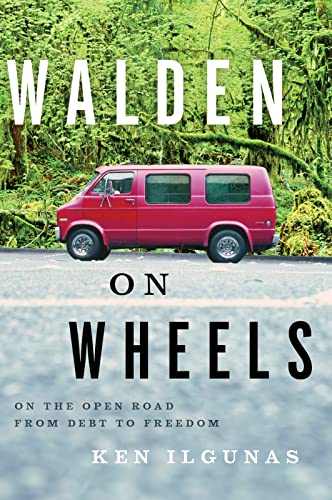
Walden on Wheels, by Ken Ilgunas

Walden on Wheels by Ken Ilgunas is many things. It’s a diatribe against student debt, an Alaskan adventure, a how-to on living simply, a reflection on the benefits of physical labor and liberal arts education, a tale of hitchhiking and characters encountered, a biting commentary on the typical American lifestyle and consumerism, and the documentation of a social experiment in which the author becomes an undercover van-dweller in order to obtain a master’s degree at Duke and come out debt-free. Also, it’s a glimpse inside the mind of a college-aged male as he comes of age and develops his voice as a writer, with a nod to Henry David Thoreau. 

Ken Ilgunas was raised in a caring, hard-working family in upstate New York. He did well in school and was both intellectual and athletic, but not particularly involved. He went off to college at the prescribed moment and earned a degree, but deeply regretted the amount of debt he incurred for it, without any palatable job prospects on the horizon. He felt victimized.  

Strapped by how much he owed and wanting to move forward on his own terms, he set out on a series of adventures in wild Alaska. There he lived very simply in exchange for room and board, and he did just about anything that was asked of him – washing dishes, leading tours, cleaning abandoned facilities – as long as he could shrink his debt with every check he sent home.  

Alaska was painfully lonely, with all his downtime spent on reading and one sketchy relationship, giving him space to clarify his thirst for education. His attention returned to college, but he knew he could not stomach the traditional costly living arrangement of grad school. Therefore, as a modern-day Thoreau might have done, he mustered all his spartan Alaskan training and went to the outskirts of campus to live deliberately in a cheap Ford Econoline van that he purchased on Craigslist and outfitted at Walmart. By day he was able to attend classes and use the campus facilities at the library and the gym; by night he cooked, slept, and studied in the van. In the end, he accomplished the goal of obtaining his master’s degree from Duke, debt-free. 

At the outset of his van-dwelling experiment, Ilgunas started a blog. In a series of posts during his two and a half years engaged in Liberal Studies at Duke, he wrote on practical and anecdotal topics such as “Dealing with the cold,” “What’s that smell?”, “So my mom knows about the van…”, “Of Mice and Ken,” and many more. When he was finally ready to tell all, he was able to pull content from these posts and write a coming out (of the van) story for his creative writing class. It made a big hit and he was encouraged to publish it, which he did in Salon magazine. From there he received nudges from publishers to consider writing a book, and he returned to Alaska to do that. He documented the publishing phase too, in posts called “To get a book deal, part 1” and “…part 2”.   

In response to the article, Duke gave him the honor of speaking at his graduation, but they also clarified their parking and transportation rules to officially ban van-dwellers from anywhere on campus henceforth. 

Like the book itself, the voice of Ken Ilgunas is many things. At times he comes off as smug, arrogant, and holier-than-thou. But when he isn’t ranting, he is also self-deprecating and sensitive. A good example of this can be seen in the exchange of e-mails with his friend, Josh, some of which he includes in the book. They contain all the profanity and trash-talk you might expect between two 20-something guys talking privately, but they also shared “politics, religion, worries, dreams, anything and everything… the more personal, the more self-admonishing – the stuff that a person feels most inclined to bottle up.” They were interested in jobs and women, but also with the Holocaust, Armenian genocide, the African American civil rights movement, the gay rights movement, poverty, the environment, and how “corrupt governments are empowered by a complacent citizenry.”  

Inadvertently, while he intended to document and share his adventures in nature and time in the van, what he also does is let the reader observe the nebulous period of growth from boy to man. At times he is downright eloquent. Describing his view of the aurora borealis, he wrote:

The sky lit up with spumes of reds, pinks, purples, and blues that swooped, twisted and curled into each other. There was no sense, no order, no logic to the aurora’s movement. It moved wildly and swiftly, changing into a different shape from one moment to the next. It was a glowing, throbbing, sashaying curtain of color, a Rorschach test that looked like whatever you wanted it to look like: a heavyset grizzly, a woman’s hips, a highway climbing hills. The aurora was a powwow of ancestral spirits – writhing apparitions, conjured from the depths of a village bonfire. It was a desert storm, a million individual particles of light whipping over dunes in patterns that no human mind could comprehend or computer generate. The aurora is alien and unworldly, but it does not frighten or flabberghast; it is a tranquilizer that sprinkles down onto its onlookers an opiate from the heavens. It puts you at ease. 

The fact that he did not set out to write a book with Walden on Wheels makes the whole feel a bit cobbled together. But he developed as a writer in the process, and the book did get national attention. He went on to use these skills to create a writer’s life for himself, satisfying his ongoing needs for freedom, adventure and study. His subsequent books are more focused and organized than the first, but still retain a great combination of experimentation, fact-finding and storytelling. 

In a 2009 blog post entitled “Thoreau’s Disciple,” Ilgunas wrote: “The ascetic who immerses himself in nature or embarks on a holy pilgrimage wishes to thrust himself into the very throes of life. In so doing, he leaves the tidy, formulaic and unwavering character of conventional life to plunge into the very breeding grounds of the authentic experience. By relying on our instincts and wits rather than on our wallets and families, we test ourselves, learn, grow; we can, in this way, reinvent our identities.” 

A gap year right out of high school might have been a less costly way to go and equally clarifying for Ken Ilgunas, but the journey that resulted in Walden on Wheels was an authentic ride worth living and sharing. It was also well worth the read. 

— Julie Feirer

Walk in a Relaxed Manner, by Joyce Rupp

I know Joyce Rupp a little because we’re both part of casual, ever-changing local writers’ group. She is a keen world traveler; I’m a stubbornly reluctant traveler. Once at a writer’s gathering, she took me aside to give me quiet advice about packing for a trip to Italy. I would describe her as elegant, yet sturdy. Reserved, yet kind and willing to share.

The fact that she did not plan to share her experience of walking the Camino de Santiago de Compostela, but meant it to be a very private pilgrimage for her own spiritual growth, is perhaps what makes the book feel so authentic and accessible. If she had walked all of September and most of October over five hundred miles of northern Spain knowing she was going to write a book at the end, surely she would have been shaping and filtering as she went. She would have been taking photos and making notes. Documenting. Planning. Instead, she kept a small, private, journal.

In her introduction she shares how her determination to keep her Camino experience private changed. In a moment of synchronicity after her return, right after she had expressed once again her determination not to write about it, she was confronted with Joseph Campbell’s—whom she admires—conviction that the returning pilgrim (hero) has an obligation to gift the community with an account of the journey.

And so she did.

In the Contents, she lists 25 life lessons she learned from the Camino: Go Prepared, Live in the Now, Experience Homelessness, etc. These lessons are learned from the cacophony of snores of fellow pilgrims, the beauty of the Pyrenees, and vineyards heavy with purple and green grapes. From blisters wrapped in duct tape, bathroom noises, poetry, and puddles of vomit. From a fox running through the chestnut trees and a cockroach swimming in the hot chocolate. From sharing scarce food, taking the time to watch ants, and finding fellow pilgrims who also love Barbara Kingsolver books.

From her privations and blessings, she feels what it means to be food insecure, to be suspected of being a shoplifter, to live without being clean as the homeless sometimes must do. From her exhaustion comes clarity. From a September 15 journal entry: Today I realized it has taken me many days of walking to finally reach a clearness inside that is allowing me to contemplate all I see. It was gradual—beginning with the magnificent grapes in the vineyards. Now I can look at this old bench I sit on, rusted green, bird poop, highway noise nearby, and I can be still inside. I can look at the shape of the bench, the holes, the patches of corrosion and “see” it with my “special eyes.” I need to “see” people’s faces more, to read the sacredness there, too.

Over the years, I’ve recommended and/or loaned this book to several people who are neither particularly spiritual nor adventurous, and it has been valued by all as a good and important read. As a reluctant traveler, I will never walk the Camino de Santiago de Compostela. But echoing Thoreau 😄 : I have travelled much in West Des Moines because of wonderful books like this. I’ve come to know we are all pilgrims, every day. And it is good to Embrace Beauty, Live in the Now, and Walk in a Relaxed Manner.

— Sharelle Moranville

The Sound of a Wild Snail Eating, by Elisabeth Tova Bailey

I started this book with a bunch of trepidation because of the strange title. Who would have thought of a story about a snail? Who would have thought that watching a snail go about its daily life would help someone get through a devastating illness? Who, also, would have completed so much excessive factual research into a small, relatively insignificant animal?

I mean, how interesting can a snail be? Entirely captivating, as it turns out. Enjoying reading the book slowly, I found that perhaps there’s something to be said for moving at a snail’s pace. I found the book to be a fascinating glimpse into the life of an animal most of us ignore or even dislike, and ended up with a new-found appreciation for a miraculous little creature that I never thought much about before — except that I hated them eating my hostas every Spring. 

In a work that beautifully demonstrates the rewards of closely observing nature, The Sound of a Wild Snail Eating is Elisabeth Tova Bailey’s account of her uncommon encounter with a common woodland snail (she never gave it a name) when she is bedridden with a mysterious pathogen she contracted during a trip to Europe. She withstood long months unable to even turn over in bed without exhausting herself, spending those months in a room with a window she couldn’t see out of and surrounded by plain white walls.

But, one day a friend brings her a pot of wild violets with—of all things—a snail in it. The mere idea of the responsibility for this is almost overwhelming for Elizabeth, but the quiet, slow, peacefulness of the snail gradually wins her over. What started as a bizarre unwanted gift became her main focus and companion.

Spending long hours watching the snail, Bailey becomes an astute and amused observer, providing a candid and engaging look into the curious life of this underappreciated small animal. She found that a snail’s world is far more interesting than one might imagine as they get by with only three senses—smell, taste, and touch. She became fascinated and intrigued by the snail’s molluscan anatomy, clear decision making, hydraulic (slimy) locomotion, and mysterious courtship activities (e.g. Romantic encounters between a pair of snails can take up to seven hours from start to finish!)

Set over the course of one year, she and the snail share an intimate journey of survival and resilience. With a naturalist’s curiosity, and told with wit and grace, Bailey delves into a wealth of gastropod literature, filling her chapters with fascinating mollusk biology (They have thousands of teeth! They can mate with themselves!)

Author Bailey reminds us that every living creature is here for a reason. Her book is well-written and is one of those sleeper books that could become a classic. The only thing that would have made it better would have been color photographs.

— Kenn Johnson