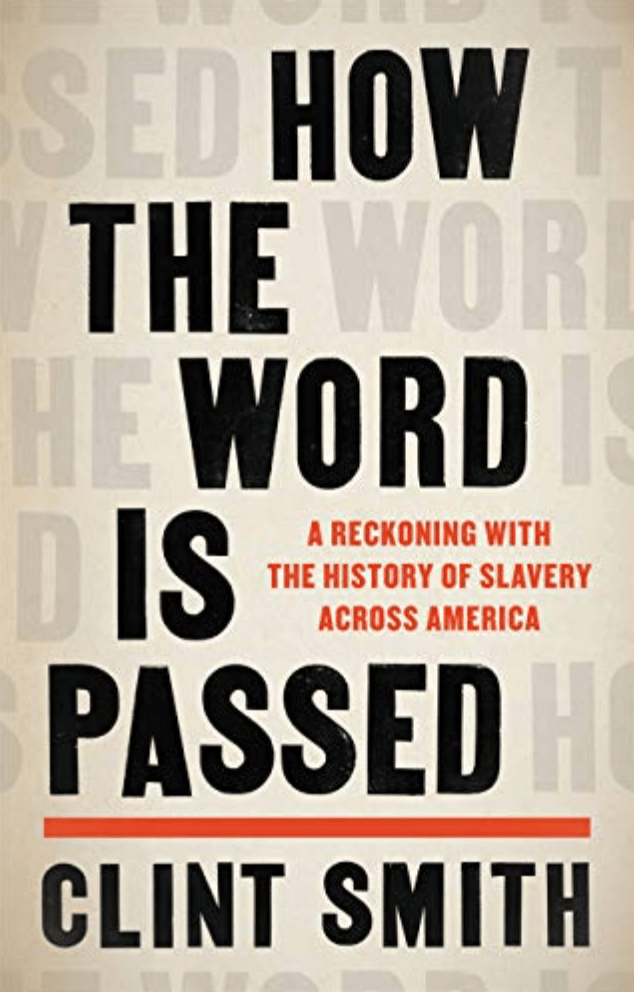
How the Word is Passed, by Clint Smith

This is a remarkable book unlike any other than I have read as I have explored over the past two years books on racism, anti-racism, caste, mass incarceration, the realities of slavery. This book is in many ways a travelogue. But a very specific travelogue, exploring sites all over the US – and one in Africa – that illuminate our history with enslavement and its aftermath. Smith visits and talks to other visitors and guides at:

  • Jefferson’s home at Monticello, Virginia, where he takes a tour that not many others take, seeing the realities of Jefferson as a slave-owner and as the father of enslaved children;
  • Whitney Plantation in Louisiana, which is the only plantation devoted to looking at life from the perspective of the enslaved;
  • Louisiana State Penitentiary at Angola, the largest and one of the most brutal prisons in the United States, built on the site of a former plantation, where African-Americans represent 76% of the incarcerated population;
  • Blandford Cemetery in Virginia, the resting place of over 30,000 Confederate soldiers, where he attends a Sons of Confederate  Veterans (SCV) commemoration celebration;
  • Galveston Island, Texas, where the last enslaved people were finally informed of their freedom after the end of the Civil War and where the Juneteenth celebration was born;
  • the Wall Street area of lower Manhattan in New York City, most of which was built by enslaved persons and which housed a thriving slave auction site until 1762; and
  • Goree Island off the coast of Senegal, where 33,000 people were chained and passed through the House of Slaves and the Door of No Return to be loaded into the holds of ships for the “Middle Passage” cross-Atlantic trip to permanent enslavement in the colonies and the emerging United State; this is a place where today the local population grapples with how to teach their history to their children.

What is remarkable about this book to me is Smith’s gentle courage. He manages to talk directly, but without accusation, with those who do not see life through the same lens. We hear from organizers of the SCV celebration, the tour guides and gift shop proprietor at the prison in Angola, along with many others. He hears their stories and then gently asks them to see things from the Black American point of view.

In a beautiful epilogue, Smith talks with his grandparents. They tell of stories received from their grandparents who were enslaved. They remember their own stories of the Jim Crow south.

Smith’s prose evokes clear images of the places he visits and the people with whom he talks. This is a beautiful book. If you’re interested in dipping your toe into some of the recently published books on “our original sin” and its aftermath, this is an excellent place to begin.

— by Jeanie Smith

The Silk Roads: A New History of the World, by Peter Frankopan

Peter Frankopan, an Oxford historian, sweeps us through the last 2,000 years of world history, showing us how it looks from an Asian perspective rather than from the European perspective that dominates our educational experiences. He posits that the Middle East, Central Asia, call it what we will, is the focal point of the world’s trade in ideas, commerce and wealth. For most of these 2,000 years, Europe was a backwater, not the driving force we imagine. He gives us example after example of how European events reacted to events in Asia — from the crusades to colonization of the Americas, the industrial revolution, and the world ward of the 20th Century.

Frankopan’s perspective intensifies as he nears the present; forty percent of the text deals with the period from World War I to the present. As we were reading this book during the final days of the US withdrawal from Afghanistan, the immediacy of Western cluelessness about this part of the world was poignant. If only Frankopan’s broader worldview had been a part of our foreign policy considerations over the last century!

This book is a long, hard read. At over 500 pages thick with unfamiliar names and places, it feels encyclopedic. Most of us felt the effort was rewarded with a new outlook on world affairs and international relationships. It is the textbook to the world history course we wish we had taken. For those looking for the Cliff Notes version, two related books are available. Frankopan has published The Silk Roads, and Illustrated New History of the World (2018), aimed at young adult readers and found in the children’s section of our library. It was a welcome companion for several of us. Another member was sent Frankopan’s The New Silk Roads: The Present and Future of the World (2019), which extends his discussion into the world he sees unfolding in Asia today. We have added it to our list of possible future books.

— Bill Smith

Classic Restaurants of Des Moines and Their Recipes, by Darcy Dougherty-Maulsby

I moved to Des Moines in 1970 and have always enjoyed eating out in Des Moines restaurants, so was very pleased to get a copy of Darcy Maulsby’s new book. What a fantastic gift for food-loving residents in Iowa. It was such fun to flip through these pages and reminisce about past dining adventures in Des Moines and see recipes for favorite local dishes. So, after reading a few chapters, and enjoying it so much, I recommended it to my book club, which agreed to read it.

In the early 70’s most of the restaurants in Des Moines, it seemed, were Italian. We tried them all: Johnny’s Vets Club, Fatinos, Tursi’s Latin King, Noah’s Ark, Chuck’s, Gino’s, even Alice’s Spaghettiland (even though it was a long drive). Later in years, we went frequently to Ajno’s as it was nearby our house. But, after a while other types of restaurants also became popular.

When I worked for Iowa Hospital Association in the early ’70s, I officed on Ingersoll, not too far from Colorado Feed and Grain. We often stopped there after work for drinks, and occasionally at dinner there. We were so regular that the waitresses all knew what we meant when we ordered our “usual”. We also ate lunch regularly at close by Maxie’s. I remember smelling like french fries after returning to work. I still eat at their West Des Moines place and always enjoy the Maxieburger.

Also in the 70’s and 80’s my wife and I ate at Bishop’s Cafeteria, as our good friend (and best man at our wedding) was the manager there and often joined him and his wife for dinner there. About the same time, the top of the Holiday Inn was a favorite place, as it rotated once every hour, giving a great view of Des Moines.

Without my wife knowing, I used to sneak out to get an occasional drink at Ruthie’s, who was famous for balancing a beer glass on each of her 48DD’s. Another place I went to without my wife (as she hated it) was George the Chili King. It was handy for lunch and I loved their chiliburgers.

Later, in the 90’s and beyond, Court Avenue was a favorite place in the evenings. Spaghetti Works, Kaplan Hat Co.,  The Metz, Gringo’s, and Julio’s were regular evening haunts for my wife and I and our kids. I also officed downtown and spent many lunch hours there.

For many years (not so much recently) we regularly attended the State Fair. We even camped out there a couple of years with good friends. Our favorites were corn dogs, pork tenders, and turkey legs. Although Darcy mentioned that the food there never changes, the DM Register published an article on July 13 that specified that there are 63 creative new dishes at the Fair this August.

For many years, I regularly ate breakfast with a business partner at the Drake Diner, and since then, our grandchildren love to go there for dinner in the evenings. We also used to go regularly to Stella’s Blue Sky Diner (at both the one in the Skywalk and in Clive), but stopped going there after finding a bandaid in my dinner.

Darcy included a large chapter about Babe Bisignano and Babe’s, his famous restaurant. What a life he led, and she covered it from his early life and well beyond. I remember often going there to eat and he was always going around, visiting with all the customers and often offering them a free drink. After I bought a downtown restaurant in 1988, I found that the previous owner had taken a lot of the restaurant equipment. But Babe took me down to his basement and gave me a dishwasher and other equipment — for free. He had a colorful personality, tough exterior, but a kind heart.

Now for a review of the book:

Author Maulsby serves up a “feast” of Des Moines restaurant classics, mixed with their history, complete with iconic recipes. She brings back many fond memories for anyone who has visited or lived around Des Moines.

In addition to writing about many restaurants in the Des Moines area, she also covered a number of famous people, including Ronald Reagan, who lived in Des Moines in the 30’s, and Roger Williams, who as an 18-year old kid majoring in music in Des Moines, got his first professional job playing piano at Babe’s, and went on to become one of the world’s most famous pianists. She even covered the life of Edna Griffin, who, on July 7, 1948, was denied service at the downtown Katz Drug Store. Her actions preceded Rosa Parks’ bus ride, and resulted in civil actions every bit as important in attacking racism.

And, Darcy covered a number of other restaurants I have enjoyed over the years, including Taste of Thailand, Younkers Tea Room, Big Daddy’s BBQ, The Pier, King Ying Low’s, Maid Rite and The Machine Shed. And well beyond restaurants and recipes, she also gives savory stories of race relations, women’s rights, Iowa Caucus politics, the arts, immigration and assimilation.

In conclusion, it was such a “delicious” book of local history and food — and such fun to scan through the pages, bringing back so many special memories of Des Moines eateries. I highly recommend it.

Ken Johnson