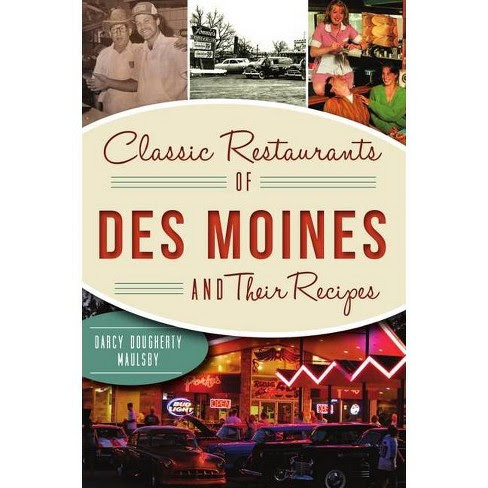
I moved to Des Moines in 1970 and have always enjoyed eating out in Des Moines restaurants, so was very pleased to get a copy of Darcy Maulsby’s new book. What a fantastic gift for food-loving residents in Iowa. It was such fun to flip through these pages and reminisce about past dining adventures in Des Moines and see recipes for favorite local dishes. So, after reading a few chapters, and enjoying it so much, I recommended it to my book club, which agreed to read it.
In the early 70’s most of the restaurants in Des Moines, it seemed, were Italian. We tried them all: Johnny’s Vets Club, Fatinos, Tursi’s Latin King, Noah’s Ark, Chuck’s, Gino’s, even Alice’s Spaghettiland (even though it was a long drive). Later in years, we went frequently to Ajno’s as it was nearby our house. But, after a while other types of restaurants also became popular.
When I worked for Iowa Hospital Association in the early ’70s, I officed on Ingersoll, not too far from Colorado Feed and Grain. We often stopped there after work for drinks, and occasionally at dinner there. We were so regular that the waitresses all knew what we meant when we ordered our “usual”. We also ate lunch regularly at close by Maxie’s. I remember smelling like french fries after returning to work. I still eat at their West Des Moines place and always enjoy the Maxieburger.
Also in the 70’s and 80’s my wife and I ate at Bishop’s Cafeteria, as our good friend (and best man at our wedding) was the manager there and often joined him and his wife for dinner there. About the same time, the top of the Holiday Inn was a favorite place, as it rotated once every hour, giving a great view of Des Moines.
Without my wife knowing, I used to sneak out to get an occasional drink at Ruthie’s, who was famous for balancing a beer glass on each of her 48DD’s. Another place I went to without my wife (as she hated it) was George the Chili King. It was handy for lunch and I loved their chiliburgers.
Later, in the 90’s and beyond, Court Avenue was a favorite place in the evenings. Spaghetti Works, Kaplan Hat Co., The Metz, Gringo’s, and Julio’s were regular evening haunts for my wife and I and our kids. I also officed downtown and spent many lunch hours there.
For many years (not so much recently) we regularly attended the State Fair. We even camped out there a couple of years with good friends. Our favorites were corn dogs, pork tenders, and turkey legs. Although Darcy mentioned that the food there never changes, the DM Register published an article on July 13 that specified that there are 63 creative new dishes at the Fair this August.
For many years, I regularly ate breakfast with a business partner at the Drake Diner, and since then, our grandchildren love to go there for dinner in the evenings. We also used to go regularly to Stella’s Blue Sky Diner (at both the one in the Skywalk and in Clive), but stopped going there after finding a bandaid in my dinner.
Darcy included a large chapter about Babe Bisignano and Babe’s, his famous restaurant. What a life he led, and she covered it from his early life and well beyond. I remember often going there to eat and he was always going around, visiting with all the customers and often offering them a free drink. After I bought a downtown restaurant in 1988, I found that the previous owner had taken a lot of the restaurant equipment. But Babe took me down to his basement and gave me a dishwasher and other equipment — for free. He had a colorful personality, tough exterior, but a kind heart.
Now for a review of the book:
Author Maulsby serves up a “feast” of Des Moines restaurant classics, mixed with their history, complete with iconic recipes. She brings back many fond memories for anyone who has visited or lived around Des Moines.
In addition to writing about many restaurants in the Des Moines area, she also covered a number of famous people, including Ronald Reagan, who lived in Des Moines in the 30’s, and Roger Williams, who as an 18-year old kid majoring in music in Des Moines, got his first professional job playing piano at Babe’s, and went on to become one of the world’s most famous pianists. She even covered the life of Edna Griffin, who, on July 7, 1948, was denied service at the downtown Katz Drug Store. Her actions preceded Rosa Parks’ bus ride, and resulted in civil actions every bit as important in attacking racism.
And, Darcy covered a number of other restaurants I have enjoyed over the years, including Taste of Thailand, Younkers Tea Room, Big Daddy’s BBQ, The Pier, King Ying Low’s, Maid Rite and The Machine Shed. And well beyond restaurants and recipes, she also gives savory stories of race relations, women’s rights, Iowa Caucus politics, the arts, immigration and assimilation.
In conclusion, it was such a “delicious” book of local history and food — and such fun to scan through the pages, bringing back so many special memories of Des Moines eateries. I highly recommend it.
Ken Johnson