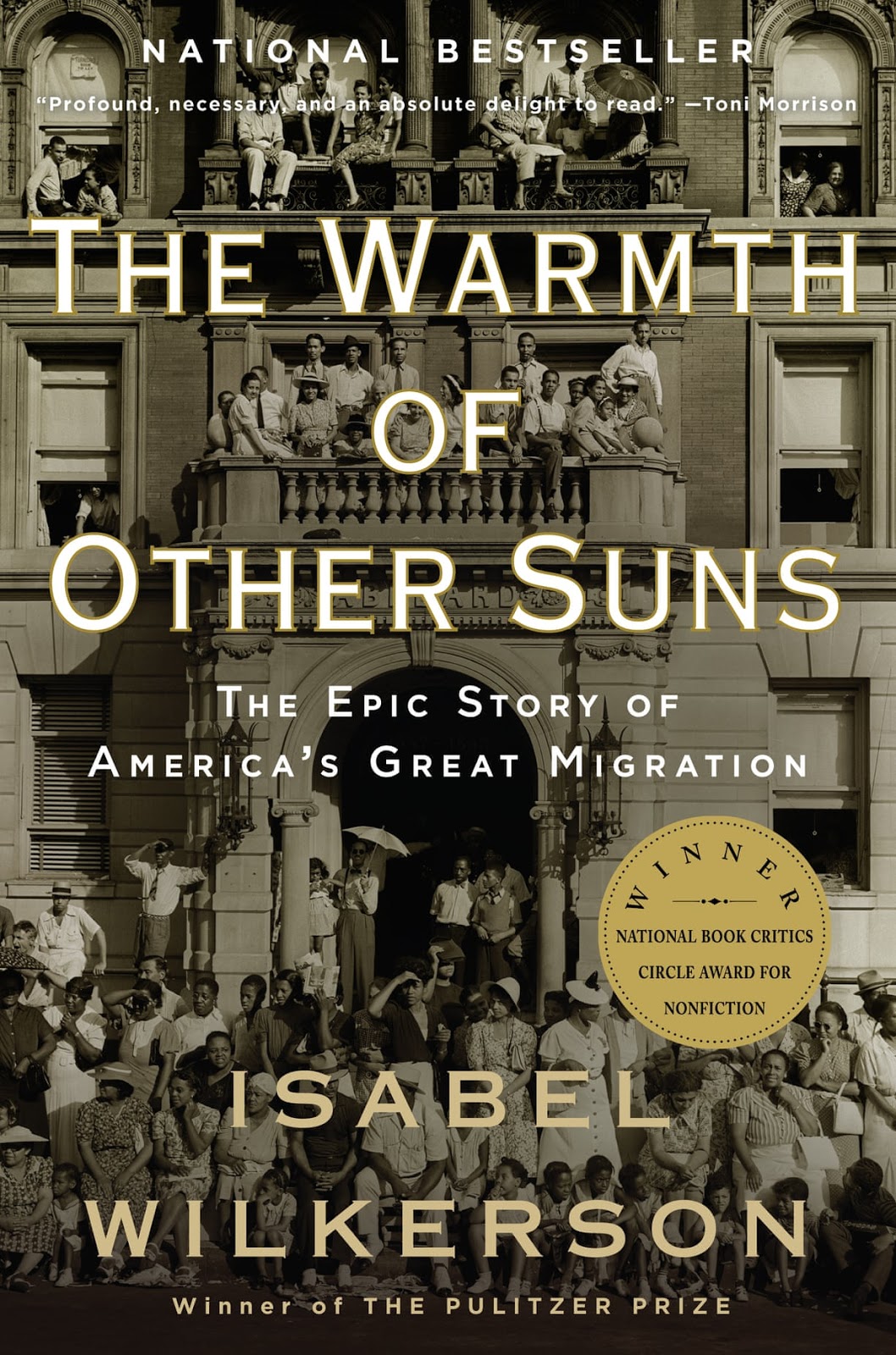
In her massive, beautifully written and masterly account of the Great Migration, Isabel Wilkerson chronicles one of the greatest untold stories of American History – the exodus of almost six million black citizens who fled the south for northern and western cities in search of a better life – forever changing the United States, especially the makeup of big cities.
The Warmth of Other Sunsis Pulitzer Prize-winning author Wilkerson’s first book. The title is borrowed from the black writer Richard Wright who fled Jim Crow Mississippi in the 1920s.
I was leaving the South
To fling myself into the unknown ..
I was taking a part of the South
To transplant in alien soil,
To see if it could grow differently,
If it could drink of new and cool rains,
Bend in strange winds,
Respond to the warmth of other suns
And, perhaps, to bloom.
— Richard Wright
Between the beginning of the First World War through the end of the Civil Rights Movement, 1915 and 1970, millions of African-Americans summoned up the courage to leave their bleak lives in the Deep South in order to give themselves and their children hope for the future. Because this pattern of migration lasted for several generations and spread over many states, it was difficult to see it happening as it occurred and most of its participants were unaware that they were part of an important demographic upheaval and dynamic shift in residency.
Wilkerson is the daughter of migrants herself and showed empathy, profound affection and compassion toward her subjects, allowing the reader to share that connection. If nothing else, Wilkerson is thorough. She interviewed approximately 1,200 people, reviewed hordes of official records, and took numerous road trips on her way to create this landmark piece of nonfiction – to tell a story she thought everyone should know.
With stunning historical detail to describe the migration, Wilkerson focuses on biographies of three very different migrants; each representing a different decade as well as a different destination and each carrying with them a different set of circumstances that factored into their decisions to leave. The details of routine racial discrimination that these people faced both before and after migrating are horrifyingly vivid and impossible to ignore.
Ida Mae Brandon Gladney, born in 1913, was a sharecropper’s wife from Mississippi. They both were relegated to picking cotton. They worked all day and all year, and at the end of it they usually broke even, which was considered lucky, because most sharecroppers ended up with nothing but debt to show for their labor, at least by the boss’s accounting. A woman was expected to pick a hundred pounds of cotton a day, and she hated it. Living in a Jim Crow society with no hope for the future, in 1937 she and her husband George, and their two children secretly boarded a midnight train to Milwaukee, where her sister lived. They decided to leave because a cousin down the road was almost beaten to death by a white posse that wrongly suspected he stole some turkeys. Fearing he would be next, and tired of working dawn to dusk for pennies, George told Ida Mae to pack up the family.
Miss Theenie, Ida Mae’s mother, then drew them close to her, as she always did whenever anyone was leaving. She had them bow their heads. She whispered a prayer that her daughter and her daughter’s family be protected on the long journey ahead in the Jim Crow car. “May the Lord be the first in the car,” she prayed, “and the last out.”
They eventually settled in Chicago’s south side, where George found work in a soup factory and Ida Mae in a hospital as a nurse’s aide. Although blue collar jobs, the Gladney’s made the most of their opportunity, never missing a day of work, and even becoming long time home owners, and their children attended a desegregated school. Chicago became their home for the rest of their lives and they never regretted their decision.
Before setting foot on the streets of Chicago, Ida Mae had never even thought about voting. Indeed, no black person she had known back in Mississippi would have dared to talk openly about such a right. But in the Windy City she was free to vote for the first time — and did so in the 1940 presidential election, casting her ballot for Franklin D. Roosevelt, and later also voted for Barack Obama when he ran for the Illinois Senate.
Isabel Wilkerson met Ida Mae in 1996, when Ida Mae was eighty-three years old. She was still living in the second floor apartment of the house that her family had bought in 1967. She lived with dignity and respect to be ninety-one. She died in her sleep, in 2004, at home.
George Starling, a bright and ambitious man was the valedictorian of his colored high school in central Florida, but dropped out of college when his money ran out. So he went to work picking oranges in the fields. Appalled by the working conditions, he tried to organize a work stoppage for higher wages and better working conditions, but was warned that the local growers, backed by a homicidal sheriff, were planning a “necktie party” for him. He also boarded a midnight train, which was bound for New York. He lived in Harlem where he was free to live his life as he pleased.
As fate would have it, he took a porter’s job on the same train that once brought him north. It had a route from New York to Florida, the very place where he had so longed to escape. That’s where he became an advocate for African American passengers. Surprisingly, though, given George’s intelligence and drive, he was never once promoted away from his boringly repetitious job, one that he endured for more than 40 years.Through his faith in God, he eventually made enough peace with the south to go back to live there as an old man.
Robert Joseph Pershing Foster had the most privileged background of the three main characters. The son of demanding middle-class parents in Monroe, Louisiana, he was educated as a physician at Morehouse, the most prestigious black college in America. An accomplished surgeon, Foster had no rights to practice in the south, even as the son-in-law of the president of a prestigious black college. So he decided that he wouldn’t waste his time in the south being paid with “the side of a freshly killed hog”, and knowing that other Monroe residents had moved to Los Angeles, made the decision to travel there in his red 1949 Buick. Wilkerson writes of his long, hungry and lonely drive west where he could find no motel that would rent him a room or restaurant which would serve him—all because of the color of his skin.
One of my favorite quotes in the book, Robert said “How could it be that people were fighting to death over something as ordinary as being free to go and do as you please, like sitting in a diner with everyone else and eating a meal.”
After an initial struggle, he had established a private practice in Los Angeles and sent for his wife and daughters.After changing his name from Pershing to Robert, even Bob, he matured into one of California’s finest surgeons, with a successful medical career which allowed him to purchase a grand home where he threw exuberant parties. Revered by all of his patients for his entire career, Dr. Foster was the personal physician of Ray Charles who wrote a song about him. Becoming addicted to gambling, Las Vegas became a second home. He lived a wild life and lost most of his wealth at the Vegas tables. Regrettably, something in his character prevented him from ever relishing the many blessings in his life.Still, at his funeral, he was mourned by his grandchildren enrolled in Ivy League schools.
Their stories are different and unique, yet they intertwine, and are interspersed with other stories of the South. They are gripping and full of life. Having spent many days and hours with the three and their families, it is clear that she became attached to them emotionally — personalized and humanized them – making the reader hope and root for them.
Wilkerson uses scholarship to quash the misconceptions that the migrants were uneducated, shiftless and promiscuous. She uses census data, stating that migrants from the South were on average better educated than those who stayed and soon would have a higher level of education than the blacks they joined in the North, and even more than the northern white population. Or that migrants had higher levels of employment. And, contrary to common belief, the migrants were more likely to be married, remain married, and less likely to bear children out of wedlock.
The Great Migration shaped America’s urban cities, their culture, the geography of neighborhoods, and the beginnings of suburbanization and housing projects. Overall, this book did a lot to explain why some cities, and even some sections of those cities transformed from white to predominately black. It did a lot to explain how those from Georgia and Florida migrated mostly to Boston and New York, and those from Alabama and Mississippi moved to cities like Detroit and Chicago, and those from Louisiana and Texas went to California. Wilkerson is superb at minding the bends and detours along the way.
The Warmth of Other Suns is a bold, remarkable and riveting account of an unrecognized immigration throughout the United States, and nearly impossible to put aside. Through the beauty of writing, the depth of her research, and the fullness of the people and their lives portrayed, the book is a classic. It serves as an important tool for better understanding of the trials and tribulations of black Americans in the 20thcentury. At 622 pages, it is something of an anomaly in today’s shrinking world of nonfiction publishing, but so immensely readable as to, what one reviewer said, “would land her on a future place on Oprah’s couch.”
—Ken Johnson

 Books, Brews & Banter