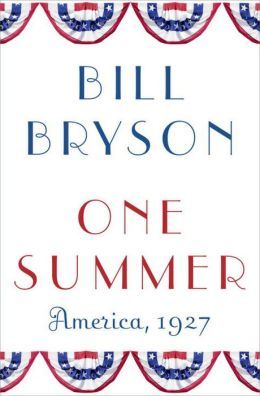
One Summer: America, 1927, by Bill Bryson

In One Summer: America, 1927, Bill Bryson—a prodigious researcher and a talented storyteller—takes us on a meandering journey through four months in a pivotal American year. He starts with the devastating Mississippi flood, pauses to introduce us to Charles Lindbergh and then interrupts that with a story about Babe Ruth, then it’s on to Henry Ford, Calvin Coolidge, Al Capone, Al Jolson, Sacco and Vanzetti, Gene Tunney, and a batch of lesser characters.

He weaves these stories into a narrative that is hilarious, fascinating, frustrating, terrifying, and educational.

Apparently women weren’t yet invented, because Bryson introduces us to only a few—the notorious Ruth Snyder who conspired with her lover to kill her husband, Warren Harding’s wife who may or may not have poisoned him but who nevertheless refused to allow his body to be autopsied, and Clara Bow, the silent movie star and original “It” girl whose career nosedived because her nasal voice was too jarring to withstand the talkies.

That aside, this book is a delight. Bryson’s style is delicious and the details he shares are compelling and often bizarre. A few examples:

• President Coolidge reportedly worked an average of only four hours a day, napped more than any other president, and took three months off to live in South Dakota where he play-acted as a cowboy, complete with oversized hat and chaps. While he was there, he gave the nod to the creation of Mount Rushmore.

• Men apparently urinated wherever with startling abandon. President Warren Harding was reported to urinate in the White House fireplace. And Al Jolson, star of The Jazz Singer, urinated on people as some sort of joke. Bryson notes that this could explain why he had four wives and few friends. Why he had any of either is surprising.

• Hordes of people—tens of thousands—congregated wherever Lindbergh landed and overwhelmed him so much that he occasionally avoided them by coasting for extended periods at 30 feet above what might well have been terrified farmers and their cows. One measure of the size of his following: the ticker-tape parade thrown for him in Manhattan in 1927 generated 1,800 tons of debris. In contrast, the armistice parade of 1918 created a paltry 155 tons.

• “There was almost nothing Henry Ford did that didn’t have some bad in it somewhere,” Bryson writes. Case in point: his “Fordlandia” settlement in Brazil, an Americanized city plopped down into the rain forest, with cozy frame houses, a Main Street, and paved avenues that dead-ended in the jungle on all sides. Not surprisingly, it was a flop.

• The wonderfully-named Philo Farnsworth may actually have invented the television but the idea was stolen, which made him so mad \”even his hair looked angry.”

• The Mississippi flood covered 16.5 million acres and cost more 1,000 lives. The human loss was “perhaps several times that,” Bryson cynically writes, but those counting “weren’t more scrupulous because, alas, so many of the victims were poor and black.”

• Bryson calls this time period “the Age of Loathing,” noting, “There may never have been another time in the nation’s history when more people disliked more other people from more directions and for less reason.” For example, Ku Klux Klan groups formed throughout the country and were full of community “leaders” opposed to Catholics, Jews, Italians, and most other “foreigners.” And the pseudoscience of eugenics was backed by top scholars, physicians, politicians, and the Supreme Court, which upheld the “right” of states to forcibly sterilize tens of thousands of Americans, considered “imbeciles” and expendable. Most at risk were the poor and unmarried women.

• Xenophobia was literally the law of the land. “Iowa, to be on the safe side, outlawed conversations in any language other than English in schools, at church, or even over the telephone,” he writes. “When people protested that they would have to give up church services in their own languages, Governor William L. Harding responded: ‘There is no use in anyone wasting his time praying in other languages than English. God is listening only to the English tongue.’”

• The Federal Reserve, supported by four odd ducks from the United States, England, France, and Germany, met and, with the best of intentions, set the stage for the Great Depression in 1929.

• Railroads were sometimes built with little rhyme or reason. Bryson writes about one such line, the Pere Marquette, which “wandered confusedly around the upper Midwest, as if looking for a lost item.” And he offers a more general point about our fond memories of railroads: “The romance of travel wasn’t always terribly evident to those who were actually experiencing it.”

• When Babe Ruth was seven, his father, knowing he did not have the resources to raise him properly, dropped him off at St. Mary’s Industrial School for Boys. Without this, he might have had no career. One of the Brothers at the school was an avid baseball fan, and his coaching got Ruth started on the sport. By 19, he was playing professionally, first as a pitcher and ultimately as a hitter. He was a remarkable athlete but a dazzlingly uncouth person.

• For book lovers, this could have been the Good Old Days. “The 1920s was a great time for reading altogether—very possibly the peak decade for reading in American life,” Bryson writes. “Each year, American publishers produced 110 million books, more than 10,000 separate titles, double the number of ten years before. For those who felt daunted by such a welter of literary possibility, a helpful new phenomenon, the book club, had just made its debut. The Book-of-the-Month Club was founded in 1926 and was followed the next year by the Literary Guild.”

Bryson, our hometown talent, is a treasure. Few writers could take all this data and turn it into such a captivating maze of mesmerizing tales. Fewer still would do the type of research that gives the stories credence. —PEP
The Color of Water, by James McBride

The Color of Water is a success story, a testament to one woman’s true heart, solid values, and indomitable will.  The story is told in two voices which alternate throughout the book. In telling his mother’s story, along with his, James McBride addresses racial identity with compassion, insight, and realism. It is, in a word, inspiring.  

McBride, a journalist and musician, explores his mother’s past, recreating her remarkable story, as well as his own upbringing and heritage in a poignant and powerful debut novel. He skillfully relates his life story and his coming to terms with his mixed ethnic and religious heritage, with chapters conveying his mother’s travails and development into a fervent Baptist.
 
His mother, born Rachel Shilsky, who changed her name to Ruth to be more American, is a story of a woman whose parents fled the anti-Jewish pogroms of Central Europe and landed in a Suffolk, Virginia, a violently racist small southern town, there to be faced by new anti-Semitism and racial prejudices and develop a few of their own.  Her father, rabbi turned storekeeper, was a cold, sexually abusive tyrant who kept his children in virtual servitude, exploited his black customers, and ultimately abandoned his wife.
 
However, her grim upbringing is left behind when she moves to Harlem, marries Dennis, a black minister, fervently adopts Christianity, and raises eight children. When she fell in love with Dennis, she said “He came from a home where kindness was a way of life.  I wanted to be in this kind of family.  I was proud to join it, and they were happy to have me.” However, they experienced a certain degree of prejudice as a result of their interracial marriage.  They opened the New Brown Memorial Church together.  Then Dennis fell ill with lung cancer and died just before James was born.
Widowed, alone and poor, she struggled fiercely to raise her family. Then she remarried to Andrew McBride, another black man, and raised four more children before he also died.
 
James reports that he grew up in “orchestrated chaos”, with his eleven siblings in the poor, all-black projects of Red Hook, Brooklyn. As a child, he became aware that his mother was different from others around him.  She was white, and she kept secrets. It is her voice, unique, incisive, at once unsparing and ironic, that is dominant in this paired history, and its richest contribution.
 
In the answer that gives the book’s its title, she says “God’s not black. He’s not white.  God is the color of water.  Water doesn’t have a color.” She schemed shrewdly to have all her children buses to schools predominately in Jewish neighborhoods, sure that learning was a priority there.  James was pleasantly surprised when he learned during his senior year in high school that he had been admitted to Oberlin College.  He and his eleven siblings all completed college and led successful careers.
 
The triumph of the book is that race and religion are transcended in these interwoven histories of family love, the sheer force of a mother’s will and her unshakable insistence that only two things really mattered: school and church, a respect for education and religion. Issues of race and identity took secondary importance to her beliefs.
 
At 65, Ruth went back to school and earned a college degree in social work.  She remains in close contact with her children, holding holiday gatherings where everyone sleeps on the floor or rugs in shifts, double or triple in bed – just like the old times.
 
The Color of Waterwill make you proud to be a member of the human race. This moving and unforgettable memoir needs to be read by people of all colors and faiths.  The two stories, son’s and mother’s, beautifully juxtaposed, strike a graceful note, particularly at this current time of racial polarization.—Kenneth N. Johnson

DEAD WAKE, by Erik Larson

Few tales in history are more haunting or more fraught with secrets than that of the final voyage of the Lusitania, which resulted in one of the most colossal tragedies of maritime history.  Author Erik Larsen ushers us aboard the Lusitania, the fastest ship of its day, on its way from America to England, when on May 7, 1915, it was torpedoed by a German submarine 12 miles off the coast of southern Ireland.  It sank in 18 minutes, 1,198 passengers and crew perished.  Only six of the 22 lifeboats were launched, and many passengers drowned because they donned their life-jackets incorrectly.

Once again, Larson demonstrates his expert researching skills and writing abilities — switching between the hunter and the hunted, his detailed forensic and utterly engrossing account of the Lusitania’s last voyage, highlights that unpredictable shifts in weather, the many small decisions made by the captains of both the luxury liner and U-Boat, a chance fog, the slowing down to get mail, and numerous other circumstances, all converged to placing the liner in precisely the wrong place at exactly the wrong time.

In Dead Wake, Larson brings to life a cast of evocative characters on board the Lusitania, including the famed Boston bookseller Charles Luriat who come on board with a priceless copy of Dickens’ “A Christmas Carol”, pioneering female architect Theodate Pope, millionaire Alfred Vanderbilt, and art collector Hugh Lane, who carried sealed tubes containing paintings by Rembrandt and Monet. Apart from the Lusitania, Larson also explores that part of the life of President Woodrow Wilson, who was grieving about the death of his wife, but smitten and captivated by the prospect of new love with Edith Galt, and Winston Churchill, then the first Lord of the Admiralty, who hoped to bring America into the war, and whose ultra-secret spy group failed to convey intelligence that might have saved the liner.

This book is excellent when describing the lethal new technology of early submarine warfare, life inside the U-boats, its cramped quarters, “the reek of three dozen men who never bathed”, and the omnipresent danger. Following his government’s new policy of unrestricted warfare, Captain Schweiger fired a single torpedo into the Lusitania’s hull, blowing a hole the size of a house beneath the liner’s waterline.  Less than a minute later, a second explosion shuddered from deep within the bowels of the Lusitania, and she listed precariously and began to sink immediately.

Unsettling questions clung to the case in the years that followed. Was the ship somehow allowed to sail into a trap? Why had the British Admiralty failed to provide a military escort? What was the cause of the second explosion? Why did Germany then decide to attack civilian shipping? There remains a mystique about the disaster, with questions that remain unresolved, and may never be.

Gripping and important, Dead Wake captures the sheer drama of the disaster.  Put in context of World War 1, the sinking of the Lusitania altered the course of history by ultimately dragging the U.S. into the conflict, although it was two years later.  I agree with one reviewer who suggested that Larson’s book “practically begs Hollywood blockbuster treatment.”

— Ken Johnson


p.s. After reading Dead Wake, I mistakenly assumed that the U-Boats were the first submarines.  But, with a little research, I found that the first submarine known to have attacked an enemy ship was the Turtle, piloted by Ezra Lee of the American Continental Army.  He piloted the Turtle under a British flagship, attempting to attach an explosive charge to the bottom of the ship.  He was unable to successfully attach it, so was forced to give up the attempt.  But George Washington personally congratulated Lee on his survival and gave him a job in the secret service.


There were a number of other experiments over the next 80+ years, but during the Civil War, submarine development got kicked up a notch. The most well-known Union sub was the USS Alligator, designed by a Frenchman named Brutus de Villeroi, who listed his occupation as “natural genius”.  The Alligator was lost during a storm, before attacking the Confederates.


But the most famous Civil War sub was built by a Horace Hunley, who egotistically named his boat the Hunley. During a test, however, the Confederate sub flooded and five crew members were drowned. It was salvaged though, and on its second attempt, Hunley failed to pull out of a dive and the sub became stuck in the sea floor.  The crew were unable to open the hatches, and Hunley and all his crew perished. Again, it was salvaged and took its first action against the Union, ramming the USS Housatonic with a torpedo protruding from the front of the sub.  After backing away from the Housatonic, the torpedo was charged, sinking the ship within five minutes.  Thus, the Hunleywas the first sub ever to sink an enemy ship, securing its place in naval history. —KJ