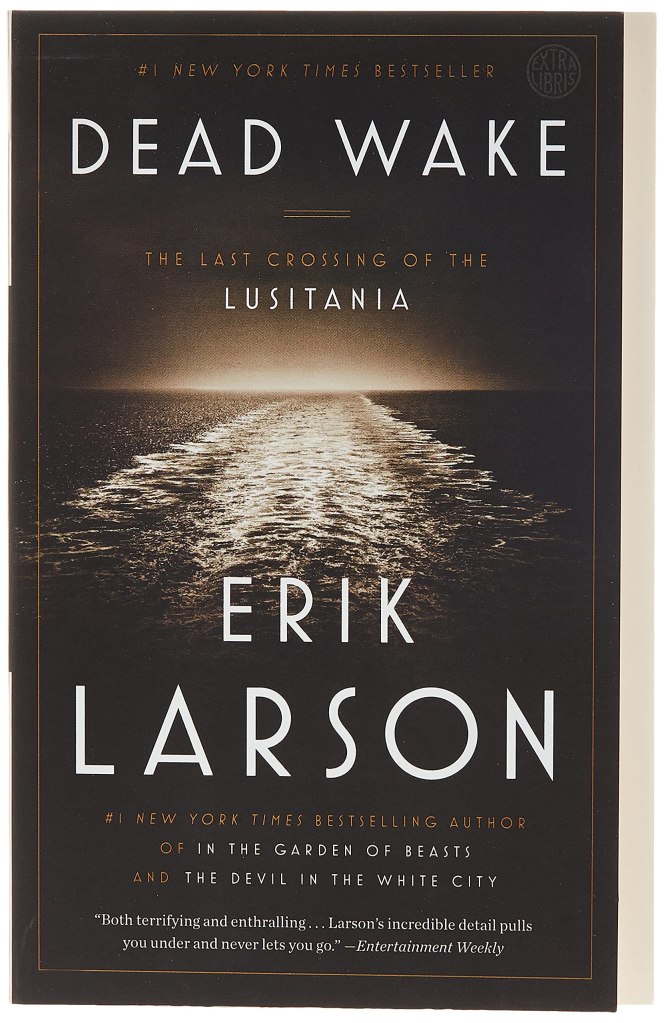
DEAD WAKE, by Erik Larson

Few tales in history are more haunting or more fraught with secrets than that of the final voyage of the Lusitania, which resulted in one of the most colossal tragedies of maritime history.  Author Erik Larsen ushers us aboard the Lusitania, the fastest ship of its day, on its way from America to England, when on May 7, 1915, it was torpedoed by a German submarine 12 miles off the coast of southern Ireland.  It sank in 18 minutes, 1,198 passengers and crew perished.  Only six of the 22 lifeboats were launched, and many passengers drowned because they donned their life-jackets incorrectly.

Once again, Larson demonstrates his expert researching skills and writing abilities — switching between the hunter and the hunted, his detailed forensic and utterly engrossing account of the Lusitania’s last voyage, highlights that unpredictable shifts in weather, the many small decisions made by the captains of both the luxury liner and U-Boat, a chance fog, the slowing down to get mail, and numerous other circumstances, all converged to placing the liner in precisely the wrong place at exactly the wrong time.

In Dead Wake, Larson brings to life a cast of evocative characters on board the Lusitania, including the famed Boston bookseller Charles Luriat who come on board with a priceless copy of Dickens’ “A Christmas Carol”, pioneering female architect Theodate Pope, millionaire Alfred Vanderbilt, and art collector Hugh Lane, who carried sealed tubes containing paintings by Rembrandt and Monet. Apart from the Lusitania, Larson also explores that part of the life of President Woodrow Wilson, who was grieving about the death of his wife, but smitten and captivated by the prospect of new love with Edith Galt, and Winston Churchill, then the first Lord of the Admiralty, who hoped to bring America into the war, and whose ultra-secret spy group failed to convey intelligence that might have saved the liner.

This book is excellent when describing the lethal new technology of early submarine warfare, life inside the U-boats, its cramped quarters, “the reek of three dozen men who never bathed”, and the omnipresent danger. Following his government’s new policy of unrestricted warfare, Captain Schweiger fired a single torpedo into the Lusitania’s hull, blowing a hole the size of a house beneath the liner’s waterline.  Less than a minute later, a second explosion shuddered from deep within the bowels of the Lusitania, and she listed precariously and began to sink immediately.

Unsettling questions clung to the case in the years that followed. Was the ship somehow allowed to sail into a trap? Why had the British Admiralty failed to provide a military escort? What was the cause of the second explosion? Why did Germany then decide to attack civilian shipping? There remains a mystique about the disaster, with questions that remain unresolved, and may never be.

Gripping and important, Dead Wake captures the sheer drama of the disaster.  Put in context of World War 1, the sinking of the Lusitania altered the course of history by ultimately dragging the U.S. into the conflict, although it was two years later.  I agree with one reviewer who suggested that Larson’s book “practically begs Hollywood blockbuster treatment.”

— Ken Johnson


p.s. After reading Dead Wake, I mistakenly assumed that the U-Boats were the first submarines.  But, with a little research, I found that the first submarine known to have attacked an enemy ship was the Turtle, piloted by Ezra Lee of the American Continental Army.  He piloted the Turtle under a British flagship, attempting to attach an explosive charge to the bottom of the ship.  He was unable to successfully attach it, so was forced to give up the attempt.  But George Washington personally congratulated Lee on his survival and gave him a job in the secret service.


There were a number of other experiments over the next 80+ years, but during the Civil War, submarine development got kicked up a notch. The most well-known Union sub was the USS Alligator, designed by a Frenchman named Brutus de Villeroi, who listed his occupation as “natural genius”.  The Alligator was lost during a storm, before attacking the Confederates.


But the most famous Civil War sub was built by a Horace Hunley, who egotistically named his boat the Hunley. During a test, however, the Confederate sub flooded and five crew members were drowned. It was salvaged though, and on its second attempt, Hunley failed to pull out of a dive and the sub became stuck in the sea floor.  The crew were unable to open the hatches, and Hunley and all his crew perished. Again, it was salvaged and took its first action against the Union, ramming the USS Housatonic with a torpedo protruding from the front of the sub.  After backing away from the Housatonic, the torpedo was charged, sinking the ship within five minutes.  Thus, the Hunleywas the first sub ever to sink an enemy ship, securing its place in naval history. —KJ

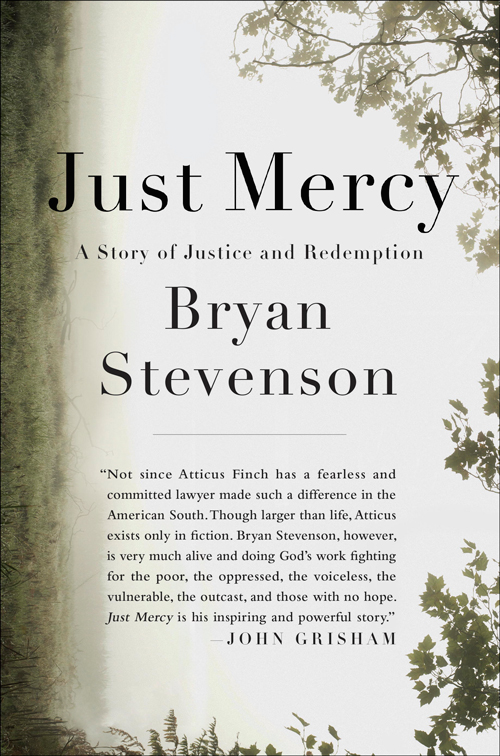
Just Mercy: A Story of Justice and Redemption by Bryan Stevenson

As I write, Arkansas is trying to execute eight men on a calendar of two a day, every other day, for over a week, beginning next Monday, April 17. The state “needs” to kill the men before the medications used in the lethal injections expire. Most of these men have been on death row for over twenty years, and now they are rushed to death because of an expiration date on a drug.

I can hardly bear to think, talk, or read about capital punishment because it feels so fundamentally wrong. So I’m amazed at how Bryan Stevenson could turn a book about death row into truly A Story of Justice and Redemption.

Stevenson is a wonderful storyteller, spotlighting individuals whom he has helped, or tried to help, since he founded the Equal Justice Initiative to defend those often wrongly condemned and trapped in the criminal justice system.

Stevenson gives horrifying numbers for what has happened in that system, to whom it has happened (mainly poor and/or dark skinned people), why it has happened, what it costs – both in terms of dollars and suffering.

He explains where we go wrong when we (with good intentions) personalize victims such as seven year-old Megan Kanka, for whom Megan’s Law is named. He explains the profit motive in incarceration.

But mainly he shows us people like ourselves, but without affluent white privilege: Walter McMillan, a black man sentenced to die for a murder he patently did not commit; Herbert Richardson, a traumatized young veteran who only meant to scare a pretty young nurse into his arms with a homemade bomb, but killed a child instead; Marsha Colbey, a mother who suffered the sadness of a stillborn child, but was demonized as a murderous parent because she was very poor; and more.

What most impresses me (and puzzled me a little at first) is Stevenson’s calm, steady perseverance: every day he walks into prisons and courthouses where the people in power are not glad to see him. They are not willing to listen, or reconsider, or admit a centimeter of error even in the face of plain and undeniable facts.

How does he keep doing such work day after day, year after year, understaffed and beleaguered by people desperate for his help?

I think his superpower comes from an amazing lack of ego. He never lets the challenges become about him. He kept his focus on others, on their needs. He admits his own brokenness – indeed, he recognizes it as a gateway to grace. And that grace, mingled with intelligence and training, keep him going. It sounds so simple, but seems so hard. I’m inspired and instructed and humbled. Just Mercy was a perfect choice for a Lenten read.

— Sharelle Moranville

Hillbilly Elegy, by J.D. Vance

This book, subtitled A Memoir of a Family and Culture in Crisis, is exactly that, a memoir.  Hard to think of a memoir written by someone who was only 31 years old when he wrote it! Vance himself confesses the absurdity of this in his introduction where he writes, “I didn’t write this book because I’ve accomplished something extraordinary.  I wrote this book because I’ve achieved something quite ordinary, which doesn’t happen to most kids who grow up like me.  You see, I grew up poor, in the Rust Belt, in an Ohio steel town that has been hemorrhaging jobs and hope for as long as I can remember.”

And so Vance begins to tell his story. What makes this story compelling is that, while it tells of all the ways in which the decline of manufacturing jobs in the United States has left people behind, he is unflinchingly honest about the ways in which many of his people, whom he calls “hillbillies,” have brought about their own demise and their own lack of hope – their lack of care for their children, their sinking into the drug culture, their laziness and lack of any self-awareness.

Vance’s own family has had its difficulties.  As he writes, “I have, to put it mildly, a complex relationship with my parents, one of whom has struggled with addiction for nearly my entire life.”  He himself came close to flunking out of high school: “Whatever talents I have, I almost squandered until a handful of loving people rescued me.  That is the real story of my life, and that is why I wrote this book.  I want people to know what it feels like to nearly give up on yourself and why you might do it.  I want people to understand what happens in the lives of the poor and the psychological impact that spiritual and material poverty has on their children.  I want people to understand the American Dream as my family and I encountered it.  I want people to understand how upward mobility really feels.  And I want people to understand something I learned only recently: that for those of us lucky enough to live the American Dream, the demons of the life we left behind continue to chase us.”

Vance clearly has a great love for the people about whom he writes, particularly his crazy grandmother and grandfather – and “crazy” is his word, not mine.  This love comes shining through the book even when he sees clearly how the ways in which they act have negative effects on everyone around them.

— Jeanie Smith