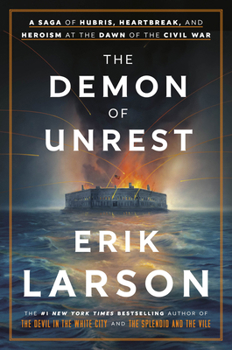
The Demon of Unrest, by Erik Larson

The book’s subtitle points to its main themes: “A Saga of Hubris, Heartbreak, and Heroism at the Dawn of the Civil War.” It is a full saga, though compressed into about five months, with plenty of each of those themes.

The election of Abraham Lincoln in November 1860 began a swirl of events in the North and in the South. In the swirl are successive state secession conventions, polarization of views, and Lincoln’s formation of his cabinet and the long train trip from Springfield to Washington. By April 1861, hostilities have begun. 

Along the way we meet a remarkable array of characters. Familiar characters include Lincoln and incoming Secretary of State William Seward, Robert E. Lee and Jefferson Davis; less familiar are people like Sen./Gov. James Hammond of South Carolina, the secessionist Edmund Ruffin, the diarist Mary Chestnut, Abner Doubleday in military service rather than baseball context, and Allan Pinkerton of detective fame. 

Larson takes us back into the decades leading up to 1860 to show the intensification of attitudes for and against slavery and how the hubris of those extreme viewpoints built on each side. Ultimately the extreme abolitionists could not reconcile slavery with union, those on the other side could not reconcile union with slavery, and all discounted the eventual cost of war. 

The heartbreak took many forms. Those in the middle ground were dragged to extreme positions by lack of familiarity with other regions, and by political bungling that drove people to opposite extremes. For example, John Brown’s raid on Harper’s Ferry pushed southerners to extreme defense of slavery, while South Carolina’s belligerence to Fort Sumter solidified northern union support. There were many examples of bungling as events built between the election and the inauguration on March 4. Did Lincoln need to enter Washington incognito? How could the battleship Powhatan be dispatched on two different missions? How many telegrams were misinterpreted or summarized to suit a political position? (Telegrams were a relatively new communication technique in 1860, and like e-mails today, lack tone of voice and body language that help convey accurate meaning. They were also subject to interception, non-delivery, and other problems. Letters and messengers were slower, but usually more secure). Decisions, like resupplying Fort Sumter, were delayed past the time when they could have made a difference.

Heroism was shown most clearly in Major Robert Anderson, commandant of Fort Sumter, which was strategically located to control access to the Port of Charleston.  He was given ambiguous orders and incomplete information, and inadequate garrison troops and supplies to actually defend the fort. He understood the political implication of surrender, and used judgment and tact to delay his surrender until mid-April, after secession decisions had been made. With 491 pages of text, the book packs a lot of information, but Larson delivers again as a superb story-teller. He gives us a page-turning narrative that holds the attention and still respects the historical record (there are 51 pages of bibliography and notes). The saga provided lots of grist for our discussion, from the depictions of slave markets to artillery techniques, planter society and mentality, and how political positions can be polarized. Even the history-reluctant members of our group enjoyed this saga.

— Bill Smith

Invisible: The Forgotten Story of the Black Woman Lawyer Who Took Down America’s Most Powerful Mobster, by Stephen L. Carter

This book presents the true story of Eunice Hunton Carter, one of the most famous and accomplished Black women of 1940s America. Although she’s no longer a household name, the author – her grandson, the novelist Stephen Carter – provides a detailed account of her fascinating life.

Eunice Hunton’s grandfather, Stanton Hunton, purchased his freedom from slavery before the Civil War. His son, William Alphaeus Hunton Sr., migrated to Atlanta and married Addie Waites Hunton. Both William and Addie were college educated and activists with the YMCA and NAACP. They had two children, Eunice and Alphaeus, and eventually they moved their family to Brooklyn, New York. Addie Hunton, Eunice’s mother, was relentless in her work in advancement and support of the “darker nation” (term used by the author), and she was clearly a role model to Eunice for choosing to pursue a non-traditional path despite both societal expectations and the seemingly insurmountable roadblocks of gender and race. Ultimately, Eunice became one of the first female African-American lawyers and one of the first African American prosecutors in the United States.

In 1921, Eunice graduated from Smith College with a degree in social work. After a few years of work in that field, she went back to school to study law. She became the first black woman to earn a law degree from Fordham University in New York City, and then in 1935, the first black woman assistant district attorney in the state of New York. After gaining some notoriety with her legal and political work, she was one of 20 lawyers selected by special prosecutor Thomas Dewey, who was on a mission to curtail the mafia in New York and in general. Although she was initially tasked on that team with listening to what were perceived to be lower-level morality crimes of prostitution, it was through that work that she identified ongoing patterns and connections that eventually led to the conviction of mafia boss Lucky Luciano in 1936. Her professional commitment to Dewey lasted through his presidential runs of 1944 and 1948.

Although she did not seem very interested in or suited for motherhood, she and her husband, Lisle Carter Sr., had a son named Lisle Carter Jr. He was the father of the author of this book, her grandson Stephen Carter.

Carter’s work in this book is a bit of an enigma. He is a well-known best-selling author of works such as The Emperor of Ocean Park, which was one of Time Magazine’s 100 best mystery and thriller books of all time. He is also a law professor at Yale Law School. But his presentation of this material is fairly dry and reads like an academic paper or a book report at times. With all the interesting facts and storyline he had to work with in his grandmother’s life, it’s odd that he wasn’t able to identify the mundane bits and condense them so that the interesting parts would have room to be more compelling. As it is, the reader has to get through a LOT of back-story about the lives of William and Addie – especially Addie – before getting to Eunice. One of our club members described the title as a bit of a bait and switch. That being said, the book also contains interesting glimpses of professional life in Harlem, and Alphaeus’s association with the Communist Party. 

We found it unusual that the author didn’t personalize the story a bit more by saying, “my grandmother” or “my father,” but always Eunice and Lisle, etc. This was especially noticeable when he talked about Eunice sending Lisle away as a child and rarely visiting, a period of time that was very painful “for Lisle.” It was unclear whether this was an attempt to stay emotionally neutral while sweeping feelings under the rug or if he really feels distant from it. In any case, he clearly does admire the work that his grandparents did, even if their paths did not allow time for warm family bonds.

Overall, our group was glad that we read this book and became aware of the life and work of Eunice Hunton Carter. Her story is an inspiration and very deserving of documentation.

— Julie Feirer & Bill Smith

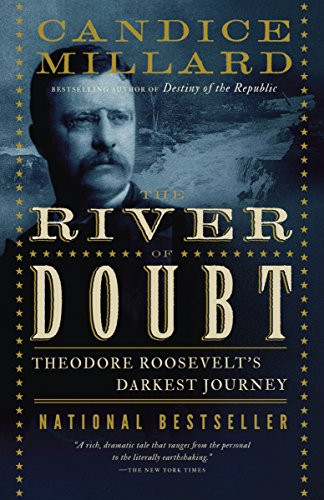
The River of Doubt: Theodore Roosevelt’s Darkest Journey, by Candice Millard

Candice Millard impressed our group before as an historian and as a storyteller – see our earlier review of Destiny of the Republic. This book repeats those skills and adds naturalist to our accolades.

Millard first introduces us to Theodore Roosevelt after his defeat for the presidency in 1912. After two terms as president, Roosevelt had selected William Howard Taft as his successor, but during Taft’s term they had a falling out and TR tried to unseat Taft in the 1912 election. In the end, they both lost to Woodrow Wilson. As he had done after the death of his first wife and after other disappointments, Roosevelt began looking for an adventure to make up for the loss. He seized on the idea of an Amazonian exploration. Both the North and South Poles had recently been explored, and the major rivers of Africa had been mapped; the Amazon was still largely unexplored. He outlined a speaking tour of South America with a river expedition to follow, descending a previously explored river that joined the Amazon. While Roosevelt was planning the speaking tour, various hangers-on planned and equipped the expedition for that route, though with little information on which to base their provisioning.

Filling in the map of interior Brazil was an ongoing challenge to its government, and the task was primarily entrusted to the Telegraph Commission, headed by Colonel Cândido Rondon, an army officer whose career mission was explore the Amazon Basin and to peacefully meet the indigenous inhabitants of the region. As luck would have it, Rondon was assigned to accompany and guide Roosevelt’s expedition. To further his own interests, Rondon preferred a route that would explore new country, and Roosevelt welcomed the adventure of new discovery. The River of Doubt met both men’s purposes. It was a river that was presumed to run hundreds of miles across the Amazon rain forest, but as of 1913, it remained unexplored and unmapped. Its source and outlet were known, but its course was a matter of doubt. 

The expedition shifted to the River of Doubt, and it entered the unknown in February 1914. 

What they passed through was Amazonian rain forest, a terrain for which they were remarkably unprepared. Here the naturalist part of Millard’s skill comes alive. She explains how the rain forest looks and feels, how it evolved, and importantly why the expedition was not able to forage food there. The rain forest had evolved highly specialized plants and animals that disperse themselves over wide regions and in unfamiliar ways. Animals and fruit are often at tree-top level and camouflaged so that the American and even the Brazilians could not spot anything, hunt anything, or harvest anything. Their crates of provisions, with rations of white wine and mustard, provided little nutrition but were a weighty hindrance at every one of the portages around the frequent rapids and waterfalls of the river. The expedition began on short rations, and since foraging was unsuccessful, time became the measure of their danger.

The expedition met a succession of native tribes, especially the Cinta Larga, who tracked them while remaining almost invisible. Remarkably, the tribes let the expedition pass without attack, not perceiving them as an actual threat. Given Rondon’s steadfast insistence on peaceful dealings, that judgment proved right, at least as to this expedition. The only deaths of the expedition were due to river accidents and a murder. (But in the long run, the fate of South American tribes was not much better than their North American counterparts).

Roosevelt’s ambition for adventure was more than satisfied. The expedition was out of touch with the rest of the world for about eight weeks. It was poorly equipped for what it confronted. The boats they took to Brazil were completely unsuitable, and the expedition ended up using hollow-log canoes with very shallow draft that were difficult to bring through rapids and were extremely heavy to portage. It lost half of those canoes and had to hollow out new ones at the cost of time and labor.  The labor, of course, was initially performed by Brazilian camaradas, but soon the American and Brazilian officers were laboring alongside them. Rations were short to begin with, quickly diminished through accidents, and to the extreme disappointment of the Americans could not be supplemented by hunting. The rain forest proved as inhospitable as any adventurer could want. It was hot, buggy, and – surprise – rainy. Portaging the frequent rapids and falls ate up time and energy and invited accidents. The river contained piranhas and other deadly fish, along with parasites and disease. On land, the expedition was open to attack by unseen Indians and snakes. Insects brought constant misery and disease. Most of the expedition suffered from malaria, especially Roosevelt’s son Kermit, who had joined the expedition to protect his father. TR had a seriously infected leg injury that brought him near death. At one point he talked with Kermit about leaving him behind.  Millard uses diaries and letters to give first-hand accounts of the desperation the expedition felt. It finally approached the Amazon and met rubber harvesters and the army unit that awaited them at the edge of civilization. 

The book gave us a wealth of subjects for discussion. Most of us have crossed an Amazonian expedition off our bucket lists. The expedition was rife with the sense of cultural superiority common to explorers of that period, such as the reluctance to seek out local advice on such basics as food and boats. Millard gives great insights into the always fascinating characters of the Roosevelt family.  While we are not planning Amazonian travel, we would be happy to read more of Millard’s work. 

— Bill Smith