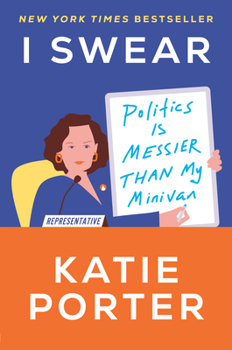
I Swear: Politics is Messier Than My Minivan, by Katie Porter

I Swear: Politics is Messier Than My Minivan is a memoir by Katie Porter, who was serving in her second term as the U.S. Representative for California’s 45th Congressional District in 2023 when it was published. While the book certainly highlights her accomplishments, it is also a window into the life of a woman trying to succeed at a highly demanding job in service to others while raising three children as a single parent.

Porter grew up in a very rural part of southern Iowa, and that background clearly informs her no-nonsense approach to both politics and family. Her childhood was spent on a small farm, sharing a tiny home with her parents and two feisty siblings. She looks back fondly on the simplicity of that life, but she also witnessed the anxiety and hardship of the 1980s farm crisis firsthand, including the day the town bank closed and the threat it posed to her family’s ability to continue their livelihood.

She must have stood out as a gifted student at her school, because she was invited by Iowa State University researchers to attend an elite academic summer program. That experience seems to have dramatically affected the trajectory of her life. Eventually she attended Phillips Academy, earned her undergraduate degree from Yale (writing her thesis on the effects of corporate farming on rural communities), and completed her law degree at Harvard, where she became a mentee of Elizabeth Warren.

After several years as a law professor, Porter notably testified before Congress in 2008 alongside Warren in support of the Credit Cardholders’ Bill of Rights, which was later signed into law. In 2012, Kamala Harris (then California Attorney General) appointed her as the state’s independent monitor for the $25 billion national mortgage settlement with major banks, such as Wells Fargo. She became internet-famous for making her points on a whiteboard – part of her crusade to stop predatory (and sloppy) practices that harm vulnerable homeowners. Her interest in running for congress was about gaining more power to continue this same work.

Although the book includes her professional achievements, it focuses a bit more on the reality of what it’s like to serve in Congress. She does not shy away from sharing personal foibles and things she learned the hard way. She writes openly about escaping an abusive marriage (at the urging of her campaign staff but at the consternation of her children), managing an intense travel schedule, and navigating the financial strain of public service without a spouse’s additional income or time. The book makes clear how challenging, if not impossible, it can be for an “ordinary” person with a family to serve in Congress, especially compared to candidates who can self-fund campaigns or rely on investment income.

Our group found ourselves wondering whether the criticisms she receives for being strident would land the same way if she were a man. Similarly, questions about whether she should have run for office while raising three young children alone seemed hard to separate from gender expectations.

Porter’s memoir is structured as a series of essays and short, nonlinear vignettes. Some in our group disliked the choppier format, but we felt that her voice throughout is real, direct, and accessible. Overall, Porter’s grit, humor, and unapologetic honesty make for an interesting read.

— Julie Feirer

How to Read a Book, by Monica Wood

The cover of Monica Wood’s How to Read a Book is warm and inviting, especially to a lover of books and reading. It shows the exterior of a cozy bookstore from the sidewalk, beckoning readers to come on in. What follows is a highly engaging and uplifting story full of quirky and complex characters, difficult situations, emotional highs and lows, growth and redemption, and resilience. Is there a bookstore in the novel? Yes – but there’s so much more! 

There’s Harriett, a.k.a. “Bookie,” who runs a book club inside a women’s prison in Maine. She is dedicated to sharing the power of literature with every member of the group, helping them know their worth and express their feelings as they read aloud, react, discuss, write, and make connections to themselves and others. Wood does not sugar-coat their voices as they express powerlessness, rage, longing, resentment, distrust, love and more. We get to know each member of the group as they support one another through a very meager existence.  

But if the cover of the book showed a prison, it would not suggest that one of the youngest inmates, 22-year-old-Violet, is suddenly freed at the beginning of the book. In fact, the bulk of the story is arguably hers as she tries to navigate life as an ex-con “on the outs” where she never had a chance to live independently before being locked up. We watch as she goes from a tense reunion with her sister to a chance meeting with Harriett (at the bookstore!) and another fraught reunion with Frank, the husband of the woman she killed in the drunk driving accident that landed her in prison. Through much effort she lands a job for which she has “affinity,” a word that provides fledgling self-esteem, documenting research on talking parrots in a university lab – where the birds themselves are characters, as well as her ill-tempered, manipulative boss. 

Perhaps a bird would have made a good cover image, since the birds, too, were captives. And in addition to Violet’s work with the birds, the inmates give a gift of a small, knitted bird to Harriett as a token of their appreciation. She keeps it, though she’s been warned not to accept anything from them, and not without consequence. This repetition of birds seems symbolic, and yet a bird on the cover wouldn’t adequately represent Frank, a third major character who longs for a relationship with Harriett while feeling terrible about his true feelings around the death of his wife. No spoilers, but it’s not what you’d think. In addition, we get to see his rocky relationship with his daughter and his brilliance as a retired machinist-turned-handyman….at the bookstore. 

So, maybe the bookstore is the thing that ties everything together and is the best choice for the cover after all. As a member of our group observed, avid readers are drawn to books that have bookstores on the cover, and an avid reader would thoroughly enjoy this book. Also, its marketing had the intended effect. It looked like it would be an easy and enjoyable read, and it was, while still being intricately well-written.

As a bonus, our book club happens to include several people who have spent time volunteering at a women’s prison in Mitchellville, Iowa, as well as providing support to women who have recently been released. While there are some differences between the systems in Iowa and Maine, and it’s clear that some details were added to advance the story (such as Violet being outfitted with a fully stocked apartment upon her release – a lucky break that is very unlikely in reality), their general take was that the overall tone of the prison aspect of this book was spot-on. If any Iowa area readers are so inspired, check out Women at the Well for ways to get involved with helping women who are incarcerated and recently released.  

We were glad to have found and read this book, and glad that it left us feeling hopeful. It was also a good reminder of this: 

“The line between this and that, you and her, us and them. The line is thin.” 

— Julie Feirer

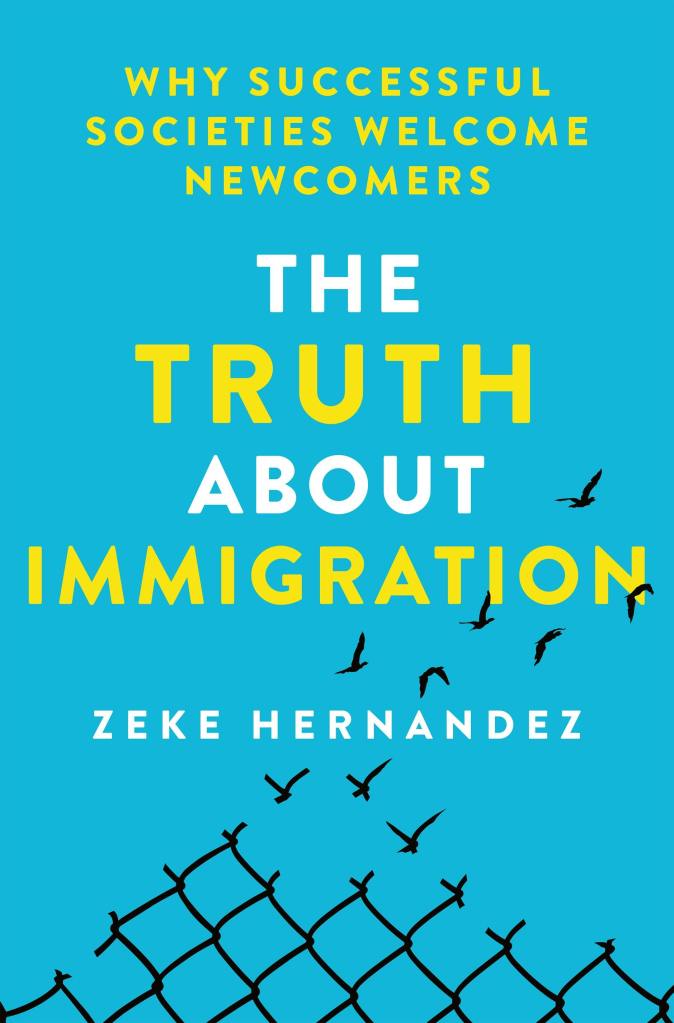
The Truth About Immigration: Why Successful Societies Welcome Newcomers, by Zeke Hernandez

The Truth About Immigration was published in June of 2024, and therefore was quite timely and relevant when our group began reading it in late Fall of 2024 – finishing our discussion of it just after the second election of Donald Trump.

Having read it, the upside is that we all feel better educated about how immigration works in the United States, as well as its pros and cons. While it’s clear that the current archaic system needs to be updated, it is also clear that immigrants are a net positive to society for economic, social and cultural reasons.

The downside is that we’re likely to start seeing mass deportations anyway, due to Trump’s campaign promises, and we’ll be powerless to do anything about it. We are living in a time when fear of immigrants has been stoked to an all-time high for political gain.

If only everyone could read this book. We’d like to think it would make a difference, but who knows. Perhaps fear is just an easier sell.

One of the main takeaways is that both sides of the typical immigration debate are wrong, or at least short-sighted. One side claims that immigrants are a drain on society’s resources and dangerous to “our way of life.” The other side tends to counter by whispering the victim narrative, that taking in immigrants is the right thing to do because of the violence and oppression that causes people to flee their home countries. The truth is actually far more powerful than the victim narrative: Successful societies welcome newcomers. Unfortunately, that information is rarely part of the discussion. It takes more time to explain, and therefore is harder to break through.

Zeke Hernandez is very thorough in his presentation of the details, and although the book is heavy on facts, it is readable for the average American who has not experienced the immigration system first-hand. Another round of editing before publishing might have eliminated some repetition of ideas and made the information that much more digestible. His various stories and anecdotes, some from friends and others from his own experience as an immigrant from Uruguay, are a welcome illustration. We applaud his effort to enlighten readers with the truth.

— Julie Feirer