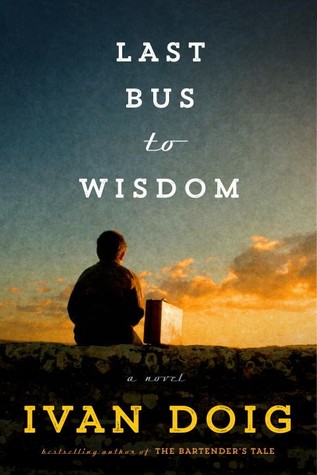
Last Bus to Wisdom, by Ivan Doig

Ivan Doig’s last book, appropriately titled Last Bus to Wisdom, is an unpredictable and boisterous road novel.  It brought back many memories of my childhood in western Kansas in the same era.

Donal Cameron is a 11-year old being raised by his grandmother on a Montana Ranch in 1951. But when Gram has to have serious surgery, she decides to ship him off to her sister Kate in Manitowoc, Wisconsin for the summer.

On his way to Wisconsin, Donal first rides the Dog Bus, as he calls the Greyhound, wearing his best rodeo shirt. Along the way, he engages with everyone he sits next to, soliciting literary gems for his cherished autograph book, which he carries everywhere. He has a $5 dollar bill in his pocket and three $10 dollar bills pinned to the inside of his shirt, along with two changes of clothes in a battered wicker suitcase.

During the ride, he lives on a steady diet of Mounds candy bars, receives his first real kiss from a good-natured waitress named Letty, and meets Harv, her boyfriend who is on his way back to jail, handcuffed and accompanied by his stepbrother, a mean-spirited sheriff. Other fellow travelers, who he easily interacts with, include young soldiers off to the Korean War, some nuns, a group of obnoxious boys on their way to summer camp who sang “great, green gobs of greasy grimy gopher guts”, a song I haven’t heard since I was a kid.

With his shock of red hair, freckles and gift of gab, Donal carries an arrowhead for luck. But, he just escapes being robbed, and missed his transfer in the Twin Cities. With luck from his Arrowhead, however, he was transported by a good Samaritan who drove him to the next bus stop so he could continue on to Wisconsin.

Upon arriving at Aunt Kate’s, he’s let down when he realizes she is not the famous singer Kate Smith, his bedroom is in the attic, she feeds him soggy cereal, and his main entertainment is playing canasta with his aunt’s friends. She is a manipulative presence who abuses her ‘husband’ Herman and condemns Donal to jigsaw puzzles for recreation. Shortly after arriving his loses his pocket money and feels doomed to a summer of endless boredom.

But Donal hits it off with Uncle Herman, a one-eyed German, who is hen-pecked by Kate. Herman routinely escapes to his greenhouse where he reads novels of the old west. During World War II, Herman was an opponent of Hitler, stowed away on a ship to the US, and lived for decades with Kate as an undocumented alien.

After only a month into Donal’s stay, aunt Kate decides to ship him back to Montana, and an uncertain fate awaits him.  But as it turns out, Donal isn’t traveling solo – Herman has decided to fly the coop, cashes his disability check and joins him on the bus, heading for all manners of adventures. Donal asks him where they will go, and Herman says “Anywhere’s.” Just so it is “that away,” pointing toward the West.

Wearing new cowboy hats they lope all over, getting into scrapes in Yellowstone National Park, seeing pow-wows and rodeos, getting Jack Kerouac’s signature in the autograph book, encountering swindlers, and evading the law. But as posters start to appear announcing that Herman is an enemy alien wanted by the FBI, the pair find themselves on the run.

After their money is stolen (again), Donal talks a doctor into providing bus fare to Wisdom, Montana.

The story picks up steam in the final pages, where the unlikely pair bunk with hobos arriving for the hay harvest.  Soon, they are adopted into the itinerant clan and obtain haying jobs.  Fortunately, their travails lead to a happy ending.

Doig does a superb job of bringing this bygone era alive for the reader. His richly drawn characters that move the story at a rollicking pace. I truly enjoyed this memorable book.

— Ken Johnson
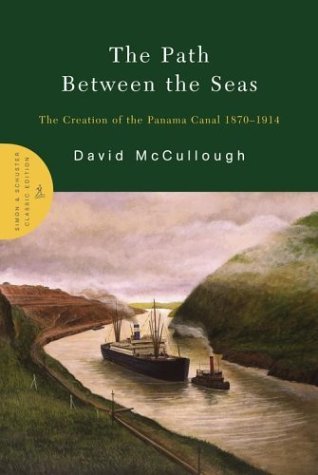
THE PATH BETWEEN THE SEAS, by David McCullough

At the outset, I have to admit that I’m biased, as McCullough is probably my favorite author, and I recommended reading the book to our Books, Brew and Banter Club.  That said, The Path Between the Seas won the National Book Award and several other awards, so I feel confident that it would be next to impossible for me to oversell his work.

The book is a first-rate drama of the bold engineering feat that was filled with both tragedy and triumph.  It is the story of the men who fought against all odds to fulfill a four-century dream of constructing a passageway between the Atlantic and Pacific oceans, which includes astonishing engineering undertakings, tremendous medical accomplishments, political power plays, tragic failures and heroic successes.

When Europeans first started to explore the possibilities of creating a link between the oceans, cutting off the long and dangerous journey round the southern tip of South America at Cape Horn, Panama was a remote part of Columbia. That changed when, in 1848, prospectors struck gold in California, creating an urgent need for quicker passage for California-bound ships. Thus, the United States built the Panama Railroad to serve that traffic and soon became the highest-priced stock on the New York Exchange.

Initially, building the canal appeared to be an easy matter, but the construction project eventually came to involve the efforts of thousands of workers from many nations, taking over four decades to complete.

In the beginning, French entrepreneur Ferdinand de Lesseps, secured capital to begin work on the canal, based on his recent success in constructing the Suez Canal between the Mediterranean and Red Seas. However, at the time, he had not set foot in Panama and had only a vague idea of the topographical setting, nor did he believe that the heat, humidity, insects, and snakes were a large problem.  In less than a decade, however, the scheme had collapsed, and his company went into receivership with only a third of the canal having been excavated.  Over 25,000 people died, including 5,000 Frenchmen, mostly succumbing to malaria, yellow fever, poisonous snakes and industrial accidents.

After a quarter century, President Theodore Roosevelt began a campaign of intervention, and negotiated a treaty to access to the Isthmus of Panama, allowing the US to buy-out the French interests. However, the Americans led a bloodless revolt after Columbia objected to the treaty, allowing for the creation of the Republic of Panama. Americans then set work along the French route using their equipment and the Panama Railroad, before shipping in more modern equipment to move billions of cubic yards of dirt and rock, to harness savage rivers, and to initiate an unprecedented lock system, that has lasted over a century, only recently being remodeled and opened again to larger ships.

Aside from President Roosevelt, two other Americans were heroes in this process.  Dr. William Gorgas found that mosquitos were the carrier of malaria and yellow fever and led efforts to destroy their breeding grounds, substantially reducing deaths from disease. Engineer John Stevens took charge of the canal project and quickly understood the French inability to remove rock and dirt was not a problem with digging, but transportation. So he led efforts to rebuild the Panama Railroad to transport not only people, but equipment and materials, and recruited the greatest engineering minds of the period to tackle the tremendous challenges.

Completing the canal was an impressive trial, but it got done. Eventually, the canal opened to traffic ahead of schedule and under budget, and became the useful waterway of commerce envisioned for centuries.

This comprehensive and captivating story is a must-read for anyone interested in American history, the history of engineering technology, international intrigue, advance of medicine and human drama. Clearly, McCullough wrote a story you won’t want to put down.

—Ken Johnson

The Life and Times of the Thunderbolt Kid, by Bill Bryson

Several years ago, my best friend, who grew up in Des Moines in the 1950’s, gave me a copy of Bill Bryson’s The Life and Times of the Thunderbolt Kid. I enjoyed it so much that I subsequently read and enjoyed virtually all of his numerous books. So, when the opportunity recently arose to suggest it to Books, Brews, and Banter, I heartily recommended it, although I rarely read books twice.
“I can’t imagine there has ever been a more gratifying time or place to be alive than in Iowa and the 50s,\” Bryson wrote in the first chapter, and then set out to corroborate it.  He and his friends found endless adventures on the streets of Des Moines at a time when all kids hung outside pretty much all day during the summers, only returning home for dinner.
In this hilarious memoir, Bryson captures the time and place of his boyhood in Des Moines in the 50s and 60s, reminding us of a happy time when cars, household appliances, and even nuclear weapons grew larger and more abundant each year, while DDT, cigarettes, and atomic fallout were considered harmless or even good for you. He writes about his loving but eccentric family, including warm portraits of his father, a gifted but often absent sportswriter for the Des Moines Register, and his absentminded mother, who was the home furnishing editor also for the Register.
His early childhood recollections include the first televisions, comic books, toys (electric football and erector sets), his mother’s bland cooking, the threat of the Atomic Bomb, movie matinees, fears of polio, TV dinners, the Iowa State Fair, and visits to Grandpa’s farm. His alter ego, The Thunderbolt Kid, born of his love for comic book super heroes and his need to vaporize awful evildoers, allowed him to see under women’s clothing, if only in his imagination. When adolescence took over, Bryson’s adventures were replaced with riskier hobbies of smoking, drinking, forging IDs, and his growing fascination with sex that included the discovery of Dad’s secret stash of girlie magazines, his attempts at gaining access to the notorious “strippers tent” at the State Fair, and his unfilled desire to see Mary O’Leary naked.
Bryson is a master of the detail.  He mined magazines and newspapers of the period with an eye for the tragic, the revealing and the just plain odd, including the story of the barmaid charged with obscenity for being able to carry two glasses of beer on her breasts, the black man sentenced to death for stealing $1.95, and parents climbing ladders outside polio wards to shout greeting to the children.
His book is so outlandish and improbably entertaining, you sometimes begin to doubt its veracity. For example, none of our book club members remember his contention that the Japanese sent balloons with bombs in them over the US during WWII, some going as far as Virginia.

Nonetheless, it’s a wondrous laugh-out-loud book, evoking both the unadulterated joys and everyday battles of childhood.  A great fun-read, especially for Baby Boomers nostalgic for the good old days. Ken Johnson