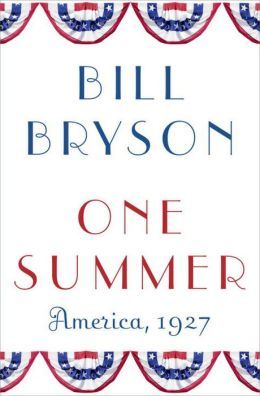
In One Summer: America, 1927, Bill Bryson—a prodigious researcher and a talented storyteller—takes us on a meandering journey through four months in a pivotal American year. He starts with the devastating Mississippi flood, pauses to introduce us to Charles Lindbergh and then interrupts that with a story about Babe Ruth, then it’s on to Henry Ford, Calvin Coolidge, Al Capone, Al Jolson, Sacco and Vanzetti, Gene Tunney, and a batch of lesser characters.
He weaves these stories into a narrative that is hilarious, fascinating, frustrating, terrifying, and educational.
Apparently women weren’t yet invented, because Bryson introduces us to only a few—the notorious Ruth Snyder who conspired with her lover to kill her husband, Warren Harding’s wife who may or may not have poisoned him but who nevertheless refused to allow his body to be autopsied, and Clara Bow, the silent movie star and original “It” girl whose career nosedived because her nasal voice was too jarring to withstand the talkies.
That aside, this book is a delight. Bryson’s style is delicious and the details he shares are compelling and often bizarre. A few examples:
• President Coolidge reportedly worked an average of only four hours a day, napped more than any other president, and took three months off to live in South Dakota where he play-acted as a cowboy, complete with oversized hat and chaps. While he was there, he gave the nod to the creation of Mount Rushmore.
• Men apparently urinated wherever with startling abandon. President Warren Harding was reported to urinate in the White House fireplace. And Al Jolson, star of The Jazz Singer, urinated on people as some sort of joke. Bryson notes that this could explain why he had four wives and few friends. Why he had any of either is surprising.
• Hordes of people—tens of thousands—congregated wherever Lindbergh landed and overwhelmed him so much that he occasionally avoided them by coasting for extended periods at 30 feet above what might well have been terrified farmers and their cows. One measure of the size of his following: the ticker-tape parade thrown for him in Manhattan in 1927 generated 1,800 tons of debris. In contrast, the armistice parade of 1918 created a paltry 155 tons.
• “There was almost nothing Henry Ford did that didn’t have some bad in it somewhere,” Bryson writes. Case in point: his “Fordlandia” settlement in Brazil, an Americanized city plopped down into the rain forest, with cozy frame houses, a Main Street, and paved avenues that dead-ended in the jungle on all sides. Not surprisingly, it was a flop.
• The wonderfully-named Philo Farnsworth may actually have invented the television but the idea was stolen, which made him so mad \”even his hair looked angry.”
• The Mississippi flood covered 16.5 million acres and cost more 1,000 lives. The human loss was “perhaps several times that,” Bryson cynically writes, but those counting “weren’t more scrupulous because, alas, so many of the victims were poor and black.”
• Bryson calls this time period “the Age of Loathing,” noting, “There may never have been another time in the nation’s history when more people disliked more other people from more directions and for less reason.” For example, Ku Klux Klan groups formed throughout the country and were full of community “leaders” opposed to Catholics, Jews, Italians, and most other “foreigners.” And the pseudoscience of eugenics was backed by top scholars, physicians, politicians, and the Supreme Court, which upheld the “right” of states to forcibly sterilize tens of thousands of Americans, considered “imbeciles” and expendable. Most at risk were the poor and unmarried women.
• Xenophobia was literally the law of the land. “Iowa, to be on the safe side, outlawed conversations in any language other than English in schools, at church, or even over the telephone,” he writes. “When people protested that they would have to give up church services in their own languages, Governor William L. Harding responded: ‘There is no use in anyone wasting his time praying in other languages than English. God is listening only to the English tongue.’”
• The Federal Reserve, supported by four odd ducks from the United States, England, France, and Germany, met and, with the best of intentions, set the stage for the Great Depression in 1929.
• Railroads were sometimes built with little rhyme or reason. Bryson writes about one such line, the Pere Marquette, which “wandered confusedly around the upper Midwest, as if looking for a lost item.” And he offers a more general point about our fond memories of railroads: “The romance of travel wasn’t always terribly evident to those who were actually experiencing it.”
• When Babe Ruth was seven, his father, knowing he did not have the resources to raise him properly, dropped him off at St. Mary’s Industrial School for Boys. Without this, he might have had no career. One of the Brothers at the school was an avid baseball fan, and his coaching got Ruth started on the sport. By 19, he was playing professionally, first as a pitcher and ultimately as a hitter. He was a remarkable athlete but a dazzlingly uncouth person.
• For book lovers, this could have been the Good Old Days. “The 1920s was a great time for reading altogether—very possibly the peak decade for reading in American life,” Bryson writes. “Each year, American publishers produced 110 million books, more than 10,000 separate titles, double the number of ten years before. For those who felt daunted by such a welter of literary possibility, a helpful new phenomenon, the book club, had just made its debut. The Book-of-the-Month Club was founded in 1926 and was followed the next year by the Literary Guild.”
Bryson, our hometown talent, is a treasure. Few writers could take all this data and turn it into such a captivating maze of mesmerizing tales. Fewer still would do the type of research that gives the stories credence. —PEP
 Books, Brews & Banter