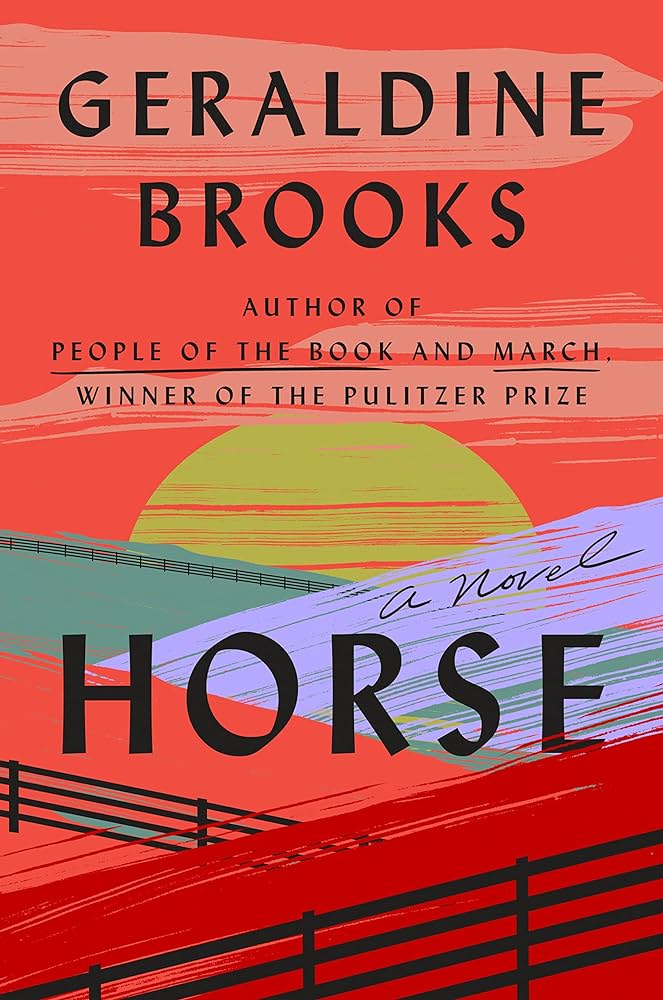
Horse, by Geraldine Brooks

Horse is a big, beautiful novel: The physical book, with its exuberant cover and elegant interior design; the story, told by five narrators, that sprawls over a hundred and seventy-five years. It’s a story about racehorses, slavery, the Civil War, race, racism, the connection between animals and people, art, history, museums, bone cleaning, skeletal articulation . . . The list is long.

Brooks explains in the backmatter that she first heard about the amazing racehorse and stud sire, Lexington, in 2010. She was seated at a luncheon by the person who had just handled the delivery of Lexington’s articulated skeleton to the Museum of the Horse in Kentucky. And she explains how her resulting research into horse racing in the mid-nineteenth century made her feel she couldn’t write about racehorses without writing about race. She also lists the characters in the novel who were real people and tells us a bit about them—for example, Black Jarrett’s owner, Dr. Warfield, who delivered Mary Todd Lincoln. Much of my enjoyment of the book comes from the clever and creative ways Brooks uses historical touchstones to unify and propel the two main stories.

The first story, that of Jarrett and Lexington, is told by Jarrett and Thomas J. Scott, the painter of racehorse portraits. Jarrett and the foal Darley (who becomes Lexington) are a matched pair until Lexington’s death. When they are separated by the whimsy of their owner, both suffer and are damaged. When they’re reunited, they heal. As a slave, Jarrett endures what he can’t change with canniness and dignity. But when the horses are threatened by Quantrill’s raiders, he reacts boldly and saves them and himself and a white man who once conspired against Jarrett and his father. Over the years, Thomas J. Scott, paints Lexington and Jarret for their owners, and he tries to befriend Jarrett. His intentions are good, but he always has a naïve understanding of what it really means to be owned.

Yet it’s his intuitive, beautiful portraits of Lexington, and the way the paintings pass from hand to hand, that unify the story—with one of them providing the much-needed bit of redemption in the second story, that of Theo and Jess. They are interesting young people in present day Georgetown. Theo is a Ph.D. candidate who believes art can change the world. Jess is an expert articulator of skeletons, and ultimately is invited to articulate Lexington’s bones, using Scott’s portraits for reference.

Their love story is touching, but complicated. They both have Australian roots. Theo is black, Jess is white. And they navigate racial shoals as most of us do–with good intentions, but a measure of ignorance and blundering awkwardness. Theo has encountered his share of racism playing polo in England, but he does not fully understand the precarity of American racism.

And in between these two love stories, is Martha Jackson’s narrative from the mid-fifties, a time of overwhelming white privilege in America. She is a wealthy art dealer who buys an old family painting of a horse from her black maid Annie as a well-meaning act of patronage. It ends up in the Smithsonian after Jackson’s death, and is a reference for Jess’s articulation of Lexington’s bones.

Brooks doesn’t tell this hundred and seventy-five-year story in a chronological line, but weaves back and forth between the time periods, creating a tapestry-like structure—one of the aspects of the novel I admired the most.

Theo’s is the first voice we hear, and Jess’s is the last. And I think, through them, Brooks is asking the question of the book: Is there hope for our deeply racist country?

Jarrett and Lexington’s story out of slavery shows us hope fulfilled: Jarrett is a free and prosperous man who can afford a portrait of Lexington by the end of the story; Lexington is retired to the cushy life of an occasional stud sire. But now we’re a hundred and seventy-five years beyond that story, where the evil of slavery has been replaced by the evil of racism.

When Brooks turned down that road of American racism, I so didn’t want to go. I was pulled out of the story the moment Jess began to fret that she had offended Theo in the conversation over the bike. But I loved Jess and Theo’s characters. They’re smart, but vulnerable. They’re devoted to Theo’s Australian dog, Clancy. They have good friends. Theo is a kind and principled person who deeply believes in the transformative power of art, and Jess—as she closes the story—hopes he’s right. For a moment on the airplane, she can believe he’s right. And Brooks does show us at least one racist person, Jarrett’s elderly white neighbor across the street, being redeemed by art.

Many of us struggled with Theo and Jess’s story, feeling it was sometimes clunky. Not nuanced. Stereotypical. I remind myself of what I’ve heard our wise Deacon Jeanie say more than once. “There’s a reason stereotypes exist, you know.” And, in the final analysis, who doesn’t love a good horse story with a gorgeous cover?

— Sharelle Moranville
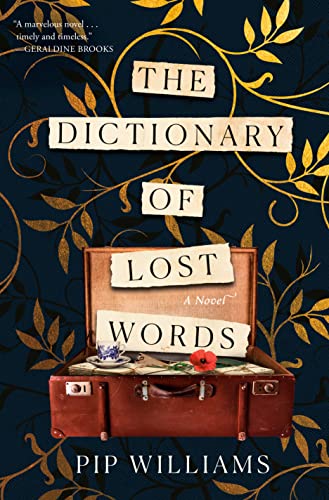
The Dictionary of Lost Words, by Pip Williams

Work on the Oxford English Dictionary began in 1857, and the enormous, crowd-sourced task finally ended with the dictionary’s publication in ten volumes in 1928. Pip Williams’s novel, The Dictionary of Lost Words, shows us the people (largely fictionalized) and the process of this amazing scholarly and technical achievement.

Via the very intimate first-person narrative of Esme, who basically grew up in the Scriptorium, Williams explores childhood, friendship, motherhood, the suffragist movement, sex, sexism, the brutality of World War I, and the shifting English class structure. Most of all, she explores the complexity of words. What they mean. How they make us feel. How we use them to include and exclude. How they bestow and deny power. How there are men’s words and women’s words. How not all words are welcome in the Oxford English Dictionary.

Esme is four years old when we meet her. She has an intuitive and visceral relationship with words even as a young child. As she tells us in the prologue, “Before the lost word, there was another.”As she sits on her dad’s lap in the Scriptorium on a snowy morning and helps him open envelopes into which readers have tucked words and citations of their use in publications, the word lily arrives. Because Lily is the name of Esme’s dead mother, her dad—in surprise and pain—throws the small piece of paper in the fire. Esme rushes to save it. She fails; and her scarred hands are lifelong physical reminders that words aren’t simple, straightforward things. They are profoundly powerful and complex. And they affect people differently.

In her intimate engaging voice, Esme invites us into her life as a motherless child and eventually a childless mother. We see her in her marriage to Gareth, who loves and understands her so well he has her collection of women’s words—with attribution cheekily in the spirit of the OED—typeset and beautifully bound as an engagement gift.

Motherhood is a huge theme in the story. It begins with Esme rescuing the word that is her mother from the fire and ends with her daughter, Megan, sixty-one years after publication of the first edition of the OED, speaking at a celebration of the recent second edition. She smooths an old piece of paper with the word bondmaid written on it. “Bondmaid. For a while this beautiful, troubling word belonged to my mother.” It was the word that launched a little girl into her passion for language, as she sat under the sorting table, catching word crumbs, studying the feet and legs of scholarly men enclosing her space.

Esme grows up without a mother, but she is not un-mothered. There is Lizzie, in service in Dr. Murray’s household, not a lot older than Esme, but wise beyond her years. Lizzie lets Esme keep her “lost” words in a trunk under Lizzie’s bed. Lizzie is not literate, but she is profoundly expressive. She explains to Esme that her needlepoint may be the only sign left to say she ever existed. The needlepoint makes her feel permanent. The rest of the time, bondmaid that she is, she feels like a dandelion just before the wind blows. –an image so perfect it made me shiver.

There’s Edith Thompson, who helps Esme navigate life much as a mother would, caring for Esme during a secret pregnancy, and brokering a good and loving home for the baby. Unlike illiterate Lizzie, Ditte, as Esme calls her, is an author and contributor to the OED, who is honored by getting to watch the men dine sumptuously in celebration—finally—of the full publication of the dictionary. Ditte is the one who passes on the first word that Esme pilfered from the Scriptorium—bondmaid—to Esme’s daughter, Megan, along with the message that Esme had always felt herself a bondmaid to the Dictionary.

While I know it’s just a story and Esme is a made-up character, I gasped when I read the news from Ditte to Megan, that Esme had been accidentally killed in a lorry accident in 1928, just as I had a two-hanky cry earlier when Gareth did not come home from the war. The Dictionary of Lost Words is a wonderful read. I wanted to turn the pages quickly and find out how Esme’s life was unfolding and, paradoxically, I wanted to savor the story of that life slowly, not to move too quickly from her innocent child’s voice, to her grown-up voice, to silence.

— Sharelle Moranville

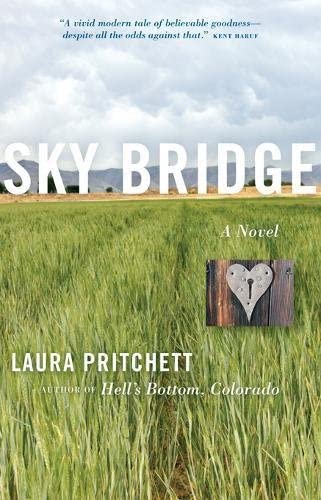
Sky Bridge, by Laura Pritchett

Miguel worries about ilegales crossing the desert—not his cousins and girlfriend, who are still waiting at the border, but others—the anonymous, but not anonymous to themselves, since this is, after all, their one life. (Libby in monologue)

In her novel, Sky Bridge, Laura Pritchett dips into the anonymous stew of struggling rural small-town humanity and shows us one life in fine detail: the life of Libby, the narrator, a young woman who became a mother in deed if not in fact when she was a child herself and took responsibility for her little sister, Tess. Now, in the time present of the story, Libby does not want pregnant Tess to have an abortion and promises to raise the child herself. And she does not want Tess to leave after the Amber’s birth, but Tess does.

And the rest is the story. And a compelling, fresh story it is.

Libby carries many voices in her head: Kay, Libby’s mom, telling her she’s a disappointment, not up to taking care of baby Amber. Derek, Libby’s boyfriend, telling her she is not beautiful. Miguel, husband of Libby’s best friend, telling her the two of them have been left behind, and now it’s too late for them to get out of Lamar, Colorado. Frank, her employer, telling her that where they live is “the last fine place to be.” Baxter, her mom’s employer, telling her “If you can suffer and not be bitter it will change you into a real human. A soft human.” Arlene, a coworker, telling her she’s a beautiful kid, though Libby feels this can’t possibly be true. Libby’s own narrative voice is so intimate the reader can’t help embracing her and hers as they each live “their one life.” Like Libby, we learn not to pay much attention to Kay’s soliloquies of rage and bitterness because we know that ultimately Kay, like almost everybody, will step up and do a version of the right thing. Exception: Tess’s associate, Clark.

Pritchett shows us the universal in the particular. Bad people do good things. Good people do bad things. Sometimes bad is good. Sometimes good is bad. Libby and Tess’s profligate and violent dad (bad) is still remembered for staying with the body of Frank’s fiancé (good) when she was killed in an auto accident. Miguel (good) grows pot (bad—at least in 2005) to pay for the coyotes (good, unless breaking the law is bad). Eventually, pretty much everybody gives a hand to the ilegales—some do it for money, but most do it out of kindness. Ed, the post-hippie beekeeping environmentalist, an outsider in an orange VW van, becomes a sort of guardian who posts his bee hives strategically so he can keep a protective eye on Libby and Amber (good) and his pot (arguably bad). Who strategically dumps a dog (in principle, bad), which Libby is sure to take in and be protected by (good).

Sometimes the bad things feel banal: Libby’s stealing beer from her employer. Arlene’s clipping unredeemed coupons and sending them in. Simon’s family deciding to take Amber from Libby because they can “raise it right”—banal because of the cliched assumption that a churchy couple will be better parents than an unmarried, unmoored young aunt.

But sometimes the bad things feel far from banal. They feel evil. Clark’s rape of Libby as entitled revenge on Tess, for example. His jacking up the price on the ilegales at the end of the trip. Yet even he gives Libby good advice when he tells her to learn to let go of certain people, which she eventually does.

 As the novel progresses, caring for a newborn wears Libby down, down, down beyond exhaustion. She comes to understand why moms sometimes do bad things to their kids, and she also comes to understand her strength and the strength of the community to do the fundamentally good thing: see other people.

See people, I want to tell her. See them, and especially see them if at first you don’t think they’re worth noticing. (Libby in monologue near the end, speaking of Tess)

Eventually the little row of marigolds in the yard begins to thrive, the bathroom gets cleaned, the house gets painted, even tough, cynical Kay pitches in to help the ilegales.Tess does the paperwork to make baby Amber legal. Libby lets Tess go. Amber wiggles with joy when she catches sight of Libby, her mom. A measure of contentment reigns, but it’s a dynamic contentment.

I keep seeing how everybody is pushing ahead, looking for a place with enough space for our dreams. The ilegales. Tess. Derek. Me. Moving forward, trying to cross those invisible boundaries so we can find the place where we’re most free and the most full.

Perhaps that place is the sky bridge—that special state of being where one can reach up and touch the blue sky.

Ed tells Libby, “Art is what gets us beyond what is real. It makes reality more real. It also shortens the distance we gotta travel to see how connected we are.” A good summation of this lovely novel.

— Sharelle Moranville