I Swear: Politics is Messier Than My Minivan, by Katie Porter

I Swear: Politics is Messier Than My Minivan is a memoir by Katie Porter, who was serving in her second term as the U.S. Representative for California’s 45th Congressional District in 2023 when it was published. While the book certainly highlights her accomplishments, it is also a window into the life of a woman trying to succeed at a highly demanding job in service to others while raising three children as a single parent.

Porter grew up in a very rural part of southern Iowa, and that background clearly informs her no-nonsense approach to both politics and family. Her childhood was spent on a small farm, sharing a tiny home with her parents and two feisty siblings. She looks back fondly on the simplicity of that life, but she also witnessed the anxiety and hardship of the 1980s farm crisis firsthand, including the day the town bank closed and the threat it posed to her family’s ability to continue their livelihood.

She must have stood out as a gifted student at her school, because she was invited by Iowa State University researchers to attend an elite academic summer program. That experience seems to have dramatically affected the trajectory of her life. Eventually she attended Phillips Academy, earned her undergraduate degree from Yale (writing her thesis on the effects of corporate farming on rural communities), and completed her law degree at Harvard, where she became a mentee of Elizabeth Warren.

After several years as a law professor, Porter notably testified before Congress in 2008 alongside Warren in support of the Credit Cardholders’ Bill of Rights, which was later signed into law. In 2012, Kamala Harris (then California Attorney General) appointed her as the state’s independent monitor for the $25 billion national mortgage settlement with major banks, such as Wells Fargo. She became internet-famous for making her points on a whiteboard – part of her crusade to stop predatory (and sloppy) practices that harm vulnerable homeowners. Her interest in running for congress was about gaining more power to continue this same work.

Although the book includes her professional achievements, it focuses a bit more on the reality of what it’s like to serve in Congress. She does not shy away from sharing personal foibles and things she learned the hard way. She writes openly about escaping an abusive marriage (at the urging of her campaign staff but at the consternation of her children), managing an intense travel schedule, and navigating the financial strain of public service without a spouse’s additional income or time. The book makes clear how challenging, if not impossible, it can be for an “ordinary” person with a family to serve in Congress, especially compared to candidates who can self-fund campaigns or rely on investment income.

Our group found ourselves wondering whether the criticisms she receives for being strident would land the same way if she were a man. Similarly, questions about whether she should have run for office while raising three young children alone seemed hard to separate from gender expectations.

Porter’s memoir is structured as a series of essays and short, nonlinear vignettes. Some in our group disliked the choppier format, but we felt that her voice throughout is real, direct, and accessible. Overall, Porter’s grit, humor, and unapologetic honesty make for an interesting read.

— Julie Feirer
River of the Gods, by Candice Millard

In the prologue to River of the Gods, Candice Millard tells us how the arrival of the Rosetta Stone in England in 1801 triggered a keen interest in Egypt and Africa and the treasures of the ancient world. The Royal Geographical Society, which sponsored exploration of these relatively unknown lands and rivers, thought the best way to learn about this part of the world was not to sail up the Nile—which had been tried without much success—but to travel inland from Africa’s east coast and search for the White Nile’s headwaters. This called for sailing to Zanzibar and there buying supplies and finding guides and workers to support long, arduous, and dangerous journeys, directed by little more than tales of snow-capped mountains and vague reports of large bodies of water somewhere.

Millard tells the story of three of these expeditions. The findings of the trips were tentative and controversial for years until, finally, Lake Victoria (Nyanza) was confidently declared to be the source of the Nile. And that is nice to know.

But the real pleasure of the book comes from Millard’s talent as a storyteller. Although quotation marks are everywhere, and there are fifty pages of notes and bibliography at the end, the story flows like a novel with fascinating, flawed characters, high stakes, and a sense of being there with the characters.

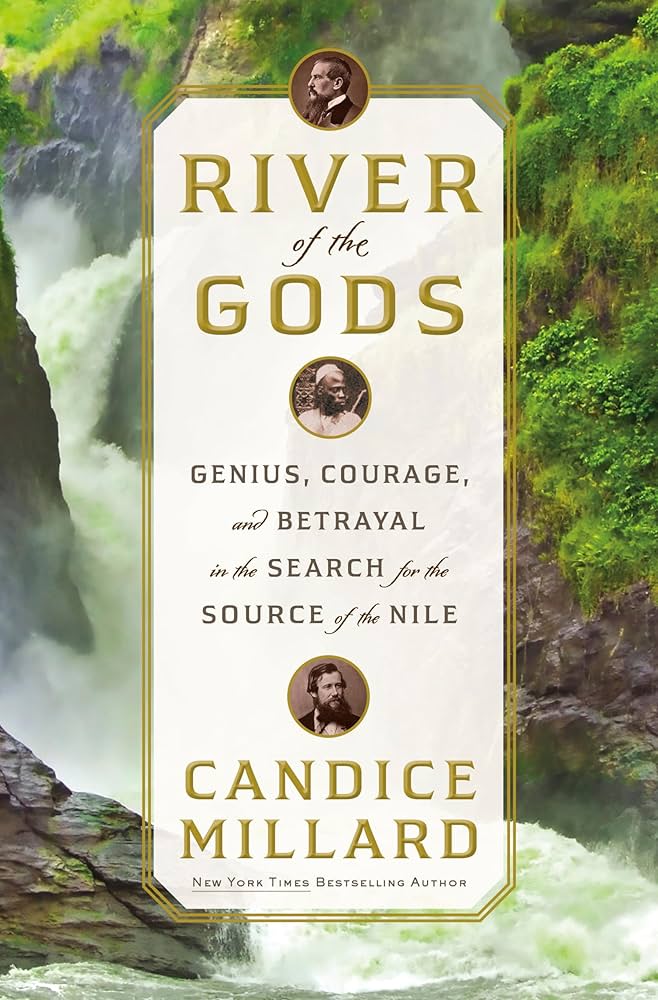
As one reader in our group pointed out, the subtitle is a key to the “real” story. River of the Gods: Genius, Courage, and Betrayal in the Search for the Source of the Nile. The real story is about the darker, the brighter, and the more ambivalent sides of humanity as shown through three very complex and diverse men and one fascinating woman. We come to care about and forgive these brave, striving people, despite their flaws.

There’s Richard Burton, only technically an Englishman, with dark hair and black eyes and long canine teeth, expelled by his own design from Oxford. An adventuresome traveler fascinated by other cultures, a linguist speaking many languages and dialects. A writer, poet, and translator (especially of erotica). A supremely confident man.

There’s John Speke, English aristocrat to the bone, a skilled hunter with a longing to explore and map. A brave, determined, would-be leader who struggles in Burton’s shadow.

There’s Sidi Mubarak Bombay, kidnapped as a child, sold in the infamous slave markets of Zanzibar, and taken to India. Eventually, as a free man, he returns to Africa and serves as a guide on all three of the expeditions. He goes on to become one of the most respected guides in Africa and, by the time he dies, is said to have travelled six thousand miles across the continent and back, mainly on foot.

And there’s Isabel Arundell, eventually Burton’s wife. Chafing under Victorian constraints on women, she writes, “I wish I were a man. If I were, I would be Richard Burton. But as I am a woman, I would be Richard Burton’s wife.”

The story begins with a breath-holding scene as Hajj pilgrims paw through Richard Burton’s possessions. An Englishman in disguise in Mecca, he watches, knowing that “A blunder, a hasty action, a misjudged word, a prayer or bow, not strictly the right shibboleth, and my bones would have whitened the desert sand.”

Because he is such a talented and adventuresome man, the Royal Geographic Society chooses him to lead the first expedition into the interior, with Speke second in command and Bombay as a guide. The challenges of the expedition form the characters, test them, pull them apart, throw them back together, foster friendship and loyalty, nurture jealousy and resentment, breed pettiness and revenge. And finally, on the eve of an important debate about the true source of the Nile—the Nianga or the Tanganika—causes the untimely death of one of them.

The story is so vividly told that the reader can (almost) feel the torment of a beetle trapped in one’s ear, of having a javelin pierce through one’s jaw, of convalescing for many months from hunger, exhaustion, and disease. The sheer courage of the characters to undertake long expeditions to who-knows-exactly-where is a celebration of the human spirit.

A wonderful, engaging book about complicated people living in interesting times. Readable and discussable.

— Sharelle Moranville

Dune, by Frank Herbert

The release of a new movie adaptation of Dune by Frank Herbert in October of 2021 had a lot of people dusting off their old copies of the book and waxing nostalgic about this epic work of science fiction that many had lost themselves in reading years ago. And apparently many others were inspired to read it for the first time, because copies with the newer cover were hard to come by at the library and available in all kinds of special formats on Amazon — from single paperbacks, to deluxe hardcovers, to full sets of books 1-6 and beyond.

Our group tackled it with some trepidation, and in the end, those who liked science fiction and remembered reading it way-back-when still loved it for its elaborate world-building. Those who were not already into the genre seemed to struggle with it, although I think we were all glad to have given it a try. We in the BBB pride ourselves on not shying away from a reading challenge, and Dune was certainly that!

Enough people love this book that its legacy has not only endured but flourished since its original publication in 1956, hence the new adaptation in 2021 starring the VERY popular Timotheé Chalamet. This article from The New Yorker explains some of that unique appeal among its millions of fans: “Dune” Endures

Julie Feirer