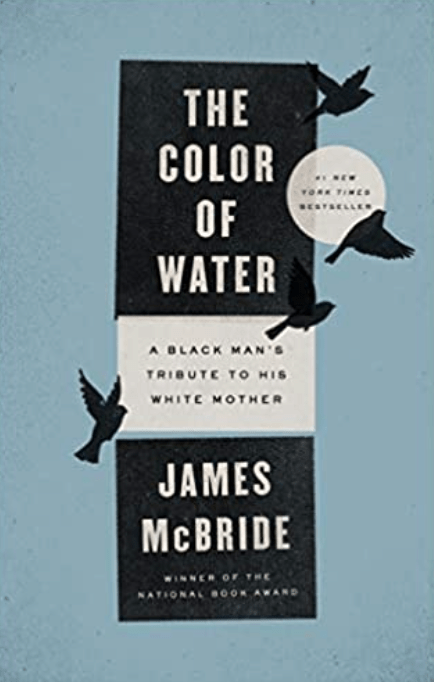
The Color of Water, by James McBride

The Color of Water is a success story, a testament to one woman’s true heart, solid values, and indomitable will.  The story is told in two voices which alternate throughout the book. In telling his mother’s story, along with his, James McBride addresses racial identity with compassion, insight, and realism. It is, in a word, inspiring.  

McBride, a journalist and musician, explores his mother’s past, recreating her remarkable story, as well as his own upbringing and heritage in a poignant and powerful debut novel. He skillfully relates his life story and his coming to terms with his mixed ethnic and religious heritage, with chapters conveying his mother’s travails and development into a fervent Baptist.
 
His mother, born Rachel Shilsky, who changed her name to Ruth to be more American, is a story of a woman whose parents fled the anti-Jewish pogroms of Central Europe and landed in a Suffolk, Virginia, a violently racist small southern town, there to be faced by new anti-Semitism and racial prejudices and develop a few of their own.  Her father, rabbi turned storekeeper, was a cold, sexually abusive tyrant who kept his children in virtual servitude, exploited his black customers, and ultimately abandoned his wife.
 
However, her grim upbringing is left behind when she moves to Harlem, marries Dennis, a black minister, fervently adopts Christianity, and raises eight children. When she fell in love with Dennis, she said “He came from a home where kindness was a way of life.  I wanted to be in this kind of family.  I was proud to join it, and they were happy to have me.” However, they experienced a certain degree of prejudice as a result of their interracial marriage.  They opened the New Brown Memorial Church together.  Then Dennis fell ill with lung cancer and died just before James was born.
Widowed, alone and poor, she struggled fiercely to raise her family. Then she remarried to Andrew McBride, another black man, and raised four more children before he also died.
 
James reports that he grew up in “orchestrated chaos”, with his eleven siblings in the poor, all-black projects of Red Hook, Brooklyn. As a child, he became aware that his mother was different from others around him.  She was white, and she kept secrets. It is her voice, unique, incisive, at once unsparing and ironic, that is dominant in this paired history, and its richest contribution.
 
In the answer that gives the book’s its title, she says “God’s not black. He’s not white.  God is the color of water.  Water doesn’t have a color.” She schemed shrewdly to have all her children buses to schools predominately in Jewish neighborhoods, sure that learning was a priority there.  James was pleasantly surprised when he learned during his senior year in high school that he had been admitted to Oberlin College.  He and his eleven siblings all completed college and led successful careers.
 
The triumph of the book is that race and religion are transcended in these interwoven histories of family love, the sheer force of a mother’s will and her unshakable insistence that only two things really mattered: school and church, a respect for education and religion. Issues of race and identity took secondary importance to her beliefs.
 
At 65, Ruth went back to school and earned a college degree in social work.  She remains in close contact with her children, holding holiday gatherings where everyone sleeps on the floor or rugs in shifts, double or triple in bed – just like the old times.
 
The Color of Waterwill make you proud to be a member of the human race. This moving and unforgettable memoir needs to be read by people of all colors and faiths.  The two stories, son’s and mother’s, beautifully juxtaposed, strike a graceful note, particularly at this current time of racial polarization.—Kenneth N. Johnson

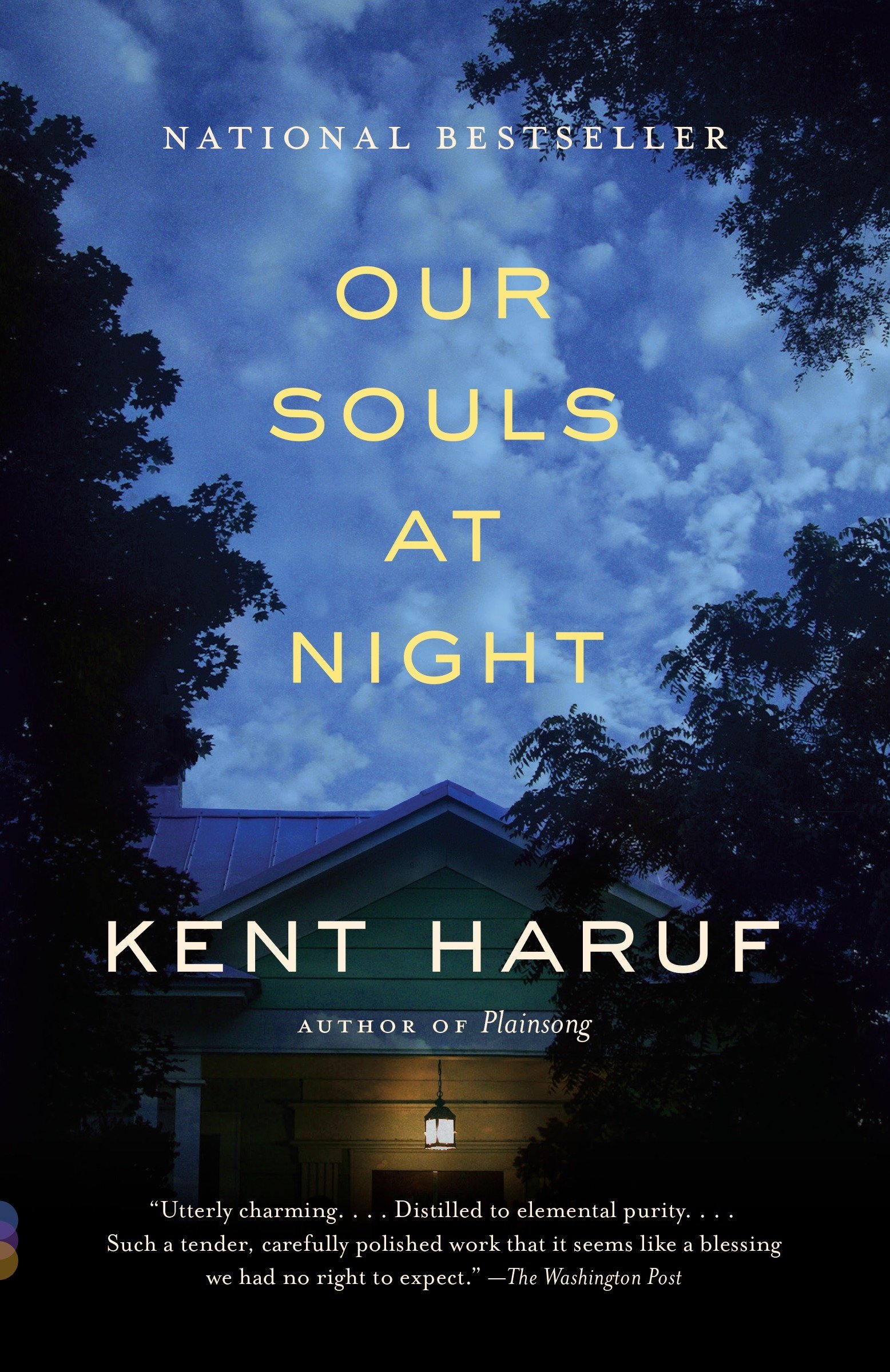
Our Souls at Night, by Kent Haruf

91M-7mC4i9L

Kent Haruf was a gentle, tranquil writer, and his voice is solid in this bittersweet story of last love.

Addie and Louis have lived near one another in Holt, Colorado—on the eastern plains—for years. They have never been close friends, but they have followed each other’s lives peripherally. Both widowed, they’ve lived parallel, but not intersected lives.

Now, Addie, 70, is tired of being alone, especially at night, and she approaches Louis with an offer: that they spend the nights together. This isn’t about sex or romance; it’s about companionship, about being with another person in the night and waking up together. At first, Louis is wary, but then he realizes he, too, needs more human contact.

They talk into the night, wiping away their loneliness, and shrug off any opposition. And from this, a sweet end-of-life love develops.

As the bond between the two grows, Addie’s son and Louis’s daughter are unsure what to make of the relationship and the rest of the town reacts with various levels of acceptance.

Reading Haruf feels like a hug. Here’s Louis talking:

I do love this physical world. I love this physical life with you. And the air and the country. The backyard, the gravel in the back alley. The grass. The cool nights. Lying in bed talking with you in the dark.

Adding to the sweet sorrow of the book is the fact that Haruf wrote it while he knew he was dying—the book was published after his death from lung cancer at 71, around the age of his characters. He knew how it felt to face death close up.

The book is also a Netflix movie starring Jane Fonda and Robert Redford, filmed last year in Colorado Springs and Florence, Colorado, where Haruf spent his final years. He was born in my hometown of Pueblo, Colorado and was my age, so we probably met in the maternity ward.

—Pat Prijatel

Dear Life, by Alice Munro

Novels have an architecture readers expect. The arc. A beginning, a middle of rising action, a climax of peak intensity, and action falling to a satisfying end.  

Many short stories have that same architecture, but Munro’s don’t. Her architecture is like a chocolate covered cherry (messy to eat, rich, with a lingering aftertaste. Not to be eaten by the handful).  

Think of the chocolate shell as the narration that swirls around, accessing the thoughts of multiple characters in a single story, and folding back and forth from past to present to past. Think of the creamy cordial inside as the life of southwestern Ontario where Munro lives – forests and lakes, farms, small towns, distances covered by trains, cities. Characters she knew or imagined. Think of the cherry as the treasure – the Ah ha! moment, cradled gently by the cordial and given shape by the chocolate shell.  

The Ah ha! moment happens to the reader as it happens to the character. For example, in “Corrie,” the main character, wealthy Corrie Carlton, attends the funeral of a woman, Lillian Wolfe, who worked in the village years ago. Indeed, she worked briefly in the Carlton household and subsequently found a way to blackmail Corrie and her married lover. When Corrie gets trapped into attending Lillian’s funeral reception, she is unsettled by the universal affection in which Lillian is held. The next morning, Corrie wakes up recognizing she has been ensnared for years in the most outrageous lie. As this awful moment of awareness comes to Corrie, a gut feeling of recognition and identification also comes to the reader. (“There’s always one morning when you realize that the birds have all gone. She knows something. She has found it in her sleep.”) And the reader has bitten into the cherry.  

Likewise, at the end of “Gravel”, neither the genderless narrator nor the reader knows what really took place that dreadful day when Caro and Blitzee drowned. But Munro has stroked the universal cloudiness of early childhood memories and stirred unease and guilt in the reader.  

In these rich, evocative, stories that are as packed with meaning as a novel, Munro revels in the ordinary: her own time and place. She writes about soldiers returning home after World War II (“Train”). She writes about the closing of factories and shifts in the class system (“Pride). She shows us the perfect post-war wife – rigid in housekeeping, wanton in bed (“Haven”). She writes about the sexual revolution and its effect on children (“To Reach Japan”). She writes about drugs, divorce, the fragility of the family, and growing old.  

Munro’s characters are never totally worthy. Some are selfish (the mothers in “To Reach Japan” and “Gravel”). Some are exploitative (the gigolo in “Corrie”). Some can’t bond (the narrator in “Train”). Some are irresponsible (Neal in “Gravel”). Munro seems to understand the condition of being broken, and the need to forgive. Even ourselves.  

At the end of the last not-quite story, “Dear Life,” Munro confesses guilt for not returning home for her mother’s last illness or funeral. She writes, “We could barely have afforded the trip, and my husband had a contempt for formal behavior, but why blame it on him? I felt the same. We say of some things that they can’t be forgiven, or that we will never forgive ourselves. But we do – we do it all the time.”  

These are the closing words in the closing book of a long, distinguished, Nobel Prize winning career. The ten stories and four almost-stories are told as only Munro could tell them. They are a celebration of dear life and an affirmation of our common humanity.  

— Sharelle Byers Moranville