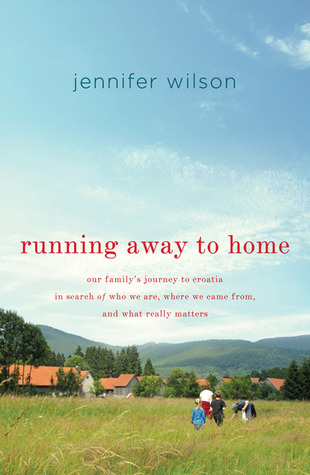
Running Away To Home, by Jennifer Wilson

A dinner of door mouse (it tastes like chicken), nights on an ancient futon in a randomly finished attic, a bathroom door that won’t shut, an annoying barking dog next door, drunken neighbors, and a solid language barrier. Such was the glamour that faced Jennifer Wilson and her family when they took a break from their stressful American life to move for four months to the home of Jen’s great-grandparents, Mrkopalj, Croatia. The family went looking for family and adventure and found both. Comfort? Not so much, at least not in the usual sense of the word.

Wilson recognizes physical characteristics that tie her to the people she meets, especially the deep-set eyes so like her own. She eats the food she remembers her beloved Grandma Kate making, such as povitica, a sweet nut bread. She shares local beer with local drinkers, learns to garden the Mrkopalj way, finds old roots and builds new ones.

In this funny and insightful book, Wilson shows us life in Croatia in 2008, and defines what we mean by family. She meets blood relatives, but bonds with an assortment of delightful, maddening, and perplexing neighbors who welcome her, her husband, and their two young children, providing food, advice, and research help. 

Initially, the kids, Sam and Zadie, miss their Iowa home and family, but when it is time to leave Mrkopalj, both mourn the loss of the community that embraced them as part of the tiny village where nothing much happens except at the local bar or the Catholic church. But to kids, that meant freedom to roam, to ride bikes on streets with few cars, to play games non-stop with the neighborhood kids, and to eat popsicles on hot afternoons.  

Wilson takes us on the family’s journey, peeling the onion of Mrkopalj to find the layers of tears below. Depending on their age, residents survived World War I, II, and the Balkan Wars of the 1990s. Many family members died, those who survived faced a life of trauma, the scars of which show in the men’s drinking, a sadness the falls over conversations, and the bad teeth from a lack of dental work and, possibly, bad water. 

After months of searching for her past, Wilson recognizes her own good fortune in being the descendent of those who left. But she sees the strength and goodness of those who stayed behind. Past and present blur as her definition—and ours—of home and family expands.

Pat Prijatel


Braving the Wilderness, by Brene Brown

It may be worth noting up front that our group read Braving the Wilderness in January of 2021, with our first of two discussions taking place just after an attack on the U.S. Capitol to disrupt the process of ratifying Electoral College votes in the 2020 presidential election. This made it a very timely and relevant read for many of us who were struggling to see these acts as anything other than “us versus them.” Having moved even deeper into the divisive and polarized culture that existed four years ago to acts of violence in 2021, Brené Brown’s words from 2017 now seem rather prophetic.

“The flags are flying from every porch and the social media memes are trending, all while fear is burrowing and metastasizing. What feels like a rallying movement is really a cover for fear, which can then start spreading over the landscape and seeping into the fault lines of our country. As fear hardens, it expands and becomes less of a protective barrier and more of a solidifying division. It forces its way down in the gaps and tears apart our social foundation, already weakened with those delicate cracks.”

In this short but powerful book, through her characteristic mode of vulnerable storytelling from her own emotionally raw experiences, Brown lets the reader know she’s seeking truths to help us all cope – not telling us she has all the answers. She challenges us to take a hard look at our responses in the face of fear and anger and whether, in our quest for belonging, we’re doing more than surrounding ourselves with like-minded others and pointing fingers for blame. While her suggestions for moving out of our own bunkers to find a greater sense of belonging absolutely make sense, they’re also no easy tasks: moving in and listening to people with whom we disagree, speaking truth to B.S. in a civil and non-dehumanizing way, and keeping a strong back, soft front and wild heart. 

A paradoxical quote by Dr. Maya Angelou, which Brown wrestles to understand throughout the book, is this: “You are only free when you realize you belong no place – you belong every place – no place at all. The price is high. The reward is great.” If the key to belonging is feeling bold enough to live authentically in every place, it opens up a lot of questions about how we raise our kids, how we form our identities and relationships, and even how we act as a church. The idea transcends any notion that one way of thinking is “correct.”  

Braving the Wilderness sparked a lot of reflection and conversation in our group of like-minded friends, but I can also see it being used as a starting point for open discussion among people who disagree. At any rate, it’s worth reminding ourselves to stay open to that conversation, and that fear of the other must be confronted in order to heal.  

Julie Feirer

Climbing Lessons, by Tim Bascom

Members of St. Timothy’s Brew, Books and Banter book club had the great opportunity to visit again with author Tim Bascom, this time to discuss his new book, Climbing Lessons, via Zoom.  A couple of years ago we enjoyed his visit to discuss his first book, Chameleon Days, his memoir of growing up in Ethiopia, where his parents were missionaries during the reign of Emperor Haile Selassie. Unfortunately, we didn’t get the honor of his presence after his second book, Running to the Fire, about his return to his teenage life in Ethiopia, during the Marxist Revolution that overthrew the emperor.

Climbing Lessons is a collection of moving stories illustrating the bond between fathers and sons, a bond often nurtured through outdoor adventures, and how that changes with generational time. Beginning in small-town Kansas, these tales span three generations. The first part of the book focuses on his life as a son and grandson. Early on, he describes how his over-eager father, while trying to demonstrate how to climb a huge sycamore, ends up dropping 12 feet and landing on his back, unable to move. Stunned, he finally recovers, and gasps, “So that’s how it’s done.” In that moment, he becomes a symbol for all fathers, trying to lead, failing, but getting back up to continue showing the way.  This “climbing lesson” is just one of 40 stories, drawing on the experience of four generations of his Midwestern family.

I was struck by the fact that, during the book, there were so many comparisons between Tim’s and my lives, beginning with the fact that we both grew up in rural Kansas communities, graduated from the University of Kansas, taught in college, and authored books. In the indented sections below, I describe some of those similarities. 

While Tim had two sons, I had two daughters. In one of the stories in this first section Tim talks about spanking – some he got from his father, and those he gave to his sons.  I was reminded that, by contrast, I only got spanked once by my father, who was unhappy that I spilled mercurochrome on my parent’s new blanket. 

The book’s second part depicts stories about his life as a father where he experiences failures also. When Tim takes his own turn at fathering, he realizes that his previously devoted toddlers are turning into unimpressed teenagers. No longer their hero he had hoped to be, he must accept a new, flawed version of himself, not unlike his father before him. 

Tim and his wife Cathleen, an Episcopal priest, parent a couple of boys, the first one nearly dies of “failure to thrive.” After three more years, another son is born, and Tim takes them on hikes and tells them stories. In one chapter, he goes hiking with his youngest son, his brother and nephew. He takes great pleasure in seeing the strong bond between his 16-year-old and the mischievous nephew. Several months later, the family moves through a terrible crisis as their nephew commits suicide. When Tim’s sons go off to college, charting their own courses, they both struggle to deal with the loss of their cousin. 

Tim talks about his sorrow that his first girlfriend left town with her family.  That happened to me too. Also, in Taking a Hit, he describes his initiation to football, where he got smeared, but didn’t quit.  By contrast, in my first game, I received the kickoff and ran down the field until I got smeared. Upon being tackled, my helmet fell off and rolled down the field. Several guys from the other team thought I fumbled the ball and jumped on it.  When I got to the sidelines, I found that our coach also thought I fumbled the ball and was livid, critically yelling at me.  At halftime, we were behind, and our coach went on a rant about how we should be doing better – for him. Not for the team, or the town, but just for HIM. It was such a bad environment, after the game I quit the team. Although I always felt guilty about quitting, but in retrospect, given all the current issues with brain trauma, I’m glad I didn’t spend a lot of time on the football field afterwards.

The last section mainly deals with the health problems of his father. After his father shatters a hip, Tim races home to Kansas.  Drawing on his father’s strength and experience to care for his boys, he realizes he must now assume a caretaking role.  When he later receives news that his father has had a massive heart attack, he races back to Kansas again. His father conveys to Tim that it will soon be time to take the role of showing his sons the way. “You’ll get your turn.  Trust me, we all do.”

In the final section, Tim describes his two cats. The kitten is hyperactive, constantly leaping toward any distraction.  The older cat, by contrast, likes to snuggle.  We have two cats with identical tendencies. He also describes his grandfather Doc Bascom, as being extremely smart, productive and admired by all.  It reminded me of my grandfather, Hank Mayse, who was a lawyer, postmaster, editor of the county newspaper, and very much admired by all.

While many can tell family stories, few can tell them with such warm-hearted detail as Tim. He succeeds in creating something both intensely personal and irresistibly universal. Although the book’s primary focus is on the beauties and difficulties of father-son relationships, the stories in Climbing Lessons warm the reader’s heart. Bascom’s skillful prose style immediately draws one into these moving tales.  These brief inter-linked stories show that abiding affection can prevail, bringing fathers and sons closer, even as they tackle the steepest parts of the climb.

Bascom completed his MFA at the University of Iowa, taught at Waldorf College in Forest City, Iowa, and now heads up the Kansas Book Festival in Topeka, Kansas, where his wife Cathleen is the Episcopal Bishop of Kansas. 

Ken Johnson