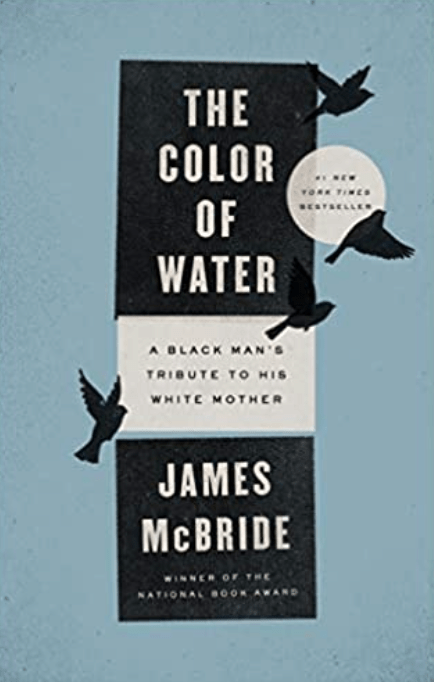
The Color of Water is a success story, a testament to one woman’s true heart, solid values, and indomitable will. The story is told in two voices which alternate throughout the book. In telling his mother’s story, along with his, James McBride addresses racial identity with compassion, insight, and realism. It is, in a word, inspiring.
McBride, a journalist and musician, explores his mother’s past, recreating her remarkable story, as well as his own upbringing and heritage in a poignant and powerful debut novel. He skillfully relates his life story and his coming to terms with his mixed ethnic and religious heritage, with chapters conveying his mother’s travails and development into a fervent Baptist.
His mother, born Rachel Shilsky, who changed her name to Ruth to be more American, is a story of a woman whose parents fled the anti-Jewish pogroms of Central Europe and landed in a Suffolk, Virginia, a violently racist small southern town, there to be faced by new anti-Semitism and racial prejudices and develop a few of their own. Her father, rabbi turned storekeeper, was a cold, sexually abusive tyrant who kept his children in virtual servitude, exploited his black customers, and ultimately abandoned his wife.
However, her grim upbringing is left behind when she moves to Harlem, marries Dennis, a black minister, fervently adopts Christianity, and raises eight children. When she fell in love with Dennis, she said “He came from a home where kindness was a way of life. I wanted to be in this kind of family. I was proud to join it, and they were happy to have me.” However, they experienced a certain degree of prejudice as a result of their interracial marriage. They opened the New Brown Memorial Church together. Then Dennis fell ill with lung cancer and died just before James was born.
Widowed, alone and poor, she struggled fiercely to raise her family. Then she remarried to Andrew McBride, another black man, and raised four more children before he also died.
James reports that he grew up in “orchestrated chaos”, with his eleven siblings in the poor, all-black projects of Red Hook, Brooklyn. As a child, he became aware that his mother was different from others around him. She was white, and she kept secrets. It is her voice, unique, incisive, at once unsparing and ironic, that is dominant in this paired history, and its richest contribution.
In the answer that gives the book’s its title, she says “God’s not black. He’s not white. God is the color of water. Water doesn’t have a color.” She schemed shrewdly to have all her children buses to schools predominately in Jewish neighborhoods, sure that learning was a priority there. James was pleasantly surprised when he learned during his senior year in high school that he had been admitted to Oberlin College. He and his eleven siblings all completed college and led successful careers.
The triumph of the book is that race and religion are transcended in these interwoven histories of family love, the sheer force of a mother’s will and her unshakable insistence that only two things really mattered: school and church, a respect for education and religion. Issues of race and identity took secondary importance to her beliefs.
At 65, Ruth went back to school and earned a college degree in social work. She remains in close contact with her children, holding holiday gatherings where everyone sleeps on the floor or rugs in shifts, double or triple in bed – just like the old times.
The Color of Waterwill make you proud to be a member of the human race. This moving and unforgettable memoir needs to be read by people of all colors and faiths. The two stories, son’s and mother’s, beautifully juxtaposed, strike a graceful note, particularly at this current time of racial polarization.—Kenneth N. Johnson
 Books, Brews & Banter