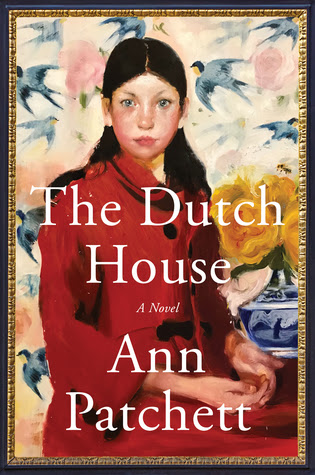
The Dutch House, by Ann Patchett

Patchett is a connoisseur of imperfect characters who are compelling mixes of the saintly, the clueless, the wise and loving, the selfish and manipulative—characters the reader can’t help but care about because they are just so human.

In The Dutch House, Patchett uses the grand VanHoebeek’s mansion that came on the market after World War II as the spine of the multi-generational story. When Cyril Conroy buys the Dutch house (with all the VanHoebeek’s personal possessions and three servants included) as a surprise for his wife Elna, it is a cruel gift to the quiet, would-be nun. 

The changes brought about by moving into the Dutch house eventually send Elna fleeing to Bombay to work with Mother Teresa (who is actually in Calcutta). After she leaves, the Conroy children, Maeve and Danny, are in the capable, loving hands of the housekeeper, the cook, and the nanny, Fiona (aka Fluffy), who is a warm, humorous presence from before the beginning of the story through the end, three generations later.

Danny, as the narrator, shows us life in the Dutch house. After their mother, who has been disappearing for increasingly long spells, seems perhaps not to be coming back ever, he and Maeve wonder if she is dead. Probably, their dad tells them. She probably died in India. Information which is neither comforting nor edifying. 

Then young and attractive Andrea begins to come and go in the Dutch house. The children are left on their own to figure out what this means. Maeve becomes suddenly and seriously ill with diabetes. Despite all this, young Danny still feels secure and loved by the servants and especially his sister, who has taken on a quasi-motherly role.  

When their dad marries Andrea, she brings two little girls, Norma and Bright, into the Dutch House. Maeve and Danny come to love the little girls, but Andrea—in a vein of casual cruelty, gives Maeve’s room to Norma when Maeve goes off to college. And when Cyril dies of a heart attack shortly after Maeve graduates, Andrea calls Maeve and says of Danny: “Come and get him.” Thus Danny and Maeve are summarily banished from the Dutch house and Norma and Bright.  Equally shocking, Maeve and Danny discover Andrea now owns everything: the Dutch house and all of Cyril’s real estate and investments. Danny and Maeve are left with Maeve’s car and a foundation established for the education of Cyril and Andrea’s four children. 

Thus begins Danny and Maeve’s period of watching the Dutch house and plotting. In Maeve’s car, they take up posts, smoking and talking, with Maeve planning ways for Danny to use up the foundation money by the longest, most costly education imaginable. And from this revenge plot, Danny eventually and unwittingly becomes a doctor, when all he wants to do is get a little money together so he can start investing in real estate and follow in his dad’s footsteps. 

Danny’s girlfriend, Celeste, in training to be the best doctor’s wife ever, discovers she has married a landlord instead of a doctor—repeating Elna’s pattern of discovering her husband was not who she thought he was. And Danny ironically repeats family history too by surprising Celeste with a beautifully restored brownstone in Manhattan not at all to her taste.

Over the years, through various bits of information, Danny and Maeve gradually come to understand their mother is still alive, living and doing good works among the homeless in the city. Danny struggles with how to feel about this, but Maeve embraces the woman she still calls Mommy.  

Near the end of the story, Elna convinces her children, as only she could, to go with her to visit the Dutch House.  This causes a tectonic shift among the characters. Now demented, Andrea is enormously comforted by Danny, who she believes is Cyril returned to her. Ever compassionate (except perhaps to her young children) Elna moves back into the Dutch house (unchanged all these years) and works with Norma (who actually did want to become a doctor) as Andrea’s caretakers. Maeve, who feels abandoned by her mother once again, dies of what is surely meant to be taken as a broken heart.  

As the story ends, Danny and Norma become siblings of sorts (“a half-sister from a second marriage,” as Danny cautiously puts it). Elna begins to disappear among the poor again. Danny finally gives up his rage at his mother and replaces it with “familiarity.” Danny and Celeste divorce. Fluffy visits the Dutch House now and then and sleeps in her old room above the garage. And May—Maeve’s namesake—gains fame and fortune as an actress and ultimately buys the Dutch house and brings back parties reminiscent of the VanHoebeek era. And the portrait of Maeve, originally painted to stare down the VanHoebeck’s portraits hanging across the room, looks to all the world like May. There’s a sense of rightness about this ending. Finally, the Dutch house has come into its own as the Conroy house. 

The Dutch House is a rich and conversation-provoking story showing us the human condition in fascinating particulars.

— Sharelle Moranville

Station Eleven, by Emily St. John Mandel

Emily St. John Mandel’s novel, Station Eleven, begins with famous actor Arthur Leander’s real-life death as he plays the role of King Lear on stage. At the same time, outside the theater, people are beginning to sicken and die of the Georgian flu as it sweeps the planet.

In the opening pages, the reader is tossed into a compelling post-apocalyptic world. Who will have the luck, grit, and skill to survive? How will they survive? How will they travel? Eat? Find shelter? Keep their sanity? Form communities? Move on?   

The novel has an ensemble cast (a nod to The Traveling Symphony and the troupe of Shakespearian actors): Arthur, Clark, Miranda, Elizabeth, Tyler, Kirsten, and Jeevan—with Arthur as the connection among all the other characters. Clark is his best friend. Miranda is his first wife. Elizabeth is his second wife, mother of their young son, Tyler (who becomes the cruel, Calvinistically-bent Prophet). Kirsten is a child actress, cast as one of Lear’s young daughters. Jeevan is the person who rushes the stage in an effort to save Arthur.

Mandel pairs Kirsten and Tyler in a very Shakespearian way. They are both eight years-old when the flu wipes out almost everybody. Both are children of Arthur (he is Kirsten’s stage father). Both have copies of Miranda’s comic book, Dr. Eleven—which is a graphic expression of the pull between good and evil, awake and asleep, life and death, love and hate, beauty and ugliness that runs throughout the story.   

As a grownup, as the Prophet, Tyler has become a cruel and terrifying cult leader in the name of God. Kirsten, on the other hand, before the company’s performance of A Midsummer Night’s Dream, describes the world thus: “What was lost in the collapse: almost everything, almost everyone, but there is still such beauty. Twilight in the altered world, a performance of A Midsummer Night’s Dream in a parking lot in the mysteriously named town of St. Deborah by the Water, Lake Michigan shining a half mile away.”

Near the end of the novel, inevitably, Kirsten and the Prophet must face off.

To weave her tale, Mandel uses a rich and flexible narrative structure sort of like crochet, where there is a string of linear yarn, but the story is told in a series of interlocking loops that often go back to the beginning and start again—growing richer with each pass. She does playful, clever things to make connections. Lots of Shakespearian allusions; four different dogs named Loki; a paperweight which is a hostess gift to Miranda at a dinner party years before Arthur’s death, which Miranda gives back to Arthur, which he gives to his lover du jour, which she gives to Kirsten, which she gives to Clark for the Museum of Civilization. And everything, big and small, supports in some way awakening into a brave new world.

Jeevan, in the old world, was a paparazzi in a relationship with a shallow, indifferent woman. In the new world, twenty years out, he lives in a settlement in Virginia practicing primitive medicine. The end of the day finds him drinking wine amidst “the gentle music of the river, cicadas in the trees, the stars above the weeping willows on the far bank. . . . He was overcome at his good fortune at having found this place, this tranquility, this woman, at having lived to see a time worth living in.”   Mandel shows us a new world which is a slow and painful work in progress. We get our parting look through the eyes of Clark who “has no expectation of seeing an airplane rise again in his lifetime, but is it possible that somewhere there are ships setting out? If there are again towns with streetlights, if there are symphonies and newspapers, then what else might this awakening world contain?”

And the Traveling Symphony is going on the road again, taking a new route, perhaps to find the far southern town with the electrical grid. The first horse-drawn truck in the procession, as always, bears the creed: Because survival is insufficient.

Sharelle Moranville

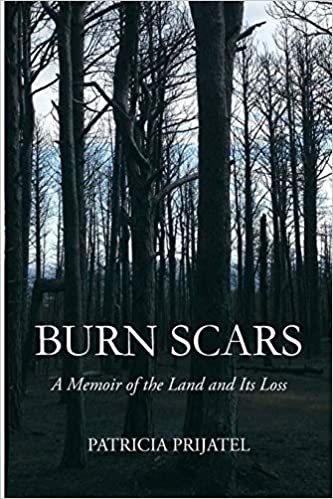
Burn Scars, by Patricia Prijatel

COMMENTS FROM BBB MEMBERS:

As I read this beautifully written memoir, it was like having my own sense of loss affirmed by someone who truly understands. When a landscape we love and are intimate with (whether it’s splendid mountains and valleys or our own backyard), is destroyed by the freakishness of our changing climate, it hurts. It changes us. We stop trusting nature. We feel stress. Maybe we get sick. We need to recover. Patricia Prijatel’s beautifully written account of the burn scars on “her” mountain and on herself is a must read if you care about climate change. It’s well researched and informative, fast paced and vivid. And perhaps surprisingly, in places it’s laugh-out-loud funny.
Sharelle Moranville

This is a beautiful book. The author has infused the opening chapters with descriptions of this land and its people she so loves. But there is a clear sense of suspenseful foreboding for a catastrophe that you know is coming. Her descriptions of the fire and the response of the human beings who are affected by it gain weight the farther we get from the event itself. Far from going back to normal, she chronicles the work of the people to prevent land erosion, how difficult and sometimes impossible it is, and the emotional toll it takes. What grows in the wake of the fire is not a regeneration of what was there before but in some cases harmful plant life that will change the landscape forever. We watch human emotions as they deny, accept, grieve and try to move on. What we learn in the process of reading this book is how precious our earth is and, in taking it for granted, how much we have endangered it.
Jeanie Smith

“Burn Scars” tells the true personal story of a Colorado family’s love for the land and the mountains. They enjoyed a wonderful life near the East Spanish Peak. Then fire erupted. They fled for their lives. Courageous firefighters saved most of the homes but the trauma lasts to this day. Prijatel talks about the personal grief. She tells the impact of fire, wind and flood on the plants and animals. She describes the increasing danger. Each year spawns higher temperatures and dryer forests. Each year sees more and bigger fires. Her well researched story flows easily. Read this book.
Ray Gaebler

The author did an extraordinary job of giving us a personal account of climate grief and educating us. Very readable, relatable and touching.
Karen Peters