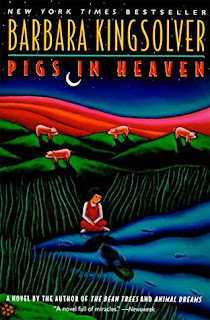
Pigs in Heaven, by Barbara Kingsolver

Pigs in Heaven (1994)is a sequel to Kingsolver’s debut 1988 novel The Bean Trees—in which Taylor, a young woman whose driving ambition is to graduate high school without getting pregnant, finds herself traveling alone cross-country in a car with serious needs. She falls into sudden, unexpected, and unwitting possession of a Cherokee toddler who has been badly abused. Taylor names the toddler Turtle and sets about forming a chosen family to raise Turtle and help her heal from the abuse she suffered. This involves getting “legal” adoption papers with the collusion of a young central American couple who are in the U.S. illegally. Readers can’t help but love adorable Turtle and spunky Taylor and the whole supporting cast. And the novel ends happily with Turtle having been saved by a bunch of white people (plus Esperanza and Estevan). 

But. And there needs to be a but.

What happens in The Bean Trees is good, but perhaps needs a second, more nuanced look. Is it in Turtle’s best interest to separate her from her Cherokee roots? Could Turtle endure the second trauma of being taken from the white mother with whom she has bonded?  Pigs in Heaven is a moving and beautifully written “second thought” about The Bean Trees. 

Young, smart attorney Annawake Fourkiller decides early on that a tribal injustice has been done, and she resolves to undo it –which naturally strikes terror in Taylor’s heart. So she goes on the run with Turtle, living on the edge, meeting fascinating characters like Barbie and the goose man and Jax. Taylor’s mother, Alice, with largely unacknowledged—up to this point—Cherokee roots, gets drawn into a quest to find her own happiness and broker a peace for Taylor and Turtle. 

Kingsolver shows the differences between the expansive tribal family structure and the constricted nuclear white family structure brilliantly. And through all the characters, but especially through the character of Alice, who has a foot in both worlds, the reader is given a more thoughtful look at what might be best for Turtle. What might be best for everybody.

I quote the novel’s ending because it is such a perfect example of Kingsolver’s inimitable style. Cash, who is conveniently both Alice’s soul mate and Turtle’s grandpa—andnow Turtle’s legal guardian—as a token of his deep and true love of Alice, leans the TV against a stump and shoots it.

“The woods go unnaturally still. All the birds take note of the round black bullet wound in the TV screen, a little right of center but still fatal. Alice’s heart performs its duties strangely inside her chest, and she understands that her life sentence of household silence has been commuted. The family of women is about to open its doors to men. Men, children, cowboys, and Indians. It’s all over now but the shouting.”

A truly righteous ending of sweet Turtle’s story.

— Sharelle Moranville
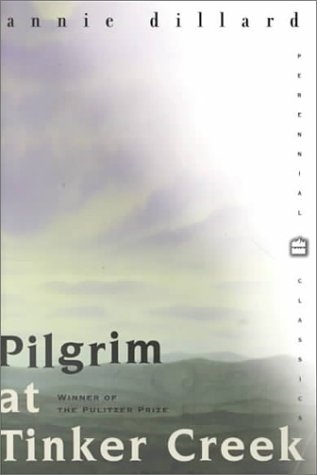
Pilgrim at Tinker Creek, by Annie Dillard

Dillard’s opening anecdote of the old fighting tom leaping through the window onto her bed at night and kneading her chest while she’s half-asleep is borrowed from someone else. But the reaction to the event is pure Dillard as poet and theologian. 

“I washed before the mirror in a daze, my twisted summer sleep still hung about me like sea kelp. What blood was this, and what roses? It could have been the rose of union, the blood of murder, or the rose of beauty bare and the blood of some unspeakable sacrifice or birth. The sign on my body could have been an emblem or a stain, the keys to the kingdom or the mark of Cain. I never knew. I never knew as I washed, and the blood streaked, faded, and finally disappeared, whether I’d purified myself or ruined the blood sign or the Passover. We wake, if we ever wake at all, to mystery, rumors of death, beauty, violence . . . ‘Seems like we’re just set down here,” a woman said to me recently, “and don’t nobody know why.”

In this opening, Dillard poses the question of the book very colloquially. Seems like we’re just set down here and don’t nobody know why. The opening also puts the reader on notice that her writing style is going to be poetic. She’s going to use words that need to be paused over and considered. And she’s going to use them abundantly in sentences with rhythm and repetition that convey feeling as much as they convey meaning. And she’s going to make lots of allusions to Scripture (just give a second glance to the quotation above as an example).

In her younger years, Dillard had turned away from organized religion because she couldn’t reconcile the easy, pious answers about Why? with the suffering she observed in the world. But in her mid-twenties, Dillard dared take a crack at answering the question of Why? herself. And she won the Pulitzer for her efforts. In Pilgrim at Tinker Creek, the young poet took on the absolutely biggest question of all, suspecting it was impossible to answer, but daring to try.

In her year-long, up-close observation of nature along Tinker Creek, Dillard does her best to show us “here” (as in Seems like we’re just set down here . . .) in blinding color, shifting shadow, ice and heat, big and small. Animal, vegetable, mineral. She serves up details of nature both adorable (the juvenile muskrat floating past with his feet over his stomach) and ghoulish. She observes the abundance of the natural world as something not altogether positive (all those parasites and predators). And trying to draw a conclusion about the nature of God from all this, she concludes merely “the creator loves pizzazz.” –which, honestly, made me laugh. And reminded me of the Psalmist claiming God made the great leviathan just for fun.

In her poetic, abundant way, in Pilgrim at Tinker Creek, Dillard show us nature in which the Creator must be because He is omnipresent, so He has to be in there, right? 

But questions linger. 

And in her later book, Holy the Firm, Dillard tries to answer them. That book was written while she lived on Lummi Island, off mainland Washington, where nature is sparse. She called Lummi Island “the edge of the known and comprehended world . . . the western rim of the real . . . the fringes’ edge . . . where time and eternity spatter each other with foam—a place, in other words, where nature stops and the darkness of Divinity begins.” Or, put more succinctly: “If God is in the abundance of creation, take away creation and get a better look at God.” Or, put a bit more esoterically, perhaps Creation was the fall.

Dillard invites us on a pilgrimage to understand God. But she also quotes Augustine: “If you do understand, then it is not God.” 

Or as Anne Lamott prays at the beginning of her day: Whatever.
Seems like we’re just set down here, and don’t nobody know why.

— Sharelle Moranville

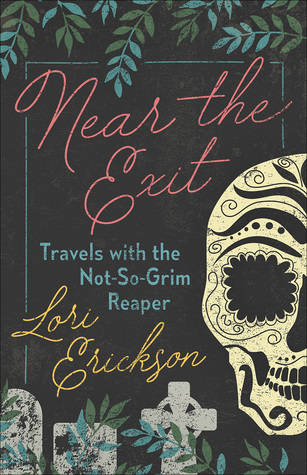
Near the Exit, by Lori Erickson

Being shown the world through the eyes of thoughtful people who are keen travelers and also engaging writers is a big treat to someone who doesn’t travel (me). Near the Exit: Travels with the Not So-Grim Reaper is a wonderful read and a thought-provoking discussion of death and death rituals.

As a huge fan of the movie Coco, I really enjoyed visiting the largest annual Day of the Dead celebration in Chicago with Erickson. Likewise, ancient Egyptian sites; nursing homes; the New Zealand Maori; Aztecs and Mayan ruins; funeral homes; the spiritual center in Crestone, Colorado; Assisi; and the Sacred Stone Circle at Harvest Preserve in Iowa City were each, in their way, fascinating destinations for conversations about death. After reading this book, I think I may be able to react to nursing homes with more peace and grace.

My favorite section of book is near the end, when Erickson describes what she saw at Eremo delle Carceri (a hermitage overlooking Assisi):

Just outside the building is a statue of Francis that’s the happiest depiction of a saint I’ve ever seen. It shows him lying on the ground, his hands behind his head, his sandals kicked off and ankles crossed, a contented smile on his face. Christianity might produce more saints if we pictured them like this, rather than carrying the tools of their martyrdom.

Erickson goes on to say:

When it came time for him to die, he wanted them (his brothers) to place his naked body on the ground, not long, just about the length of time it took someone to walk a mile.  . . . maybe he knew that after his death his bones—and his message—would become the property of the church, which would inevitably try to corral and domesticate the wild spirit he’d unleashed. Before that happened, he would have one last moment of communion with the earth he loved so much. It is said when Francis died, a chorus of larks wheeled and swooped above him for a long time, singing him home.

I’m not sure why that passage is so appealing. Maybe because it shows such a vibrant, living membrane between the spiritual and the physical–which is, indeed, something I sometimes, in lucky moments, feel.

Humans are apparently the only one of God’s creatures who grapple with their own mortality. In Near the Exit, Erickson shows us a way to circle closely to the inevitable and look at it without too much unease.

—Sharelle Moranville