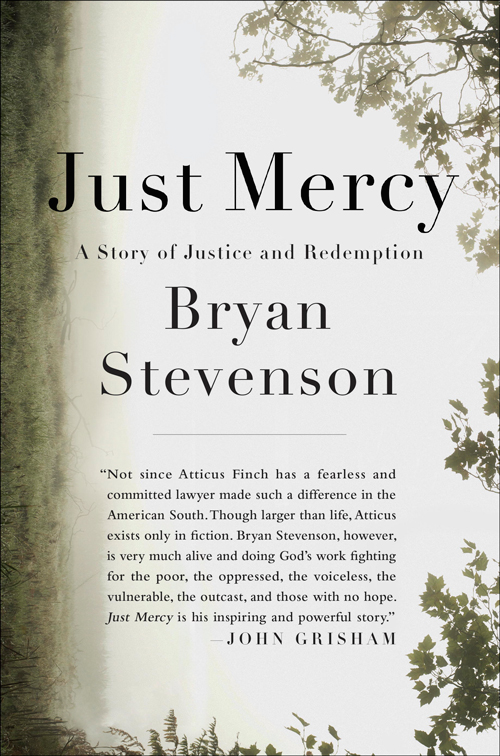
Just Mercy: A Story of Justice and Redemption by Bryan Stevenson

As I write, Arkansas is trying to execute eight men on a calendar of two a day, every other day, for over a week, beginning next Monday, April 17. The state “needs” to kill the men before the medications used in the lethal injections expire. Most of these men have been on death row for over twenty years, and now they are rushed to death because of an expiration date on a drug.

I can hardly bear to think, talk, or read about capital punishment because it feels so fundamentally wrong. So I’m amazed at how Bryan Stevenson could turn a book about death row into truly A Story of Justice and Redemption.

Stevenson is a wonderful storyteller, spotlighting individuals whom he has helped, or tried to help, since he founded the Equal Justice Initiative to defend those often wrongly condemned and trapped in the criminal justice system.

Stevenson gives horrifying numbers for what has happened in that system, to whom it has happened (mainly poor and/or dark skinned people), why it has happened, what it costs – both in terms of dollars and suffering.

He explains where we go wrong when we (with good intentions) personalize victims such as seven year-old Megan Kanka, for whom Megan’s Law is named. He explains the profit motive in incarceration.

But mainly he shows us people like ourselves, but without affluent white privilege: Walter McMillan, a black man sentenced to die for a murder he patently did not commit; Herbert Richardson, a traumatized young veteran who only meant to scare a pretty young nurse into his arms with a homemade bomb, but killed a child instead; Marsha Colbey, a mother who suffered the sadness of a stillborn child, but was demonized as a murderous parent because she was very poor; and more.

What most impresses me (and puzzled me a little at first) is Stevenson’s calm, steady perseverance: every day he walks into prisons and courthouses where the people in power are not glad to see him. They are not willing to listen, or reconsider, or admit a centimeter of error even in the face of plain and undeniable facts.

How does he keep doing such work day after day, year after year, understaffed and beleaguered by people desperate for his help?

I think his superpower comes from an amazing lack of ego. He never lets the challenges become about him. He kept his focus on others, on their needs. He admits his own brokenness – indeed, he recognizes it as a gateway to grace. And that grace, mingled with intelligence and training, keep him going. It sounds so simple, but seems so hard. I’m inspired and instructed and humbled. Just Mercy was a perfect choice for a Lenten read.

— Sharelle Moranville
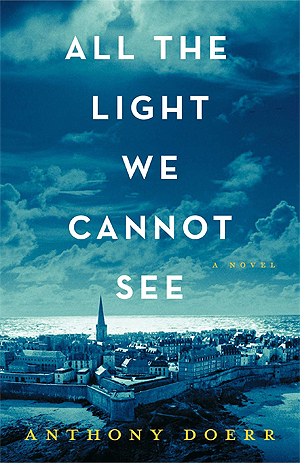
All the Light We Cannot See, by Anthony Doerr

(Warning: contains spoilers)

Anthony Doerr’s 2014 novel All the Light We Cannot See is a story of survival, courage, sacrifice, suffering, family, friendship, love, and hope. It’s set in France and Germany during WW II. How many thousands of novels does that thumbnail description fit? (Jaded publishers and others in the business are starting to think of such novels as just another WW II book, which might account for some of the tepid reviews the novel got before it circulated through the wider reading community.)

All the Light We Cannot See is one of the richest, most readable, discussable, and likeable WW II novels ever. Yes. Likeable. A narrative of war and suffering and death becomes a hopeful hymn about family, kindness, potential, magic, love, and mystery.

Doerr brilliantly shows us the specifics in the general: the character so unique and real that the reader can become the character. And thus we can truly cloak ourselves in the potential for individual goodness in the storm of a world gone mad. We learn and are comforted by how we might behave in a similar situation.    

In the final analysis, the story belongs to Marie-Laure, the little blind girl with the father who keeps thousands of keys for the National Museum of Natural History and is a gifted woodcarver. In both Paris and Saint-Malo he carves tiny, clever models of their neighborhoods, which Marie-Laure must memorize with her fingertips. Then by counting grates, benches, streets, and tapping her other senses for cues, she must show him she can navigate their neighborhood. He also teaches her to use her cleverness to unlock tiny objects to find the treasures inside. To this reviewer, those incredible miniatures, made in such a rush by a father for his vulnerable six-year old girl as the Germans draw near, are the most unforgettable takeaways of the novel.

And as her world is going up in conflagration, Marie-Laure’s fingertips race across the braille dots to open another world, the world of Twenty Thousand Leagues Beneath the Sea, which she broadcasts as the bombs fall. Marie-Laure, with her blindness, has a huge capacity for the world and human experience.    

Then there is Werner, a German boy, whose snowy white hair is almost as much a character marker as Marie-Laure’s blindness. He is an undersized orphan trying to look after his sister and others in the industrial area of Zollverein, Germany. Werner has a preternatural gift for mathematics and radios and, as a result, is spared going into the mines, but is scooped up into the German army where he becomes a radio operator.    

Marie-Laure and Werner cross paths when the Allies begin bombing the holdout of Saint-Malo in early August, 1944. During the most intense part of the circular, reiterative narrative, Werner is trapped in the basement of the Hotel of Bees because of a bomb hit. Marie-Laure is trapped not far away in the attic of her uncle’s house with the cursed jewel, The Sea of Flames, in her possession. A mad, dying Nazi stalks the downstairs desperate to get at the jewel, which he believes will save his life.     Thankfully, Doerr lets a long, comforting resolution play out as we see what happens to the survivors of the bombing of Saint-Malo. We see the survivors intermittently as they go about life-after-the-war until 2014 (the novel’s pub date).

So vicariously was I participating in this novel, if I should go to Paris this year (fat chance), I would keep an eye out for an elderly blind lady who seems to know where she is going. And I do believe some evil potential, buffeted and stained to look like ordinary sea rock, is always being swished around on the ocean floor waiting to be found and polished.    

Doerr expands the literal plot line (this-happens-then-this-happens-then-this-happens) with a richness of inversions, paradoxes, oxymorons, juxtapositions, repetitions, symbols, and motifs that invite the reader to go beyond the storyline. For example:

  • Clearly, a mollusk is not just a mollusk. And what’s with all those birds?
  • Before two of the most heart-breaking events of the narrative (the rape and Werner’s death), why are there quasi-Eucharistic events?
  • Why is the fabulous diamond, The Sea of Flames, given such an oxymoronic name?
  • How can we not see light?
  • Why is Twenty Thousand Leagues Beneath the Sea the message of comfort to all who hear Marie-Laure’s last broadcast? (On the surface, it would seem to be an inversion of the usual message of hope.)
  • Why can the story be read pretty effectively backwards?

Doerr’s story has become an earwig. Certain images, characters, events, and themes will always remain in my head. More than any novel I’ve read in years, I felt that I was buried with Werner below the Hotel of Bees. I was in the cold orphanage attic with him when, as a boy, he listened to a faraway voice talking about the nature of light on the radio. I was as hungry as Marie-Laure contemplating opening the last unlabeled can of food in the attic.    

As an adult who has read a gazillion novels, I’ve largely lost my childhood ability to be carried away into another world by a story. So thank you, Anthony Doerr, for letting me do that again.

Sharelle Moranville

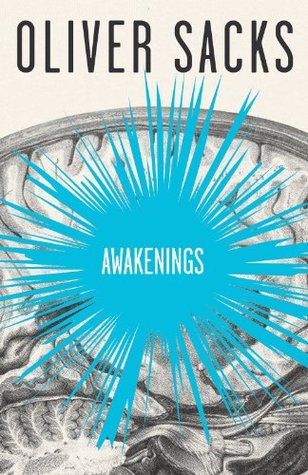
Awakenings, Oliver Sacks

Once when I was working in the garden, a bee plummeted out of the blue and dove into the heart of a hollyhock and stayed in there a long time, maintaining a little motion and humming, gorging. Eventually, he crawled out, sat a spell, and lifted off heavily. He literally couldn’t fly straight. After a couple of lazy loops and bemused U-turns he disappeared over the hedge.

That’s a fair description of what can happen to readers of Oliver Sacks’ Awakenings, a book about the catatonic, post-encephalitic patients Dr. Sacks treated at Mt. Carmel hospital when he went there as a young neurologist in 1966. We readers dive in because both author and book are so widely acclaimed (ten other well-received books and countless articles and lectures from Sacks; a movie and various stage plays from the book.)

Like the bee, we find lots to feed on: several prefaces and forewords as the book has gone through different editions. A twenty-five-page prologue. And then the heart: The compelling stories of twenty patients who awoke from their long sleep (brought on by encephalitis) after being administered L-Dopa (one of the very early psychotropic meds). In this section, there are surely as many lines of footnotes as of body. And they aren’t necessarily boring footnotes that the reader wants to skip.

Then there is a forty-page riff, in a section called Perspectives, on how illness fits into Western culture, history, philosophy, and literature. And a thirty-five-page epilogue to the 1982 edition and a brief postscript to the 1990 edition. Plus eighty pages of appendices (an interesting series of essays/papers that has an “Oh, and everything else interesting on the subject . . .” feel to it). Followed by a glossary (useful for medical terms), a bibliography, and an index.

In the middle of the book is an inset of haunting photographs of Mt. Carmel patients caught in catatonic sleep and their poignant awakenings. There are also clips from the media: Sleepy Sickness Spreading: Fatal Cases: Hunt for Elusive Germ: 20,000 Cases Last Year: Epidemic Worst In Britain and Italy: Record Death Toll.

That’s why the reader comes out sated. A little over-fed. Stunned. Sacks was (he died this year) a brilliant neurologist and a deeply compassionate physician. He had the imagination and audacity to experiment with new chemistry and awaken catatonic patients; he had the sorrow of watching them eventually regress and suffer and die.

Perhaps one reason Sacks has been so embraced as a person, physician, and writer is that he felt the humanity of illness. In the section called Perspectives, he writes “Diseases have a character of their own, but they also partake of our character; we have a character of our own, but we also partake of the world’s character: character is monadic or microcosmic, worlds within worlds within worlds, worlds which express worlds. The disease-the man-the world go together and cannot be considered separately as things-in-themselves.”

In our current specialized, assembly line, code-for-payment medical industrial complex, who can help but feel nostalgia for that humanity?  

Sharelle Moranville